 By
By Whether you are an undergraduate student or a PhD student, you might face the problem while navigating academic writing, and one of the common confusions is between references & bibliography.
Many students think that it is the same. Oh, how wrong you are! Often considered as the same, references and bibliography are two different words. Every student whether working on dissertations, coursework or reflective essays, wonders what goes in the end of the list and what we call it.
Furthermore, many use the terms interchangeably. However, in the rigorous world of UK higher education, they have several distinct yet vital purposes.
Understanding this difference is not only important in academic writing but it is also essential to maintain credibility and integrity.
It is the difference between simply submitting the work and submitting assignments that demonstrates scholarly rigour, respects intellectual property and communicates your research process with clarity.
Imagine your requirements say to include references; however, you include bibliography and vice versa. Well, there are consequences of getting it all wrong. This just shows that you have misunderstood the task.
Additionally, the most serious drawback of not understanding the difference between bibliography and referencing is that it might lead to plagiarism which is a serious academic offence with severe penalties.
However, worry not as we are here to help you. This guide is designed to help you grasp these common terms. Here we will dive deep into references & bibliography, including basic definitions, differences and how to incorporate them in your work.
Additionally, you can also explore the Harvard referencing style in depth, provide side-by-side comparisons and walk you through the entire process of crediting flawless citations and bibliographies for your assignments.
So once you are done reading this blog you will not only know the difference between them but have mastered the art of incorporating them with confidence.
So, come on! Let’s get into the blog.
| Key Takeaways
Core Function: Referencing is for verifying the sources, while bibliography demonstrates them. Content Scope: The reference list is a closed set of cited works. However,a bibliography is an open set of consulted works. Structural Placement: The reference list is essential and comes right after the conclusion, whereas the bibliography is an optional text. Strategic Use: Mastering both allows you to meet the basic requirements and showcase that you have achieved exceptional results. Relation to the work: Every entry in a reference list links back to the citation in the assignment. However, the bibliography has no such direct link. |
Understanding Academic Referencing
Before we dive into what the difference is between referencing and bibliography, let us understand the academic referencing
At its heart, academic referencing is a system of intellectual honesty. Furthermore, it is a formal method by which you acknowledge the sources of information, ideas and theories that you have used to build your own academic arguments.
Furthermore, think of your essay as a new building. And referencing how you show the blueprints. Also, it shows how you set the tone. It even allows others to see how your structure was built and verify its soundness.
The Two-Pillar System of Referencing
Referencing is not a single task. Instead, it is a two-part process that works together. For example:
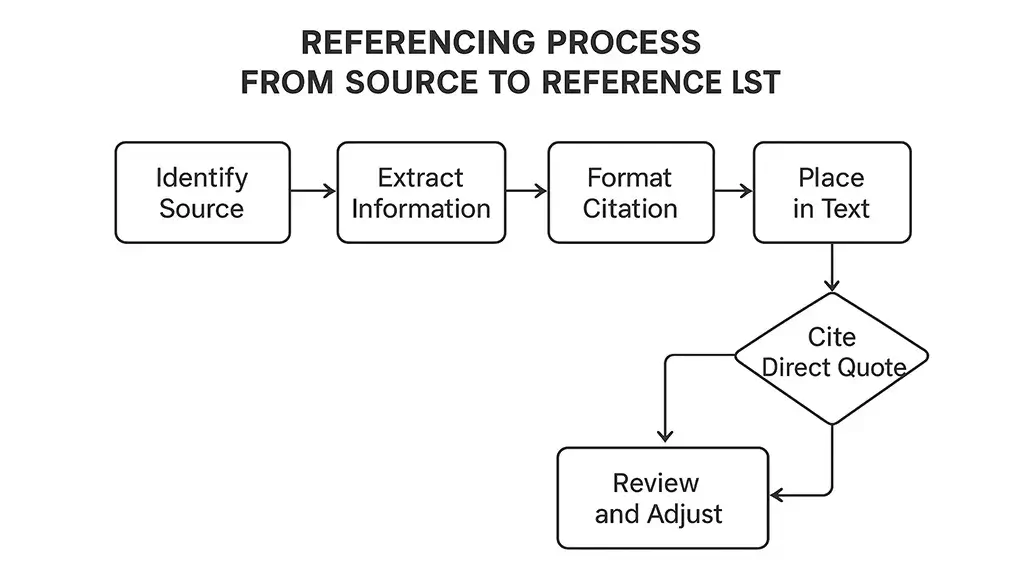
- In-Text Citations (The Signposts): These are the brief, parenthetical notes you place within the main body of your text. Moreover, they come in immediately after you quote, paraphrase, or summarise from a source. While they might not be noticeable, they are very informative, pointing the readers to the full source details without breaking the flow of your argument. The most common citation style is Harvard. In this style, this typically means including the author’s surname, the year of publication and often a page number for direct quotes.
For example (Direct Quote): “Emotional intelligence is not a natural trait but a learnable skill that is critical for effective leadership.” Goleman, 1998, p.45)
However, if we paraphrase it, this would look like:
“According to a study, emotional intelligence is a core skill for effective leadership. Furthermore, it is developed with hard work. (Goleman, 1998).
- Reference List (The Destination): This is the comprehensive list at the end of your document where every in-text citation is given its full bibliographical identity. It is organised alphabetically by the author’s surname. Furthermore, it provides all the necessary information for a reader to locate the exact source themselves. This is where you provide the full title, publisher, and other specific publication details.
Why is Proper referencing essential in Academia?
So now comes the most important question: why is referencing essential in academia?
Well, imagine you are working on an essay that requires you to quote someone’s words. However, you don’t include the references. It is considered cheating. Furthermore, it might even lead to plagiarism and other consequences.
On the contrary, when you reference the source properly, it shows your hard work. Moreover, it helps give the right owner its due credit.
Apart from this, there are other reasons too. Come on! Let’s have a look at them:
While avoiding plagiarism is the most frequently cited reason for referencing, its importance runs much deeper:
- Building a Credible Argument: Referencing transforms your subjective opinion into an evidence-based argument. By showing that your points are supported by established experts and peer-reviewed research, you show credibility and authority of your work.
- Enabling Verification and Scholarship: Academia is a collaborative endeavour. Adding references allows your tutor or any other researcher to trace your steps. They can check your interpretation, verify your facts, and use your sources for their own research. Thus, this can contribute to the ongoing scholarly work.
- Demonstrating Critical Engagement: Good referencing shows you have not just collected quotes, but have engaged with the literature. By choosing to reference one author who challenges another, you demonstrate your ability to analyse and synthesise different viewpoints.
- Developing a Professional Habit: In many professional fields, such as law, healthcare, and policy development, citing evidence accurately is a non-negotiable professional standard. Mastering academic referencing is training for this professional reality.
Now that’s clear, let’s have a look at the different referencing styles:
Different Referencing Styles That You Need to Know About
Different academic places have developed their own preferred referencing styles. While the difference between referencing and bibliography remains consistent, the formatting rules change every few years. Here are some of the most common referencing styles that you need to know about:
- Harvard (Author-Date): It is perhaps the most common style in UK universities, used across social sciences, business, and humanities. It is prized for its simplicity and clarity.
- APA (American Psychological Association): Similar to Harvard, it is the standard in psychology, education, and some social sciences. It places a strong emphasis on the date of publication.
- MLA (Modern Language Association): This type of referencing is common in literature, languages, and the arts. Moreover, this uses an author-page number system for in-text citations.
- OSCOLA (Oxford Standard for Citation of Legal Authorities): This is used for law. The only difference is that it has footnotes rather than in-text citations.
- Vancouver (Numbered): Mostly used in medicine and the sciences, it uses superscript numbers in the text that correspond to a numbered reference list.
While all these references are essential, we will explore more about Harvard referencing as the UK universities mostly ask about that. If you want to learn more about this, consider reading our blog on: Practical Tips for Conducting Effective Nursing Research?
Understanding Bibliography – Mapping the Intellectual Journey
If referencing is about providing the specific details about your evidence, think of the bibliography as an entire map of the research question.
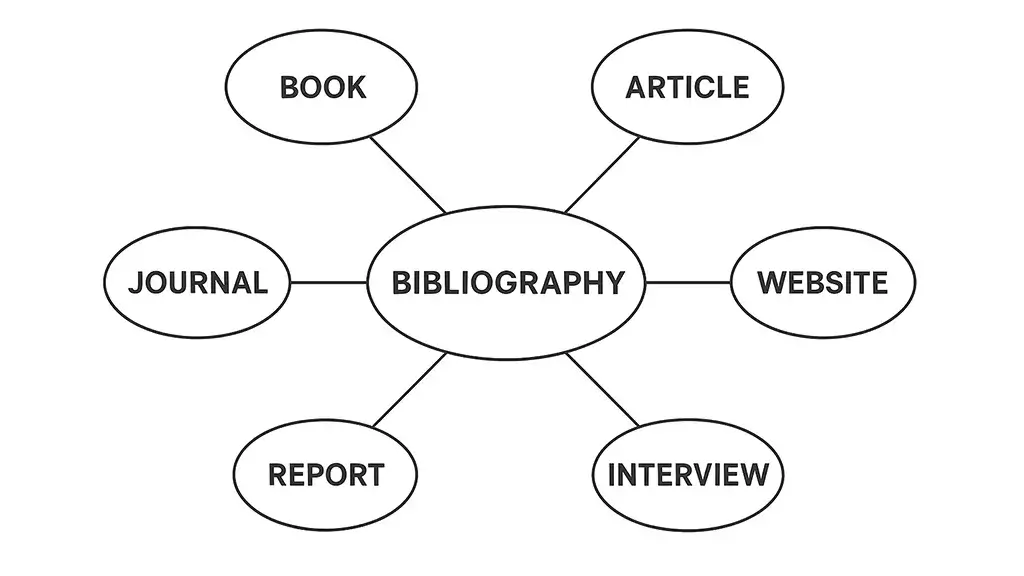
Furthermore, it is a systematic list of all the sources you consulted, read or came across during the research and writing of the assignment. It doesn’t matter if you directly cited them in your final text.
This is crucial for understanding, especially while working on the research papers.
The reason?
Well, your research process is almost always wider than the argument you eventually present. Furthermore, you might want to read twenty articles to understand. However, your 2000-word essay may only have the space to directly include only the ten sources.
While the reference list may have those ten, the bibliography, however, offers a more transparent and complete account by including all twenty. Thus, this helps you showcase the full depth of your scholarly assignment.
The Purpose of a Bibliography
Adding the bibliography to the assignment is optional, depending on your assignment brief. However, it does serve the crucial purpose of:
- It is tangible proof of the effort you put in while conducting research. Furthermore, it shows your understanding of the topic and helps build a comprehensive literature review. This is essential in dissertations and thesis.
- Additionally, for the readers who are new to the topic, your bibliography can serve as a reading list, guiding them to the key texts.
- Sometimes you include a source without directly quoting the words. Well, this allows you to acknowledge this work and show that you are informed about the current trends.
- In certain subjects, especially in the humanities, having a detailed bibliography section is considered essential. And even contributes to the grades.
When is a Bibliography Required? Decoding Your Assignment Brief
Struggling to understand when you need to add a bibliography?
No worries! We got you!
Remember, it depends on the content you’re working on. For example, it is common in:
- Dissertations
- Thesis
- Final year projects
- Literature review
- Any large scale research assignment.
Similarly, there are certain tasks where you don’t have to include a bibliography at all. They include:
- Standard essays
- Exams
- Short Reports
To know when you need to incorporate a bibliography, consider reading the assignment brief thoroughly. If it asks for a List of References or works cited, you need to add the reference list. However, if it asks for a Bibliography, you have to provide a broader list. If you are confused about this and have no clue how to add this to your work, no worries! Instead, ask your professor for guidance. You can even hire the professionals at Nursing Assignment Writers UK who can help you add references to the work.
Example of a Bibliography Entry (Harvard):
If you are adding a single entry in the bibliography, the formatting remains the same as the reference list. Always remember their difference lies in the criteria. Here is an example for you:
Ferguson, N. (2011) Civilisation: The West and the Rest. London: Penguin Books.
Imagine you read this book to get the historical context for an essay on modern economics. However, you did not cite it directly. Thus, it would appear in your Bibliography but would not be present in the reference list.
Harvard Referencing & Bibliography Explained!
Universities in the UK mostly use the Harvard referencing system because it’s simple and only includes the author-date approach. Furthermore, this model makes it very simple for you to understand the difference between citation referencing and bibliography. Come on! Let’s have a look at them in detail!
Defining the Lists in Harvard
In the Harvard system, the terms are specific and should be followed strictly.
- Reference List: This is the term you will use most often. It is a list titled ‘Reference List’ and it has a direct relationship with your in-text citations. Every source in this list must have been cited within the body of your work.
- Bibliography: If required, this list is titled ‘Bibliography’. It is a superset of the Reference List. It includes every source from your Reference List, plus any other sources you consulted during your research. The relationship between the text and the bibliography is not direct; it is reflective of your overall research process.
A Detailed Comparative Example
Here is a detailed example. Imagine you are writing a 3000-word research proposal on “The Impact of Microplastics on Marine Biodiversity in the North Sea.”
Here is your Research Activity:
You conducted a detailed analysis and directly quoted from:
- A 2020 scientific report from the Marine Conservation Society.
- A 2021 journal article by Dr. James in a leading environmental science journal.
- A key textbook from 2019 by Professors Smith and Jones.
- To build your foundational knowledge, you also thoroughly read (but did not directly cite):
- A government policy document from DEFRA (2022).
- A book by environmentalist author Lee (2018).
- Webpage from National Oceanography Centre (2023).
Your Citations would look like this:
You can not deny the microplastic pollution because a recent survey found out that “an average of 150 plastic fibres per litre of seawater in the coastal regions sampled for this research” (Marine Conservation Society, 2020, p. 12)T. his has a direct toxicological effect on marine life, as shown in the lab studies (James, 2021). Furthermore, the long-term ecological consequences threaten to disrupt entire food webs (Smith and Jones, 2019).
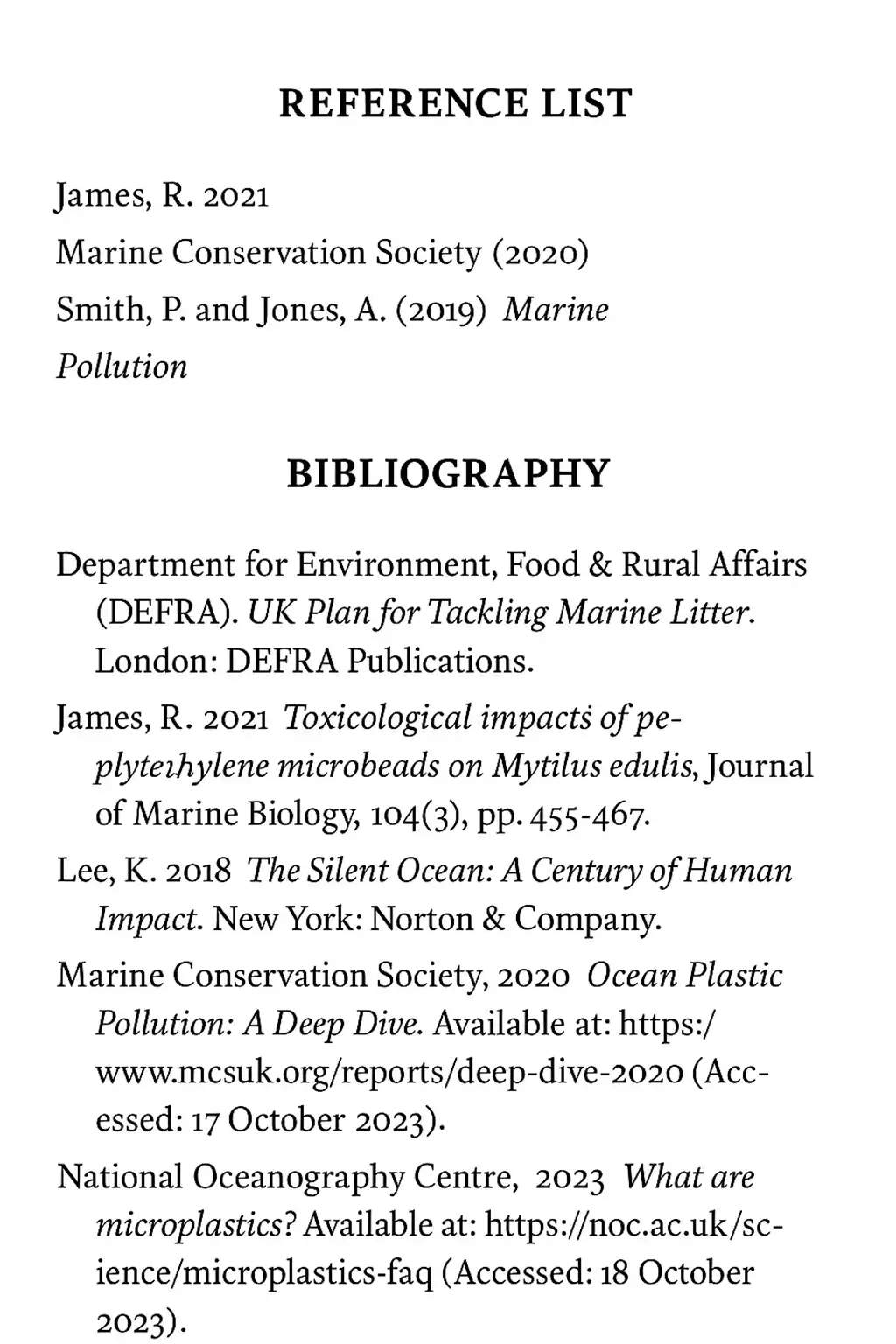
Did you see how the Bibliography offers a complete picture of how you conducted the research, even if they are not in your reference list. Moreover, if you want to learn more about this, read
Quick guide to Harvard referencing (Cite Them Right) by The Open University.
Key Differences Between References & Bibliography
Now come to the main point: What are the main differences between references & Bibliography?
Well, here are the ten prominent differences that you need to know of:
Purpose
- Referencing: Think of it as a tool that helps verify your sources. Furthermore, its role is to give credit to the authors whose work you have used in the assignments. It answers the question: “Can you prove where this specific idea or quote came from?”
- Bibliography: The purpose is based on context. Furthermore, it is a broader, more narrative tool whose role is to show the scope of your research journey, determining how you conducted the research. It answers the question: “What is the full landscape of literature that informed your thinking?”
Content and Scope
- Referencing (Reference List): The content is exclusive and finite. Moreover, it contains a closed set of sources, the ones that have been directly referenced within the text via an in-text citation. It shows the evidence that you included in your work.
- Bibliography: The content is inclusive. It contains an open set of sources, including all works consulted during the research phase, whether cited or not. This shows your complete research process.
Placement
- Referencing (Reference List): This is an essential part of your academic work and is always placed immediately after the main body of the text and before any appendices. You can’t change its structure.
- Bibliography: This is an optional supplementary section. If included, it is always placed after the Reference List. The standard order of a dissertation or thesis is:
Main Chapters , Conclusion , Reference List , Bibliography , Appendices.
Academic Requirement
- Referencing: It is essential in academic work, and you can’t submit your assignments without it, or it might cause consequences. Think of it as a baseline to maintain academic integrity.
- Bibliography: It is conditional and depends on the specific instructions in the assignment brief. Furthermore, it even depends on academic discipline for example, it is common in History but not found in standard essays. Even the level of study like PhD, can determine if you need to include this in your work.
- The conventions of your academic discipline (e.g., common in History, rare in Mathematics).
Relationship to the Main Text
- Referencing: The relationship is direct and non-negotiable.
- Bibliography: The relationship is indirect and separate.
Formatting and Consistency
- Referencing: The formatting is very strict as you need to include every comma, full stop, italic, and capital letter according to the chosen citation style, e.g., Harvard. Additionally, maintaining consistency throughout is essential.
- Bibliography: The formatting of individual entries is equally strict. However, the overall list has more flexibility in its scope.
Function in Argumentation
- Referencing: It is the evidential backbone of your argument, as each citation offers the supporting evidence for a specific claim you are making.
- Bibliography: It functions as a testament to how well you know the subject and how you conducted research.
Reader’s Perspective
- Referencing: A reader uses the reference list to check your sources. They are asking, where did this specific claim come from and if the sources are reliable?
- Bibliography: A reader uses the bibliography to understand your research methodology and find further reading. They are asking, what has this author read, and are the other sources relevant to this topic?
Impact on Assessment
Referencing: Incorrect or missing referencing directly can cause consequences and are considered academic conduct.
Bibliography: The presence of a strong, relevant bibliography can positively influence marks in categories like Research, Depth of Knowledge, and “Scholarly Diligence, especially if you are working on complex projects.
Summary Table: The Definitive Comparison
| Feature | Referencing (Reference List) | Bibliography |
|---|---|---|
| Primary Purpose | To verify direct sources. | To demonstrate the full scope of background reading. |
| Content | Always required. | Conditionally required. Hence, don’t forget to check the assignment brief. |
| Position in Doc? | Immediately after the main text, before appendices. | After the Reference List. |
| Relationship to Text | Direct link with in-text citations. | Indirect, no direct link to specific text points. |
| Formatting | Extremely strict adherence to style guide. | Strict for entries, flexible for scope. |
| Function | Provides the evidential backbone for arguments. | Demonstrates scholarly authority and context. |
| Answers | “What did you use as direct evidence?” | “What did you read to form your understanding?” |
So there you go, a complete analysis about how references & bibliography is different from one another.
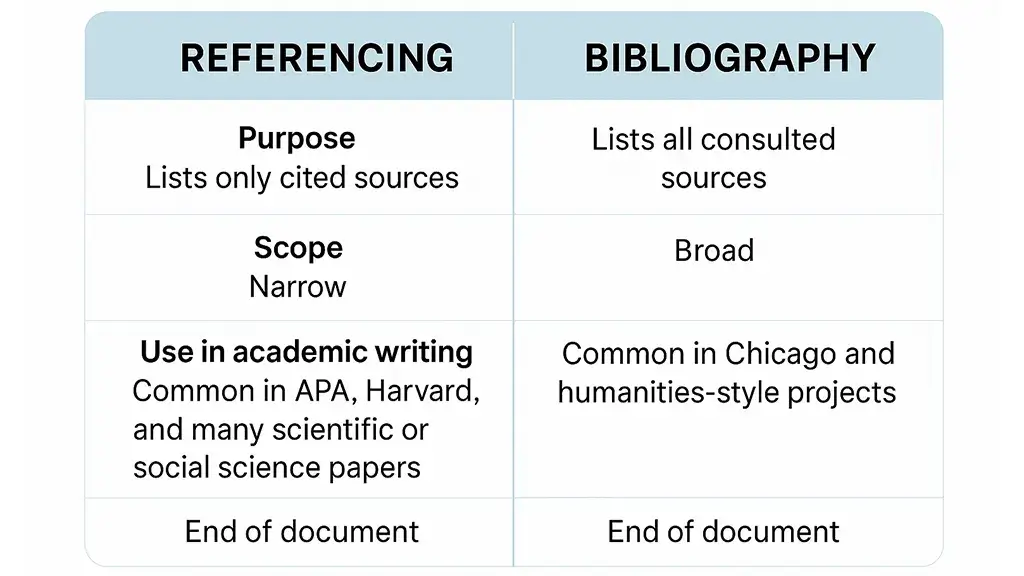
Similarities Between Referencing & Bibliography
Despite their differences, referencing and bibliography are two sides of the same coin of academic integrity. Furthermore, they share several characteristics that are crucial for maintaining scholarly standards.
- Placement at the Document’s End: Both are end-matter components. They are never integrated into the main body of the text. This standardised placement makes it easy for the reader to locate and consult.
- Adherence to a Formal Citation Style: Both lists must be formatted according to a specific, recognised citation style e.g., Harvard, APA, MLA. Furthermore,even the rules for italics, punctuation, and order of elements are identical.
- Alphabetical Organisation: Both lists are almost universally organised in alphabetical order by the lead author’s surname. This provides a logical and consistent system that allows readers to quickly find a specific source.
- Demonstration of Research Effort: Both, in their own ways, prove that you have conducted research. The Reference List shows how accurate your research is, while the Bibliography shows how you conducted the research. Together, they paint a complete picture of you as a researcher.
- Fundamental Role in Preventing Plagiarism: Both are key weapons in the fight against plagiarism. The Reference List does this directly by crediting every used source. The Bibliography does it indirectly by promoting full transparency about all intellectual influences.
- Contribution to Assessment: In UK universities, the quality, accuracy, and appropriateness of both your Reference List and Bibliography if required are assessed. The teachers use them to judge your research skills, attention to detail, and understanding of academic conventions.
Contextual Use in UK Universities: DMU, ESOL, and Nursing Specifics
When applying referencing and bibliography, there are some specific course guidelines, university requirements and even your personal background as a student matters.
Here is how you can navigate through all of this:
Navigating Institutional Variations
While the Harvard style is consistent, universities often have their own slight requirements. Thus, it is your responsibility to find and use your institution’s official guide.
De Montfort University (DMU): DMU provides a comprehensive ‘DMU Harvard Referencing Style’ guide through its library website. It may have specific rules for citing module handbooks or lecture notes that you must follow.
University of Leeds: Similarly, Leeds has its own ‘University of Leeds Harvard Referencing’ guide. There might be minor differences in how to format URLs or the use of punctuation.
Therefore, when working do make sure if your university has additional requirements for referencing and bibliography.
Specific Challenges for ESOL Students
For students of English for Speakers of Other Languages (ESOL), the differences between referencing and bibliography can be difficult because of the language barriers.
Conceptual Problems: The very idea of intellectual property and the need to credit every single idea can be unfamiliar in some educational cultures. Understanding that even paraphrased ideas require a citation is a crucial mental shift.
Linguistic Precision: The formal language and strict punctuation of referencing can be daunting. Knowing where to place a full stop, a comma, or when to use italics requires meticulous care.
Paraphrasing vs. Plagiarism: This is a major challenge. ESOL pupils may struggle to paraphrase complex English texts effectively. Thus, this sometimes leads to unintentional plagiarism by staying too close to the original source’s wording.
Strategy: Use your university’s academic support services. Most UK universities have dedicated academic learning centres that run workshops on referencing and academic writing. These are invaluable resources.
Referencing in Nursing and Healthcare
For nursing and healthcare students, referencing is not an academic exercise. Instead it is a reflection of professional practice. Your writing must be grounded in evidence-based practice (EBP). Here is what you need to know:
- Accountability and Safety: When you make a claim about a clinical procedure or a patient care strategy, you must back it up with evidence from the latest clinical guidelines, peer-reviewed journals, or official bodies like the Nursing & Midwifery Council (NMC). This ensures that your references are credible.
Here are some documents that you need to add:
- NMC Code
- Government Reports e.g., from NHS England or Public Health England. They are perfect for policy context
- Clinical Guidelines e.g., from NICE – National Institute for Health and Care Excellence. This one is for evidence-based treatment protocols.
- Peer-reviewed journals to find out about the the latest research
A Bibliography in a Nursing Dissertation: In a nursing dissertation, a bibliography can be powerful. It shows your marker that you have consulted not just clinical studies but also ethical frameworks, policy documents, and sociological texts that inform a holistic understanding of patient care.
The universal advice no matter what your context, is to always decode your assignment brief like a detective. The verbs used will guide you. “Reference these sources” implies a Reference List. “Provide a bibliography of relevant reading” is an explicit instruction for the broader list.
Examples and Case Studies: From Theory to Practice

To help you understand the difference between references and bibliography, let us walk you through an extended, realistic case study.
For example:
Imagine you are a final year business student in the UK writing a 5000-word report on “The efficiency of remote working models on employee productivity and engagement.”
Here is a detailed research scenario:
Scenario
Here is how you conducted the complete research:
- Core analysis (Directly included as citations)
- Analysed the data from the CIPD report 2022
- Engaged with and quoted from a 2021 study published in a top management journal.
- Furthermore, created a theoretical framework using a 2019 seminal textbook on Organisational Behaviour by Robbins and Judge.
- Background and contextual reading for consultation
- Read a book by Friedman 2020 on the future of work to understand the trends.
- Read the website article from ONS 2023 for labour market data for UK labour. However, I used the CIPD data instead.
- Reviewed the Harvard Business Blog 2022 for managerial perspectives.
Now that you are done with the research here are the in-text citations that you will add in the report.
In-Text Citations
The shift to remote work due to the global events such as COVID-19 has caused a fundamental re-valuation of the productivity metrics. While some managers have concerns about oversight, the data conducted through research tells a different story. According to the survey around 65% of organisations reported that productivity either stayed the same or increased after implementing the remote working policies. CIPD, 2022, p.8. This evidence is supported by a study that found out that around 13% of performance increased for remote workers as compared to those working on site. Bloom et al, 2021, p 215.Thus this goes on to challenge the traditional models of supervision in organisational theory (Robbins and Judge 2019)
REFERENCE LIST
Bloom, N., Davis, S. and Van Reenen, J. (2021) Does Working from Home Work? Evidence from a Chinese Experiment. The Quarterly Journal of Economics, 136(1), pp. 205-260.
Chartered Institute of Personnel and Development (CIPD) (2022) Megatrends: Remote Working. London: CIPD Publications.
Robbins, S.P. and Judge, T.A. (2019) Organizational Behavior. 18th edn. Harlow: Pearson Education.
BIBLIOGRAPHY
Bloom, N., Davis, S. and Van Reenen, J. (2021) Does Working from Home Work? Evidence from a Chinese Experiment. The Quarterly Journal of Economics, 136(1), pp. 205-260.
Chartered Institute of Personnel and Development (CIPD) (2022) Megatrends: Remote Working. London: CIPD Publications.
Friedman, T. (2020) Thank You for Being Late: An Optimist’s Guide to Thriving in the Age of Accelerations. 2nd edn. New York: Farrar, Straus and Giroux.
Harvard Business Review (2022) How to Keep Your Team Motivated When They’re Working Remotely
Office for National Statistics (2023) Homeworking in the UK labour market.
Robbins, S.P. and Judge, T.A. (2019) Organizational Behavior. 18th edn. Harlow: Pearson Education.
Note: This case study shows how both references and bibliography is essential. As you guys can see the reference list is lean and focused, having only the citations that were used in the argument. However, the bibliography is contextual and shows the sources you used for your research.
How to Write Referencing and Bibliography: A Methodical Process
Now that we have understood both of these terms properly, it is time for us to see how to write them.
Well, transforming a pile of sources into a perfectly formatted reference list and bibliography is a process that is quite easy if you follow a systematic approach.
Here is a step-by-step guide on what you need to do:
Step 1: Style Selection and Source Gathering
Start with confirming the required referencing style mentioned in the assignment brief or module guide. Furthermore, remember as you research, document all your sources as this will help you note down the essential details. Here is the example:
- Book: Author, Year, Title, Edition, Publisher, Place of Publication.
- Journal Article: Author, Year, Article Title, Journal Title, Volume (Issue), Page Numbers, DOI.
- Website: Author/Organisation, Year, Page Title, URL, Access Date.
Step 2: In-Text Citation Implementation
As you write your assignment, insert an in-text citation immediately after you use information from a source. Always make sure to be consistent with your format.
Here is the example: (Author, Year) for paraphrases and (Author, Year, p. X) for direct quotes.
Step 3: Compiling the Reference List
Now that you are done adding citation in the main body of your text, consider going to the master source list: Furthermore, here is what you should do:
- Identify every source that has an in-text citation in your work.
- Furthermore, copy only these sources into a new document.
- Also, format each entry meticulously according to the Harvard style guide.
- Arrange all entries in a single alphabetical list by author surname.
- Lastly, title this list “Reference List”.
Step 4: Compiling the Bibliography (If Required)
So if your assignment requires a proper bibliography, it is time for you to return to the master source list. This time here is what you need to do:
- copy all the sources you have used including the cited ones and the uncited ones.
- Furthermore, paste them into a new document
- Format all entries in the same Harvard style.
- Combine them into a single, alphabetical list.
- Title this list “Bibliography”.
See? That’s how easy it is to add references and a bibliography in your academic work. The best thing is that you can use tools for this. Come on! Let’s have a look at them.
Essential Tools for Efficiency
If you want to add in-text citations faster and save some time, here are some reference management software tools that can prove to be the game changers.
- Zotero: Free and powerful. It allows you to save sources from your browser with one click and automatically generates citations and bibliographies in Word.
- Mendeley: Also free, it combines reference management with a social network for researchers.
- EndNote: It is a premium, industry-standard software often provided by university licenses.
- University Library Support: Do not underestimate this. Attend a library workshop on referencing and trust us it will be one of the most valuable hours you spend.
Common Formatting Errors to Consider
When it comes to referencing and bibliography, there are some common formatting issues that you need to avoid at any cost or it might make all your hard work go down the drain. They include:
Inconsistent Italics: Forgetting to italicise book and journal titles might make them appear as the basic text. Therefore, be mindful of that.
Missing Punctuation: Omitting even the smallest full stops after initials, or the colons after the place of publication, can cause plagiarism.
Incorrect Capitalisation: Using sentence cases for book titles is a mistake you should avoid. Many universities use the Harvard style, which typically uses capital cases for major words. Therefore, you have to follow this rule at any cost.
Forgotten Access Dates: For online sources, adding the Accessed date is a mandatory part of the reference.
Alphabetical Errors: Misordering entries, especially with multiple authors, can lead to invalid or inaccurate sources.
By considering these errors you can definitely reference properly, build credibility and show your understanding towards the topic. Additionally, it even helps you avoid plagiarism, ensuring your work is 100% original.
Step-by-Step Guide: Harvard Referencing vs Bibliography – The Practical Workshop

Doing Harvard referencing and bibliography can be challenging, especially if you are doing it for the first time. However, this section provides you with a step-by-step walkthrough for creating both a Harvard reference list and a Bibliography as two separate yet related tasks.
The Exact Process for Writing Harvard References
So you might be wondering what is the exact process for writing Harvard references? Here is what you need to do:
Step 1: Source Identification and Data Capture
This begins at the research stage. Be meticulous. For a journal article found online, you need:
- Author(s) – Surname and Initials.
- Year of Publication (in brackets).
- Article Title – in single quotation marks, not italicised.
- Journal Title – in italics.
- Volume Number.
- Issue Number (in brackets).
- Page numbers of the article.
- DOI (Digital Object Identifier) or URL if no DOI.
Note down all the crucial information on the separate documents so that you don’t have any problem while you are adding the references.
Step 2: Apply the Harvard Formula with Precision
Now that we have all the information, we will format the journal article from above:
Author, Initial(s). (Year) ‘Article title’, Journal Title, Volume(Issue), pp. Page Numbers.
For Example:
Holloway, M. and Smith, P. (2023) ‘The impact of mindfulness on student stress’, Journal of Applied Psychology, 18(8), pp. 150-176
This is just an example to tell you how to add proper referencing.
Step 3: Assemble and Alphabetise the List
Now is the time for you to properly assemble the list. Here is how you need to do it:
- Create a new page at the end of your document titled “Reference List”.
- List all formatted references.
- Sort them alphabetically by the first author’s surname. For multiple works by the same author, list them chronologically (oldest first).
Step 4: The Final Quality Check
Lastly, you need to verify that every single entry has a matching in-text citation. Hence,
- Check for consistency in punctuation and italics.
- Additionally, read the list aloud to catch missing full stops or commas.
- Ensure all hyperlinks (if used) are active and correct.
There you go, a complete step-by-step instruction on how to add Harvard-style references in your work.
The Exact Process for Writing a Harvard Bibliography
Now come on! Let’s master the exact process of writing a Harvard Bibliography. Here is what you need to do:
Step 1: Compile the Comprehensive Master List
Remember the research notes that you created while referencing? Well, go back to them. Also open up your browser history and Zotero library.
Additionally, don’t forget to gather the full details for every source you engaged with during your research phase. This includes books you skimmed, articles you read the abstract of, and websites you visited for context.
Step 2: Integrate and Format All Entries
Now it is time for you to add it in your work:
- Start a new page after your Reference List. Title it “Bibliography”.
- Copy every entry from your Reference List into this new document.
- Now, add the additional, non-cited sources.
- Furthermore, format each new entry with the same rigorous Harvard style.
Step 3: Create a Unified Alphabetical Sequence
Do not create separate sections for “cited” and “non-cited” sources. Instead, blend all entries from both the Reference List and your additional reading into one single, seamless alphabetical list.
Step 4: Final Bibliography Review
Lastly, it is time for you to finally review the bibliography. Make sure to
- Check that all entries, old and new, are correctly formatted.
- Ensure the overall list is in perfect alphabetical order.
- Confirm that the title is “Bibliography” and not “References.”
The key insight is that the mechanics of writing each entry are identical for both lists. However, the fundamental difference between referencing and bibliography lies in the decision about what source you need to include in your work.
Common Mistakes Students Make: A Catalogue of Errors to Avoid
Even with the best intentions, it’s easy to make mistakes. Here is an exhaustive list of common errors to remember so that you don’t make any errors while working on the tasks.
- The Title Blunder: Titling your list Bibliography when it only contains cited works is the most common and fundamental error. It immediately signals a misunderstanding of the core concepts. Instead it should be titled as referencing.
- The Orphaned Citation: Having an in-text citation (Smith, 2020) in your paper, but no corresponding entry for Smith (2020) in your Reference List can be a problem as this breaks the verifiable link and frustrates the reader.
- The Ghost Source: This is actually the reverse of the above. Having a full reference in your Reference List for a source that is never once mentioned in the text can cause errors. This suggests you forgot to include the evidence or added the reference as an afterthought.
- Formatting Inconsistency: Mixing styles within one list, e.g., sometimes using APA, sometimes Harvard or being inconsistent with punctuation for e.g., sometimes using a full stop after the year, sometimes a comma shows your poor content.
- Incomplete References: Omitting crucial information that makes a source unfindable. Common omissions include the edition of a book (e.g., 3rd edn.), the issue number of a journal (e.g., 10(2)), the page numbers for a journal article and the “Accessed:” date for a website.
- Over-reliance on Generators: Blindly trusting citation generators, such as Word’s built-in tool or online services, is also not advisable. These are often incorrect. Therefore, it is better to use them as a first draft. Also, don’t forget to always check and correct the output against an official guide.
- Alphabetical Chaos: Failing to order the list correctly. Remember: ‘MacDonald’ comes before ‘McCartney’, and works by the same author are listed by year, earliest first.
- Incorrect Use of et al.: Misusing “et al.” in the reference list. In Harvard, “et al.” is only for in-text citations when there are three or more authors. In the reference list, you should list all authors up to three, and then use “et al.” for four or more. Thus, always check your university’s specific rules.
- Confusing the Need for a Bibliography: Assuming a bibliography is always needed, or conversely, not including one when the assignment brief explicitly asks for it. Always let the brief be your guide.
- Poor Presentation: Submitting a reference list with inconsistent font, spacing, or hanging indents. A messy list looks unprofessional and can create a negative impression.
Always remember that references and bibliographies are two different things. Their structure might be the same, but their context is entirely different. Therefore, when you sit down to work, do remember these mistakes.
Feeling overwhelmed by the demands of accurate formatting and in-depth research?
Whether you’re working on a complex dissertation, a detailed research proposal, or any assignment where precision is paramount, our Professional Assignment Writing Service can provide the support you need to ensure your work is structurally perfect, impeccably referenced, and ready to achieve the grade you deserve. Connect with us and get the help you deserve.

Quick Summary: 5 Main Differences Between Referencing and Bibliography
To make sure that everything is clear to you, here are the five most critical distinctions to remember:
- The “What” vs. “What Else”: A Reference List tells the reader what you directly used as evidence, whereas the bibliography tells the reader what else you read to form your understanding.
- The Mandatory vs. The Optional: A Reference List is non-negotiable in every academic submission. On the other hand, bibliography is an optional extra used in specific, often larger, assignments.
- The Closed Loop vs. The Open Field: Referencing creates a closed, verifiable loop between your text and your sources. However, a bibliography presents an open field of all your research influences.
- The Argument’s Foundation vs. The Researcher’s Portrait: The Reference List is the foundation of your specific argument. On the other hand, the bibliography is a portrait of you as a well-read researcher.
- The Legal Requirement vs. The Professional Showcase: Using a Reference List is like citing your legal sources in court. It’s mandatory for credibility and shows that you have done your research. On the other hand, providing a bibliography is like showcasing your professional library—it’s a demonstration of expertise and depth.
Hopefully, now the difference between the references and the bibliography is clear to you. Also, if you are having any trouble adding any of those things, consider connecting with the professional services. They can assist you.
Wrap Up: Mastering the Craft of Academic Attribution
This brings us to the end of the guide! Understanding the difference between referencing and bibliography is a journey towards becoming a more credible and accountable academic writer. Furthermore, it is a lifelong skill that contributes to your academic career as in the UK, you have to include them in your assignments, research papers and scholarly articles.
Furthermore, it moves you from seeking these lists as a tedious last-minute chore to understanding them as a powerful, strategic tool that can enhance your work.
Here is a complete recap:
- Referencing is your commitment to accuracy and intellectual honesty. Think of it as the bedrock of trust in academia.
- However, the bibliography is your opportunity to showcase curiosity and scholarly diligence. This is evidence of your engagement with a field of knowledge.
- Together, they form a complete system of academic attribution that protects you, strengthens your work, and communicates your findings with clarity and professionalism.
The skills you hone while learning these, including attention to detail, systematic organisation, and respect for intellectual property, are not confined to the university walls or as academic writers.
Instead, they are the hallmarks of a critical thinker and a responsible professional in any field.
are not confined to the university walls? They are the hallmarks of a critical thinker and a responsible professional in any field. Therefore, you should not be discouraged by the initial complexity. Instead, consider using this guide as a reference, consult your university’s specific guidelines, and practice consistently.
This kind of precise and detailed knowledge paves a path to higher grades and academic confidence. Therefore, don’t be afraid to embrace the challenge. Trust us! This way you will find that what once was a source of anxiety becomes a point of pride and a key to your success.