
 By
By The healthcare industry is changing so fast that nothing has ever happened this quickly. The role of healthcare professionals in the UK has changed dramatically in recent years, due to many factors, including increased patient expectations, the increasing complexity of long-term conditions, staff shortages and the continuing advances in medical technology. The evolution of advanced practice has allowed experienced clinicians to deliver high-level patient care and to lead, educate and research in multidisciplinary teams.
The NHS is still increasingly introducing advanced clinical roles to provide more access to health services, shorter waiting times and better patient outcomes. Advanced practitioners are now present in a variety of settings, including hospitals, communities, mental health, primary care, emergency departments and specialist clinics.
They have experience not only in patient care but also in shaping healthcare policies, training the next generation of healthcare professionals, championing quality improvement initiatives, and engaging in evidence-based practice.
The advanced practitioner has a broad clinical knowledge base and is trained in leadership, education and research. This combination permits healthcare practitioners to make complex clinical decisions, assess patients without a supervisor’s assistance, prescribe medicines when licensed, and coordinate effective care across various health service locations.
This is more than a clinical path one takes, as it requires ongoing professional learning, post-graduate training, reflective learning and the process of lifelong learning.
Furthermore, the demand for adaptable, resourceful healthcare practitioners, able to meet evolving patient needs and uphold rigorous safety, ethical, and professional standards, continues to rise in healthcare organisations.
For all registered health professionals – nurses, allied health professionals, physiotherapists, pharmacists, paramedics, occupational therapists,s etc – seeking to advance their careers, it is important to understand what is involved in advanced practice. Unlike many other career paths in today’s healthcare system, this is not just a nursing specialty, but one that allows professionals from a variety of disciplines.
What is Advanced Practice?
Advanced practice is a type of practice characterized by high autonomy, advanced knowledge coupled with postgraduate education, and high complexity in clinical decision-making. Advanced practitioners in the UK are found across a range of professions and are recognised as experts through their respective advanced practitioner frameworks.
Furthermore, it is not a specific job description, but a level of professional competence. The advanced practice nurse should combine the skills of the expert clinical professional with skills in leadership, education and research to enhance the quality of patient care and health services.
Advanced practitioners have roles that differ from those of traditional clinical practitioners because they can influence facets of organisational development. They plan and implement service enhancements, implement evidence-based interventions, mentor colleagues, supervise students, engage in clinical governance and appraise healthcare outcomes.
Independent judgment is required to evaluate patients, diagnose disease, order diagnostic procedures, analyze patient history and examination data, formulate a treatment plan, and care for chronic illnesses. These responsibilities require extensive experience and postgraduate academic qualifications.
In the UK, advanced practice is recognised in a variety of health and social care professions, such as:
- Nursing
- Physiotherapy
- Paramedicine
- Pharmacy
- Occupational therapy
- Radiography
- Speech and language therapy
While responsibilities vary across professions, all advanced practitioners should demonstrate competence within the same professional capability framework.
What is an Advanced Practitioner?
An advanced practitioner is a registered health care practitioner with advanced clinical skills and specialist knowledge, beyond that required for his/her original registration. They work in complex health care settings with considerable autonomy, accountability, and decision-making.
Moreover, advanced medical practitioners often have the opportunity to care for patients without direct supervision from senior practitioners. They may have responsibilities such as:
- Informed patient assessment and scoring.
- Identifying and diagnosing acute and chronic conditions
- Ordering and interpreting the results of diagnostic tests.
- Making medication prescriptions (where appropriate)
- Managing long-term illnesses
- Performing the advanced clinical procedures
- Coordinating multidisciplinary care
- Taking the lead in clinical improvement programmes.
They do not just provide direct patient care; they also help develop services, educate the workforce, lead in healthcare, and engage in research.
The advanced practitioner is expected to have capabilities in four nationally recognised areas, known as the four pillars of the NHS England Centre for Advancing Practice, including safe, effective, and evidence-based healthcare delivery.
The growth in jobs for these professionals is linked to wider workforce planning for the NHS. Since then, NHS England has systematically grown advanced clinical practice programmes as a way to tackle access issues for patients and staffing gaps in primary and secondary care.
What is an Advanced Clinical Practitioner?
The Advanced Clinical Practitioner (ACP) is a registered health care professional who practices at an advanced level of clinical practice and who has demonstrated competence in the four areas of advanced practice.
The title ACP is used by many people across the NHS and is not restricted to nurses. Advanced Clinical Practitioners can be a physiotherapist, pharmacist, radiographer or paramedic, following relevant training and practice to develop advanced skills.
Typically operates clinically with a high degree of autonomy, including:
- Assessing undifferentiated patients
- Diagnosing complex conditions
- Developing management plans
- Making referrals
- Leading multidisciplinary decision-making
- Supporting organisational improvement
Furthermore, an advanced clinical practitioner is employed within the urgent care centre, ED, GP surgery, community services, specialist outpatient clinics and acute hospital settings.
It fills the gap between old professional lines and guarantees prompt and quality services to patients.
Advanced Practice Nurse & Advanced Practice Nursing
The terms advanced practice nurse and advanced practice nursing are used interchangeably but mean slightly different things.
Advanced Practice Nurse
Advanced Practice Nurse (APN) is a registered nurse with advanced clinical skills and knowledge obtained through additional postgraduate studies, specialisation and extensive clinical experience. They are not simply nurses; they are more than that, and they have the responsibility to assess, diagnose, prescribe, manage, lead, educate, and research beyond nursing duties.
APN helps to promote patient-centred care in many specialty areas, including:
- Emergency nursing
- Critical care
- Oncology
- Cardiology
- Mental health
- Community nursing
- Primary care
- Paediatrics
- Older adult services
APNs can often take on a leadership role in their organisation and can be involved with workforce development and service redesign.
Internationally, the function is different between health care systems. Advanced Clinical practice in the UK is similar to a framework defined by NHS England.
Advanced Practice Registered Nurse (APRN)
In the United States and in a few other countries, the phrase advanced practice registered nurse is well known. Advanced Nursing roles in the UK are broadly similar to those in Australia but differ in various regulatory respects.
An Advanced Practice Registered Nurse (APRN) is a licensed registered nurse with graduate-level education and advanced clinical certification. Generally, the APRN category consists of:
- Nurse Practitioners (NPs)
- Clinical Nurse Specialists (CNS)
- Certified Nurse Midwives (CNMs)
- Anaesthetists, Certified Registered Nurse Anaesthetists (CRNAs)
These practitioners prescribe medicine, diagnose diseases, directly manage patient care and offer specialist health care in a variety of environments.
There is no regulation of advanced nursing practice with the APRN title in the UK. Advanced practitioners, however, work to capability frameworks set out by NHS England but are held to account by their professional regulator (e.g. Nursing and Midwifery Council (NMC) or HCPC (Health and Care Professions Council)).
While the language varies around the world, all translate to a common goal: to enhance the care of patients through knowledge and advanced practice and to lead the profession.
ACP, ANP, and APRN: What’s the Difference?
Advanced roles are also often confused due to the different titles given by the healthcare systems.
| ACP | ANP | APRN |
|---|---|---|
| The UK’s multidisciplinary model is called the Advanced Clinical Practitioner (ACP). | Advanced Nurse Practitioner (ANP) is a term that is reserved for nurses who are working clinically at an advanced level. | APRN is the name for several advanced nursing professions, and is a mainly North American designation. |
| Advanced education and competency in the four pillars of nursing, physiotherapy, pharmacy, paramedicine, occupational therapy, and other professions can lead to qualification for the nursing profession. | ANPs are frequently responsible for independent patient care, may be able to make diagnoses, may prescribe medications in some cases – if qualified – and may manage the nursing practice for specialist services. | It is more of a legal profession classification than a capability framework. |
Although there are variations in language, each role aims to provide enhanced clinical judgement, evidence-based decision-making and professional accountability to improve patient outcomes.
As reflective learning becomes a greater priority, it can also help advance in one’s career for positions of greater importance.
Enhancing reflective skills supports the development of clinical judgement and lifelong learning, and structured reflection models are useful throughout the professional development process.
These skills can be developed through various strategies, including using Gibbs’ Reflective Cycle to facilitate reflective practice and ongoing learning in healthcare settings.
4 Pillars of Advanced Practice Examples
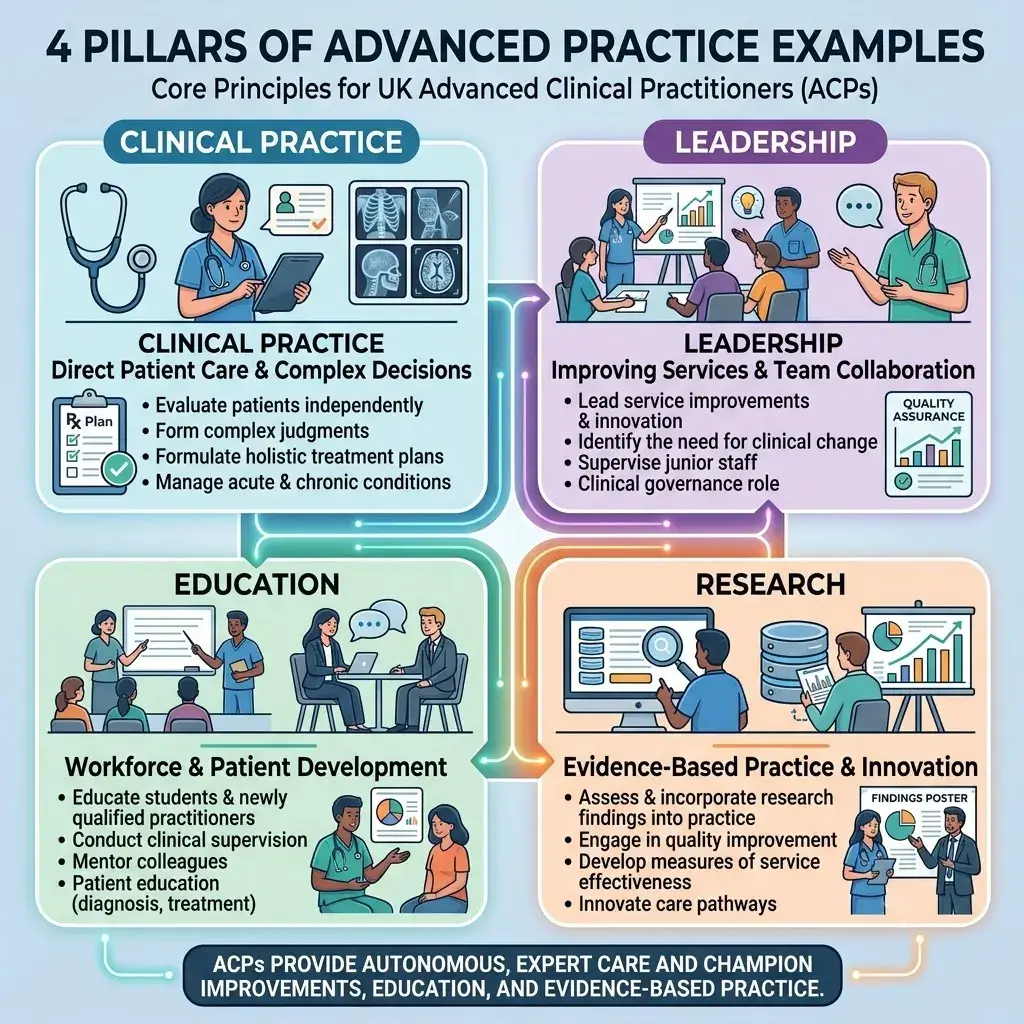
The 4 pillars of clinical practice underpin Advanced Clinical Practitioners (ACPs) throughout the UK. In addition to providing patient care, practitioners should be expected to demonstrate proficiency in
- Clinical practice
- Leadership
- Education
- Research
These four pillars of advanced practice work together to ensure that healthcare professionals provide safe, evidence-based, patient-centred care and contribute to improving services.
1. Clinical Practice
Advanced practice is at the heart of clinical practice. Advanced practitioners evaluate patients independently, form complex judgments, request and interpret diagnostic tests, create treatment plans, and care for acute and chronic conditions within their scope of practice.
An advanced clinical practitioner integrates clinical knowledge, expertise, and critical thinking skills to provide efficient, effective, and high-quality care in various settings, including specialist clinics, community services, primary care, and emergency departments.
The role has been broadened by digital health technologies, electronic patient records, and virtual consultations. Hence, in addition to clinical skills, practitioners require strong digital and communication skills.
NHS England is committed to continuing to invest in advanced clinical practice roles to enhance patient access, reduce waiting times and improve multidisciplinary working within the health system.
2. Leadership
Advanced practitioners can enhance health care outcomes beyond their role with individual patients through leadership. This entails leading improvements in service, assisting with quality assurance, mentoring colleagues, and encouraging the use of evidence.
Furthermore, they frequently recognize the need for change and implement improvements that provide more efficient and effective patient care. They additionally supervise junior staff, are involved in clinical governance and promote reflective learning in multidisciplinary teams.
Effective leadership helps build workforce resilience and keeps patient safety the top priority.
3. Education
Professional and workforce development is grounded in education. Advanced practitioners educate students, mentor newly qualified practitioners, and do clinical supervision in health care settings.
Patient education is also a crucial aspect. Educating patients about their health status, treatment options, and preventive measures enhances their ability to manage their conditions and maintain better health.
This pillar is supported by Continuous Professional Development (CPD). A key requirement of the Nursing and Midwifery Council (NMC) is that nurses continue their learning and reflection to maintain their professional competence. Teachers who seek to enhance their teaching abilities can also find innovative methods to support the learning process in nursing practice.
4. Research
The research is used to ensure that the advanced practitioner provides evidence-based practice rather than routine practice. Practitioners assess existing evidence, incorporate research findings into their clinical practice, and participate in quality improvement initiatives to improve patient outcomes.
Research skills can also be used to develop measures of service effectiveness, enhance care pathways, and participate in healthcare innovation. For example, an evidence-based mobilisation programme led by an ACP reduced hospital length of stay and improved recovery for patients following stroke.
These skills are further developed in a project such as a nursing dissertation, which professionals undertake during postgraduate studies and enables them to incorporate research into their daily clinical practice. For this purpose, various nursing assignment writing services assist future practitioners in submitting well-researched papers.
These advanced practice principles combine to empower healthcare professionals to deliver expert clinical care and champion improvements, education, and evidence-based practice within the NHS.
How to Become an Advanced Clinical Practitioner?
Advanced Clinical Practice is more than just clinical practice. Employers seek practitioners who can make sophisticated decisions, be held accountable for their practice, demonstrate leadership, and have a lifelong commitment to learning.
The route to becoming a professional physician is different for each profession but similar in that it takes a fixed path through education, experience and ongoing professional development.
1. Develop a Solid Clinical Base
Becoming an Advanced Clinical Practitioner begins with good post-registration experience in a specific clinical area. When seeking advanced positions, most employers require several years of clinical experience.
Healthcare professionals gain confidence to handle increasingly challenging patient cases and improve their assessment, communication, and decision-making abilities during this time.
Work experience in an emergency service, critical care, community health, primary care, mental health or specialist service will give you good exposure to a variety of patient needs and working with other professionals.
2. Take an Advanced Practitioner Course
Career advancement requires formal education. For most NHS organisations, practitioners will be expected to undertake an advanced practitioner course which meets the requirements of Advanced Clinical Practice.
The programmes are typically master’s level courses which are offered through the United Kingdom’s universities and involve supervised clinical practice alongside academic study.
The typical topics covered in a course are:
- Advanced clinical assessment
- Diagnostic reasoning
- Pharmacology and prescribing
- Evidence-based practice
- Leadership and enhancement of service.
- Research methods
- Clinical decision-making
Many of the practitioners finish their studies without leaving their jobs, which means that they can apply new knowledge when they are working in their clinical practice.
Struggling to Grasp the Complex Clinical Nursing Topics? Get Professional Help from Nursing Assignment Writing Services UK!
Whether it’s grasping the complex advanced clinical assessment strategies or applying clinical decision-making to assignments, students often struggle. We’ve got you covered! We have a team of talented writers who help simplify the complex topics, complete assignments on time and boost knowledge. Connect now!

3. Create a Professional Portfolio
A professional portfolio is a means of demonstrating competence in the four areas of advanced practice. It documents clinical excellence, leadership activities, contributions to learning and quality improvement.
An impressive portfolio might consist of:
- Reflective accounts
- Clinical competencies
- Quality improvement and audit projects.
- Patient feedback
- Continuing Professional Development (CPD) records
- Secondments and teaching experiences
- Research participation
- By presenting papers or publishing articles at conferences
Having accurate records also assists in annual appraisals, career development and professional revalidation.
4. Find the Best Mentor
The Mentor Program is a significant part of professional development. Advanced Clinical Practitioners share their knowledge and expertise in clinical decision-making, career planning, portfolio development, and tackling the growing complexities of their roles.
Practitioners will have the opportunity to receive supervision, provide positive feedback, reflect on difficult cases, and gain confidence whilst keeping patients safe, with regular supervision.
Structured supervision programmes are now offered by many NHS Trusts and will provide consistent support to trainee Advanced Clinical Practitioners throughout their training.
5. Continuous Learning Throughout Your Career!
Even as an adult, you can take part in learning opportunities.
Advanced practice is not an endpoint; it is an attitude to excellence. Lifelong learning is a necessary factor of clinical guidelines, medical technologies, and patient needs.
Attending conferences, gaining specialist qualifications, and participating in clinical audits, research projects, and further postgraduate studies are all ways practitioners enhance their skills.
Through this ongoing process of improvement, advanced practitioners can provide high-quality, evidence-based care for a lifetime.
How to Become an Advanced Nurse Practitioner?
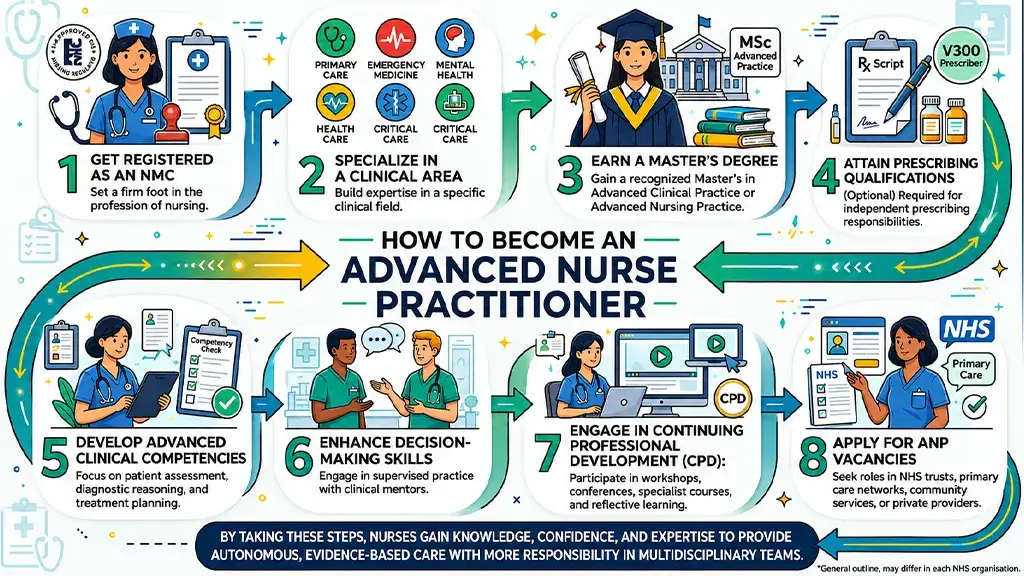
Advanced nurse practitioner careers require advanced clinical and professional skills, as well as specialist expertise. This is a general outline of the process, although it may differ in each NHS organisation.
- Get registered as an NMC and set a firm foot in the profession of nursing.
- Specialize in a particular clinical area, like primary care, emergency medicine, mental health and critical care, etc.
- Earn a Master’s Degree from a recognized university in Advanced Clinical Practice or Advanced Nursing Practice.
- If independent prescribing responsibilities are required, attain prescribing qualifications.
- Develop advanced clinical competencies (patient assessment, diagnostic reasoning and treatment planning).
- Enhance decision-making skills through supervised practice with advanced nurse practitioners or clinical mentors.
- Engage in Continuing Professional Development (CPD) via workshops, conferences, specialist courses and reflective learning.
- Once all of the advanced nurse practitioner competencies have been fulfilled, apply for vacancies in NHS trusts, primary care networks, community services or private health care providers.
By taking these steps, nurses will be equipped with the knowledge, confidence, and clinical expertise to provide autonomous, evidence-based care and have more responsibility in multidisciplinary healthcare teams.
Advanced Practice Strategies for Clinical Practitioners
Advanced practice strategies are essential for practitioners to continuously be effective in their careers.
Professional relationships, lifelong learning, and the ability to adapt to evolving healthcare settings are all important factors in long-term success, while clinical competence is the foundation.
1. Build a Strong Professional Network
Networking can provide chances for collaboration, mentorship and career advancement. Practitioners can share their knowledge and learn about new developments in clinical practice through membership of professional organisations and by attending NHS learning sessions, conferences and multidisciplinary meetings.
Professional relationships are also beneficial, facilitating collaboration in problem-solving and patient care in healthcare.
2. Make CPD a Priority
Continuous Professional Development (CPD) is an investment that is one of the most valuable for any advanced practitioner. Regular learning helps to keep clinical knowledge up-to-date and meet professional registration standards.
Postgraduate modules, clinical workshops, simulation training, journal club, webinars and evidence-based learning sessions are examples of useful CPD activities. Each learning experience should be accompanied by reflective practice to highlight strengths and areas for further development.
3. Embrace Evidence-Based Practice
The field of healthcare is constantly evolving as new research findings emerge. Successful practitioners consistently review clinical guidelines, assess research findings, and apply high-quality evidence to client care.
In addition to better clinical outcomes, evidence-based decision-making can help ensure the safe, consistent delivery of healthcare within organisations.
4. Build Leadership Beyond your Job
Leadership is by action, not by position. Quality improvement volunteers, mentors, and other service redesign or organisational project participants enrich their professional profiles, as well as their healthcare organisations.
Slow and steady wins the race—small improvements over time can yield long-term patient and clinical rewards.
5. Invest in Communication and Reflective Practice
Advanced practitioners often have to engage in delicate interactions with patients, their families, and other professionals from various disciplines. Good communication skills enhance the collaborative decision making process, minimize misunderstandings, and foster trust with patients.
Self-reflection is also important for professional development. Reflection on clinical experiences supports practitioners’ judgement, identification of learning opportunities and enhancement of practice.
Healthcare IT professionals with strong clinical skills and leadership, research, education and a commitment to lifelong learning will still be well-equipped to provide excellent patient care and develop the future of healthcare in a complex landscape.
Wrap Up!
As healthcare systems have been adapting to the evolving landscape of patient care, staffing demands, and clinical innovation, the need for advanced practice has steadily grown. Advanced practitioners are essential to delivering safe, effective and patient-centred services throughout the NHS, by applying their clinical expertise, leadership, education and research.
If you are aiming to become an Advanced Practice Nurse, it is essential to keep learning, gain experience, and stay up to date with evidence-based practice.
The skills developed across the four pillars could enhance individual career development and lead to improved patient outcomes, better healthcare services, and a more resilient workforce. By investing in professional development and lifelong learning, practitioners can enjoy a rewarding career and contribute to the future of healthcare in the UK.
Frequently Asked Questions
1. What is an advanced practice in healthcare?
Ans: It is an advanced level of professional practice in which a registered health care worker applies advanced clinical knowledge, independent decision-making, leadership, education and research skills to provide high-quality patient care. Furthermore, it is based on four pillars set out by NHS England.
2. What’s an advanced clinical practitioner?
Ans: An advanced clinical practitioner is a registered health care practitioner who operates with a high degree of independence in relation to the assessment, diagnosis, treatment and management of patients. The ACPs work in a wide range of professions such as nursing, physiotherapy, pharmacy, paramedicine and occupational therapy.
3. What are the advanced practice pillars?
Ans: The four pillars of the advanced practice are Clinical Practice, Leadership and Management, Education and Research. These pillars complement each other, enabling practitioners to provide safe, evidence-based, patient-centred care and to be part of service improvement and workforce development.
4. How long does it take to become an Advanced Clinical Practitioner?
Ans: There is no accurate answer based on differing experiences and educational backgrounds. The pathway typically takes 5 to 8 years, as most health professionals acquire a number of years of post-registration clinical experience prior to enrolling in an advanced practitioner course at the master’s degree level.
5. Can advanced practitioners prescribe drugs?
Ans: Yes. Many advanced practitioners have undertaken accredited prescribing qualifications to become independent prescribers, as it requires professional registration, further training and policies of practising employers.
6. Can anyone become an Advanced Clinical Practitioner?
Ans: Advanced Clinical Practitioners can be from a variety of registered health professions such as nursing, physiotherapy, paramedicine, pharmacy, radiography, occupational therapy and other allied health professions.
7. How does research play a role in advanced clinical practice?
Ans: Research supports practitioners in making informed clinical decisions, assessing healthcare outcomes, making improvements, and implementing new practices that increase patient safety and improve the quality of care.