
 By
By The introduction of an assignment is the most important part of writing a work because it is essential to introduce it clearly and interestingly. The introduction prepares the reader by stating the subject, the purpose, the objectives, and the scope of the assignment.
A well-written introduction not only reflects academic competence but also enables the reader to be able to trace the logical structure of your assignment. For UK students, a good introduction is one that can boost grades and academic achievement.
Importance of an Assignment Introduction
The first section of an assignment that the teacher reads aloud is the introduction, and it gives us an idea of the rest of the assignment.
It serves as a roadmap for the reader, explaining what the assignment will include and why the subject is important. Such complex matters can be understood better with the help of a clear introduction that gives the context, outlines the objectives, and presents the main argument. A sound introduction would also prove that you are well-versed in the topic and that the assignment is structured, outlined, and centered to provide meaningful information.
Components of an Assignment Introduction
A good introduction must have a number of features:
- Opening Statement: This is the opening line of the introduction, and it must be attractive. It can be a striking fact, statistic, or an idea to ponder over and grab the attention of the reader.
- Background Information: This provides context for the subject matter, explaining its relevance, history, and current trends. This helps the reader understand the significance of the subject and why it should be discussed.
- Goal: Be clear about what the assignment aims to do. This gives the reader a purpose and direction.
- Scope: In a few words, summarize what you will be covering in your assignment. This makes certain that the reader is aware of the limits of discussion.
- Thesis Statement: A brief statement or two about the overall argument or stance of your assignment. This quote serves as a guide for the reader and sets the path ahead.
How to Write an Introduction for an Assignment?
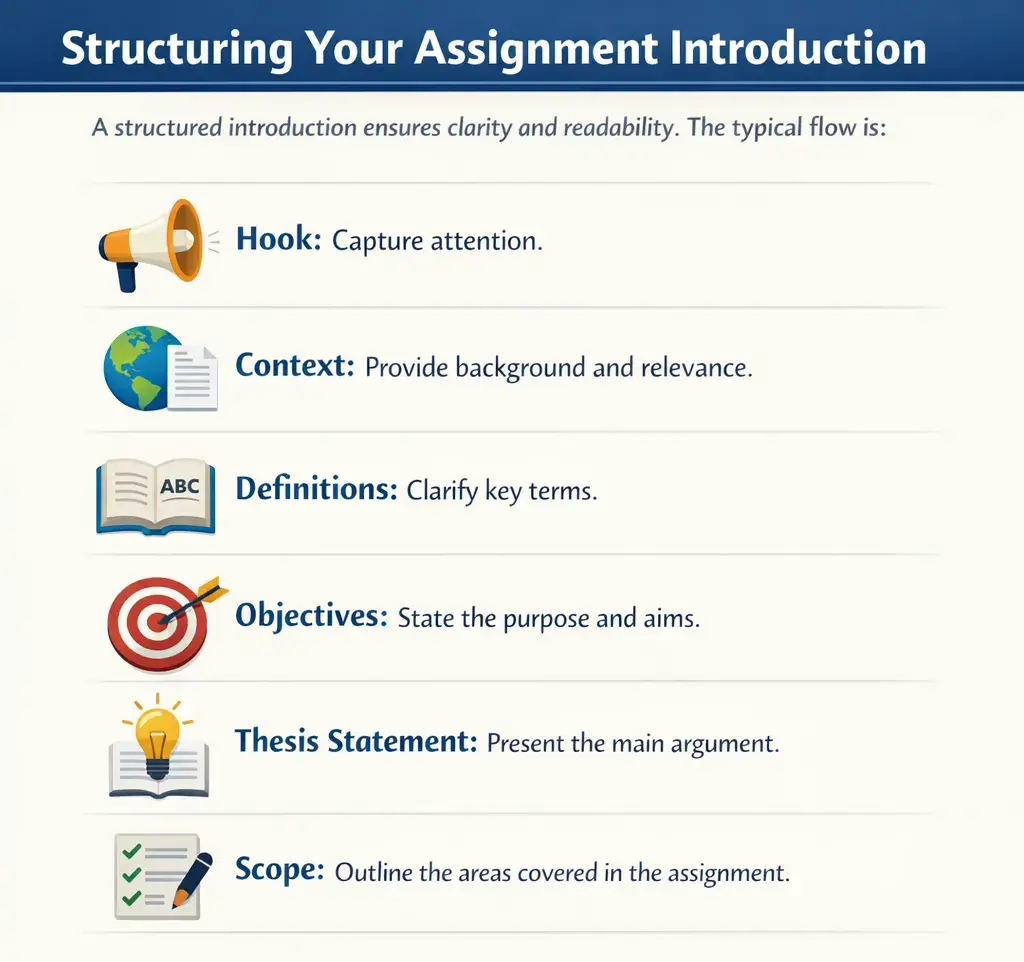
A good introduction is well thought out and concise. All the sections of the introduction must have a purpose and lead the reader to your central discussion. The steps to follow with examples are detailed below in order to assist you in knowing how to write an effective assignment introduction.
Step 1: Start with a Hook
Your opening sentence of the introduction must be catchy and generate interest in your subject. The hook may be a statistic, a powerful sentence, a definition, or a short fact that will make your subject matter clear. The opening paragraph must be quite interesting and motivate the reader to go on to read further, and demonstrate that your assignment is not pointless.
Your hook must always be connected to your assignment subject. Do not make general statements that are not value-adding. Rather, exploit meaningful information that appeals to your subject area.
Example:
Communication is an important element in healthcare that determines patient outcomes. A study conducted by the NHS shows that poor communication is a cause of almost 30% of avoidable medical errors in UK hospitals.
Relevance and significance are created at first glance. The reader gets an understanding of the topic, and he/she is motivated to read further.
This hook is effective since it presents the subject matter clearly and brings out its significance.
Step 2: Background Information
Following the hook, give background information to enable the readers to be aware of the topic. Background information provides the context and reason as to why the subject is important. This bit can contain historical processes, current trends or issues surrounding the issue.
Its background section must be brief and concentrated. You should not include any unnecessary points that are not relevant to the purpose of your assignment.
Example:
The concept of patient-centered care has gained prominence in health care systems over the past ten years. This method aims at enhancing communication, collaboration, and decision-making between healthcare professionals and patients. With the ever-increasing needs in healthcare, communication remains vital to enhancing patient safety and satisfaction.
Step 3: Define Key Terms
If your assignment contains some technical or specialized terminology, then define it. Definitions will ensure that the reader understands the concepts under discussion and that it does not become confusing. Pay attention to only the important words in your assignment.
It is better not to define too many terms, which can make the introduction long. Rather, incorporate the most significant definitions that are required in your discussion.
Example:
Patient-centered care is a concept that prioritizes the patient, their needs, and values in making health care decisions. The strategy promotes collaborative efforts between medical practitioners and patients to achieve better healthcare outcomes.
Step 4: State Your Objectives
Have a clear purpose for your assignment. Goals direct the reader and reveal what your assignment is going to accomplish. Goals are expected to be clear and topic-oriented.
Your goals can be studying a theory, assessing strategies, debating issues, or making recommendations.
Example:
This assignment is intended to assess the significance of effective communication in healthcare and to examine strategies that enhance patient safety and satisfaction.
Step 5: Outline the Structure
In a short description, explain the way your assignment is structured. This provides a guide and helps readers see how you have discussed the issues. Talk about the key areas without going into too much detail.
Example:
This assignment will start with a discussion of communication theories, followed by an evaluation of practical approaches for use in a healthcare environment. It then weighs issues encountered by healthcare professionals and ends with recommendations for improving patient care.
Step 6: State the Thesis Statement
End the introduction with an impressive thesis statement. The thesis is a summary of the principal point or stance of your assignment. Having a thesis helps to get direction and focus in your assignment.
Your thesis must be concise and aligned with your goals.
Example:
The article states that effective communication is an important factor in enhancing patient outcomes and that structured communication strategies can improve patient safety in a healthcare context.
Pro Tip: If you are having troubles in writing your assignment introduction, consider seeking help from our highly skilled Nursing Essay Writers in the UK. They have professionals in their team who can assist you with your queries.
Full Introduction Sample
A full introduction can appear as follows when all the steps are put together:
Communication in healthcare is crucial to enhancing patient outcomes. It has been found that poor communication may be one of the causes of avoidable medical errors in hospitals. Patient-centered care has become a crucial concept of healthcare systems to enhance safety and satisfaction. Patient-centered care is a form of healthcare provision that considers patients’ needs and preferences. This assignment will assess the relevance of communication strategies in the health care facility. The topic of the discussion is the review of theoretical frameworks, analysis of practical strategies, and assessment of challenges that healthcare professionals have to deal with. The application of effective communication strategies can help to improve patient safety and increase healthcare outcomes to a greater extent.
The example shows how each step contributes to a successful, structured assignment introduction.
Writing Tips for Assignment Introduction
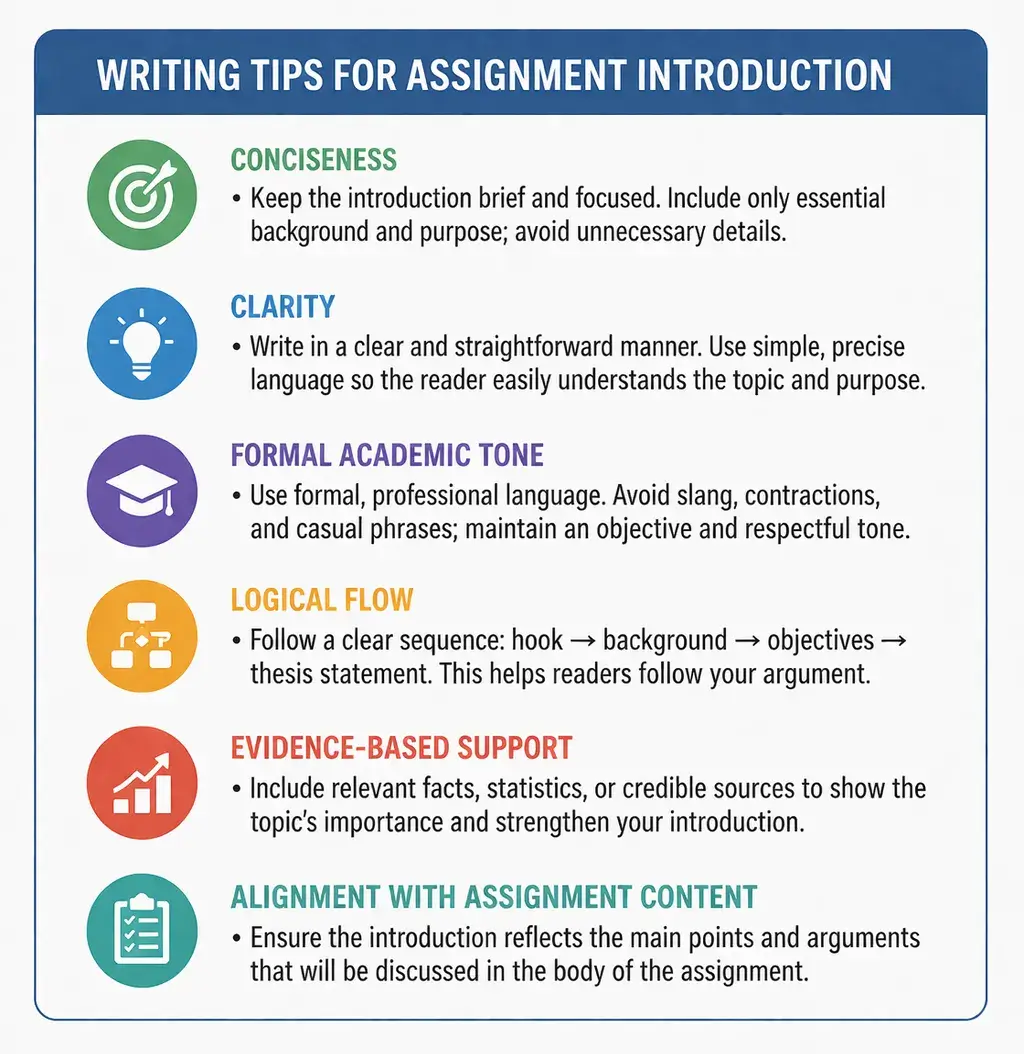
Here are some key factors that you need to follow while writing an assignment introduction:
Conciseness
A good assignment introduction must be informative, at the same time, not too long. The introduction is intended to provide a quick overview of the subject and lead the reader to the assignment’s topic. Writers are not to provide any superfluous information, long explanations, and any information that can distract the reader should not be included in the writing.
Rather, the introduction must deal with the necessary items that can assist a reader in realizing the topic and its importance. Every sentence needs to be directly relevant to the overall explanation of the subject, or the creation of context, or the approach to the thesis statement.
Being concise is important as it keeps the reader interested and is able to see the point of the assignment faster.
Clarity
Effective academic writing contains clarity as one of its essential components. Ideas that are introduced should be presented clearly and in a straightforward manner, so that readers can easily grasp what is being discussed.
Sentences are to be well constructed and arranged to prevent confusion. The writers are not supposed to use vague statements, ambiguous words, or too complicated words that can complicate the introduction. They need to be oriented towards giving information in a factual and comprehensible manner. Clarity not only makes the writing more readable, but also helps ensure that the reader picks up the purpose and direction of the assignment early in the work.
Formal Academic Tone
Academic works must be written formally to be professional and objective. The writers must be careful not to use casual language, abbreviations, and slang words and expressions, which are appropriate in informal communication.
On the contrary, they ought to apply formal words, correct grammar, and well-constructed sentences. Keeping an academic tone also entails objectively representing the ideas and not offering personal views in a non-formal manner. Formal writing style contributes to the plausibility of the piece and proves that the author is aware of the norms of academic writing.
Logical Flow
An effective introduction must have a logical flow that will progressively instruct the reader from the general information to the concentration of the particular assignment. The introduction would normally start with a hook or a statement that attracts the reader’s interest.
This is preceded by background information that puts the context and explains why the topic is important or relevant. Once the setting is established, the writer must indicate clearly the goals or purpose of the assignment.
Lastly, the introduction must end with a clear thesis statement that presents the paper’s argument or focus. This logical flow makes the readers get the structure of the assignment and it prepares them with the discussion which is to follow.
Evidence-Based Support
To make the introduction more powerful, it may be important to include relevant statistics, facts, or credible sources. Evidence-based information demonstrates that the issue under consideration is significant and supported by credible data.
Including factual information or referencing research by the writers proves that the assignment is based on scholarly knowledge and not the personal view. It is a strategy for increasing the credibility of the introduction and giving the discussion a serious tone for readers.
Correlation with Assignment Material
The introduction should be a representation of the contents and arguments in the main body of the assignment. The introduction outlines the objectives, themes, or claims that should be elaborated in subsequent sections of the paper.
If the introduction presupposes certain ideas or states that some analysis will be done, one should address the rest of the assignment. It is important to keep the introduction aligned with the main content to ensure coherence and help the reader follow the argument overall.
Word Count Allocation
The number of words to be allocated to a 2,000-word assignment is as follows:
- Introduction: 200–250 words
- Body: 1,500–1,600 words
- Conclusion: 200–250 words
This distribution will make your introduction informative yet not very long giving your assignment a good kick-off.
Phrases to Use in the Introduction of an Assignment.
- “This assignment examines…”
- “The aim of this study is…”
- “Evidence indicates…”
- “Research demonstrates…”
The goal of this assignment is to find out and determine the following:
Common Mistakes to Avoid
Here are some common mistakes that you need to avoid:
- Being too general or not precise enough in the introductory statement.
- The absence of the thesis statement.
- Having too much background information that does not follow the central point.
- Speak in an informal manner, use filler words, or colloquial terms.
- Restating the information in the titles.
Struggling with your Nursing Assignment Introduction?
Introductions are a big part of your assignments. However, many students struggle to get past the first page. That’s where the Nursing Assignment Writers in the UK come in. Whether you need help in writing the introduction from scratch or want to polish it, we’ve you covered.

Wrap Up!
A good assignment introduction will give you a clear, well-organized and interesting start to your work. You lead the reader by including a strong hook, appropriate background details, clear goals, and a clear thesis statement. By emphasizing conciseness, logical progression and proper academic terminology, you guarantee the establishment of a solid ground to do a successful assignment in the introduction.
FAQs
Q#1 What is an assignment introduction?
Ans: The introduction to your assignment is what introduces the subject, gives some background, explains goals and gives you an outline.
Q#2 What is the length of an assignment introduction?
Ans: In most cases, 200 and 300 words depending on the total amount of words, assigned.
Q#3 Is it possible to mention statistics in the introduction?
Ans: Yes, the inclusion of correct statistics or facts make it believable and interest the reader.
Q#4 Define key terms in the introduction?
Ans: Yes, especially technical or special words to provide clarity.
Q#5 What is a thesis statement?
Ans: In the end of the introduction summarize your key point in one or two sentences.
Q#6 Can examples be included?
Ans: Yes, short illustrations to your subject matter can help you to explain your points.
Q#7 What are the pitfalls that I should not make?
Ans: One should avoid generalized statements, filler words, excessive background information and lack of a thesis statement.
Q#8 Does the introduction count in the word count?
Ans: Yes, it adds to the overall number of words in your assignment.
Q#9 What do I do to make the introduction interesting?
Ans: A powerful introduction, facts, and objectives are points that should be used to ensure that the reader is hooked.
Q#10 Is it possible to use references in the introduction?
Ans: Yes, brief citations of authoritative sources can substantiate your introductory remark and make you more credible.