
 By
By | According to the UK higher education data, over 60% of nursing students report that the dissertation is the most stressful part of their degree. Furthermore, nearly 1 in 3 students struggle with time management and research confidence during the process. Well, this explains why many students search online for How to Write A Nursing Dissertation often late at night, as they are feeling overwhelmed. |
Writing a nursing dissertation is a part of your degree if you want to graduate. However, it is a troublesome task. Working on these dissertations can feel a little difficult because they combine academic research, clinical relevance, ethics and strict structure. Furthermore, many students often manage their placements, shifts, and part-time work while working on this.
Thus, they often struggle to find credible nursing sources, choose the topic, write critically, or even manage time effectively. While a nursing dissertation can be challenging, it is absolutely manageable with the right approach and support.
So, if you are a nursing student who is tired of searching every blog about how to write a dissertation but return empty handed, this blog is designed for you. By the end of it, you will know how to plan, research, write, and complete your nursing dissertation confidently.
What are you waiting for? Let’s get into the blog!
What is a Nursing Dissertation?
In simple words, a nursing dissertation is a long, independent research project that is usually completed by the end of the final year of a nursing degree.
Additionally, it allows students to explore the topic related to nursing practice, healthcare, patient outcomes and professional development.
The main purpose of a nursing dissertation is to show that you can:
- Conduct academic research
- Critically analyse nursing literature
- Apply theory to real nursing practice
- Follow ethical and professional standards
Furthermore, it is way different than the nursing assignment. While the assignments are short and focus on the theory, the dissertation covers the practical aspects. Here is the main difference between them:
Nursing Dissertation Vs Nursing Assignment
| Feature | Nursing Assignment | Nursing Dissertation |
|---|---|---|
| Length | Short (1,500–3,000 words) | Long (8,000–12,000+ words) |
| Research depth | Limited | In-depth |
| Independence | Guided | Mostly independent |
| Importance | Module-based | Degree-defining |
For students who are pursuing nursing degrees in the UK, the dissertation is a major academic milestone. Furthermore, it often carries a high credit value and can strongly influence your final classification.
Now that you know what a nursing dissertation is, let’s discover how to write a perfect one.
How to Write a Nursing Dissertation Step by Step?
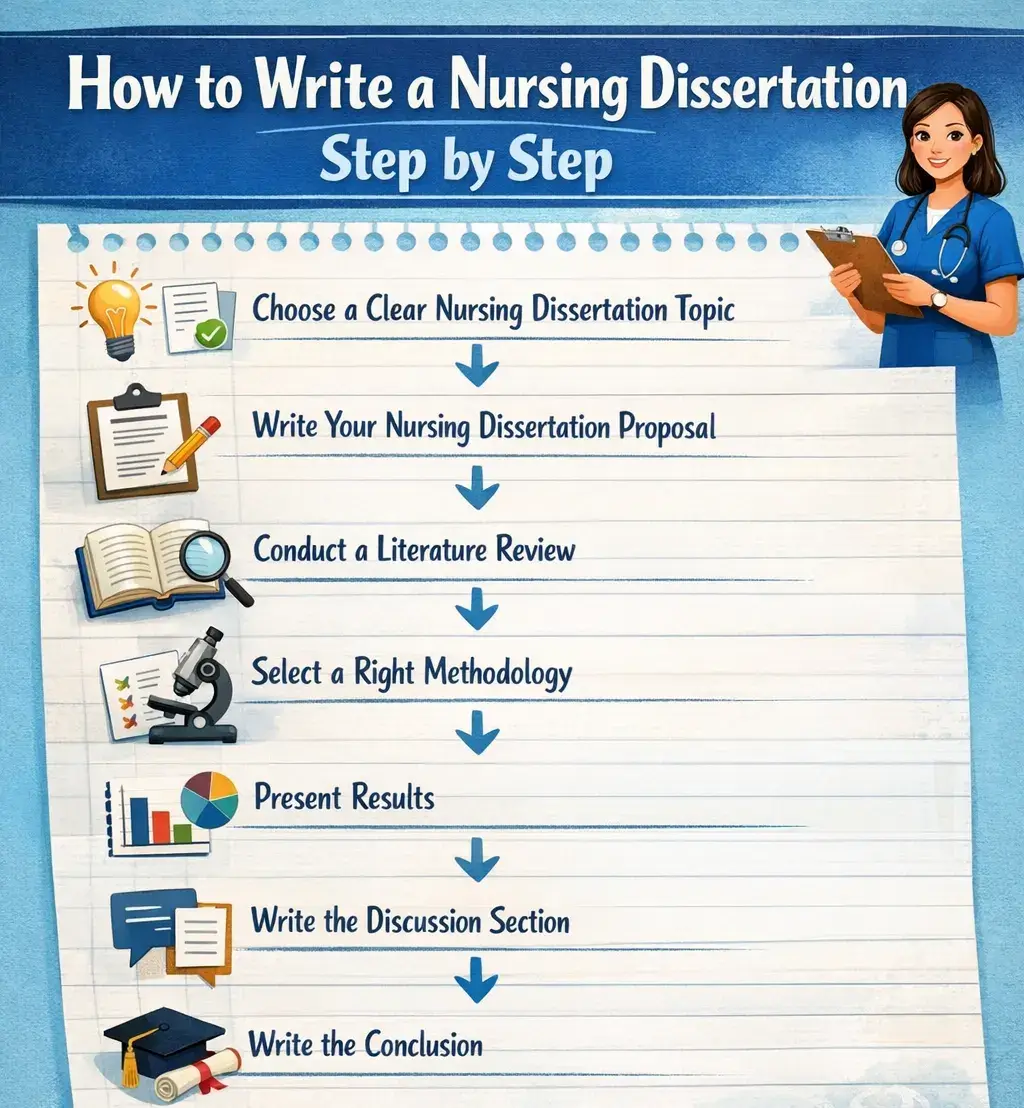
Here comes the most searched question on Google: How to write a nursing dissertation. Well, here are some steps that can make your dissertation writing easy and simple:
- Choose a clear nursing dissertation topic
- Write Your Nursing Dissertation proposal
- Conduct a literature Review
- Select a Right Methodlogy
- Present Results
- Write the Discussion Section
- Write the Conclusion.
Come on! Let’s dive deep into the details:
Step 1 – Choose a Clear Nursing Dissertation Topic
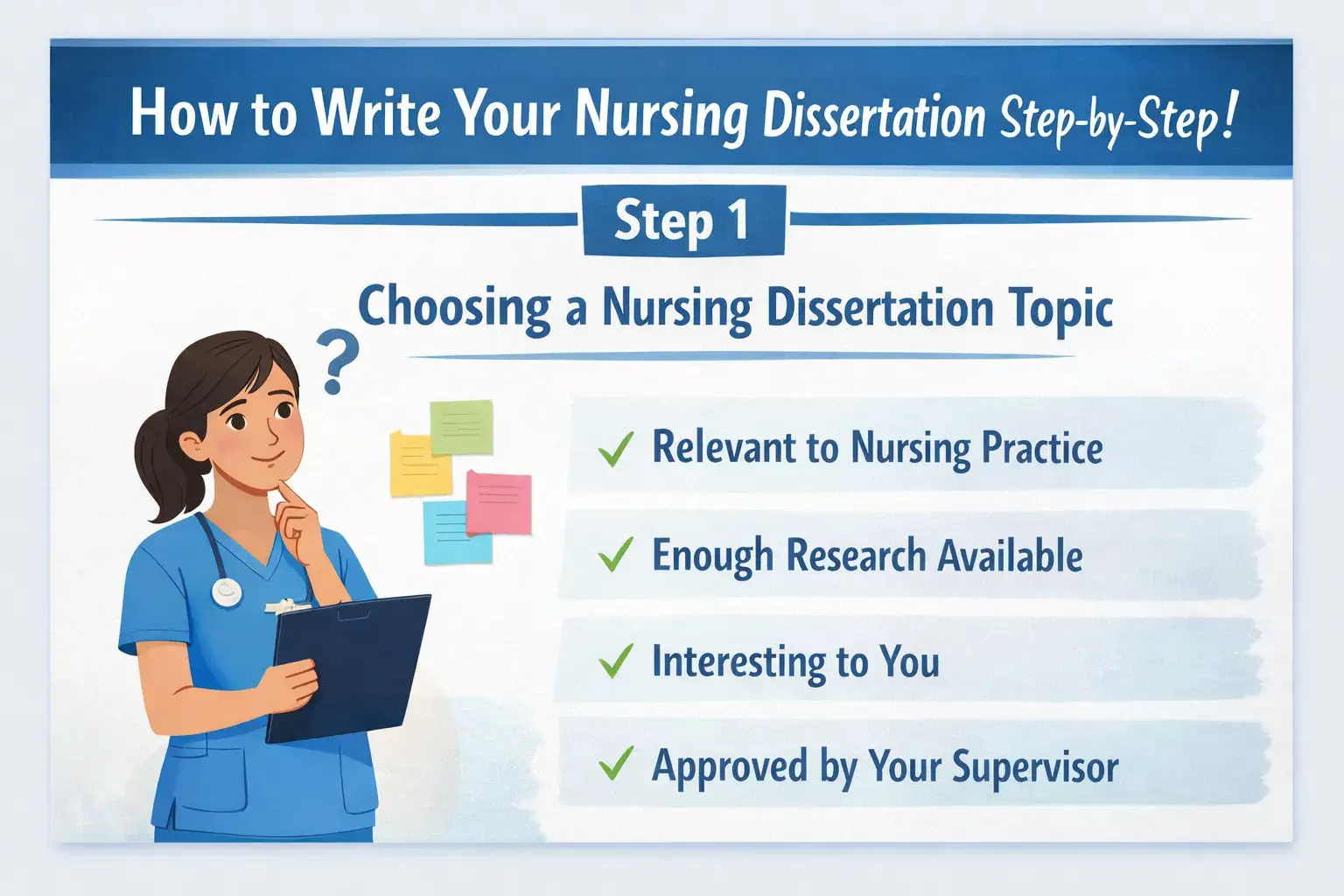
Here comes the first step. You need to start by choosing a clear nursing dissertation topic. Having the right topic can help you set the foundation for your entire dissertation. However, it is not easy. In fact, the strong topic should be:
- Be relevant to current nursing practice
- Before picking out the topic, ensure that there is enough academic research available so that you won’t have a problem while writing.
- Make sure that the topic you choose matches your personal interests or clinical experience
- Additionally, double-check with your supervisor to ensure they approve it.
Here are some good topic areas that you can talk about:
- Patient safety
- Mental health nursing
- Infection control
- Pain management
- Nurse-patient communication
- Leadership in nursing
Top 10 General Nursing Dissertation Topics to Talk About:
- The Impact of Nurse–Patient Communication on Patient Satisfaction in Hospitals
- Factors Affecting Job Satisfaction Among Registered Nurses in Healthcare Settings
- The Role of Nurses in Improving Patient Safety and Reducing Medical Errors
- Stress and Burnout Among Nurses: Causes and Coping Strategies
- The Effectiveness of Infection Control Practices in Clinical Nursing Care
- Time Management Challenges Faced by Nurses in Acute Care Units
- The Importance of Evidence-Based Practice in Modern Nursing
- Nurses’ Knowledge and Attitudes Toward Pain Management in Patients
- The Role of Nursing Leadership in Enhancing Quality of Patient Care
- Ethical Challenges Faced by Nurses in Clinical Practice
Tip: If you are having a tough time finding the research articles, the topic may be too narrow. Therefore, narrow it down.
Step 2 – Write Your Nursing Dissertation Proposal
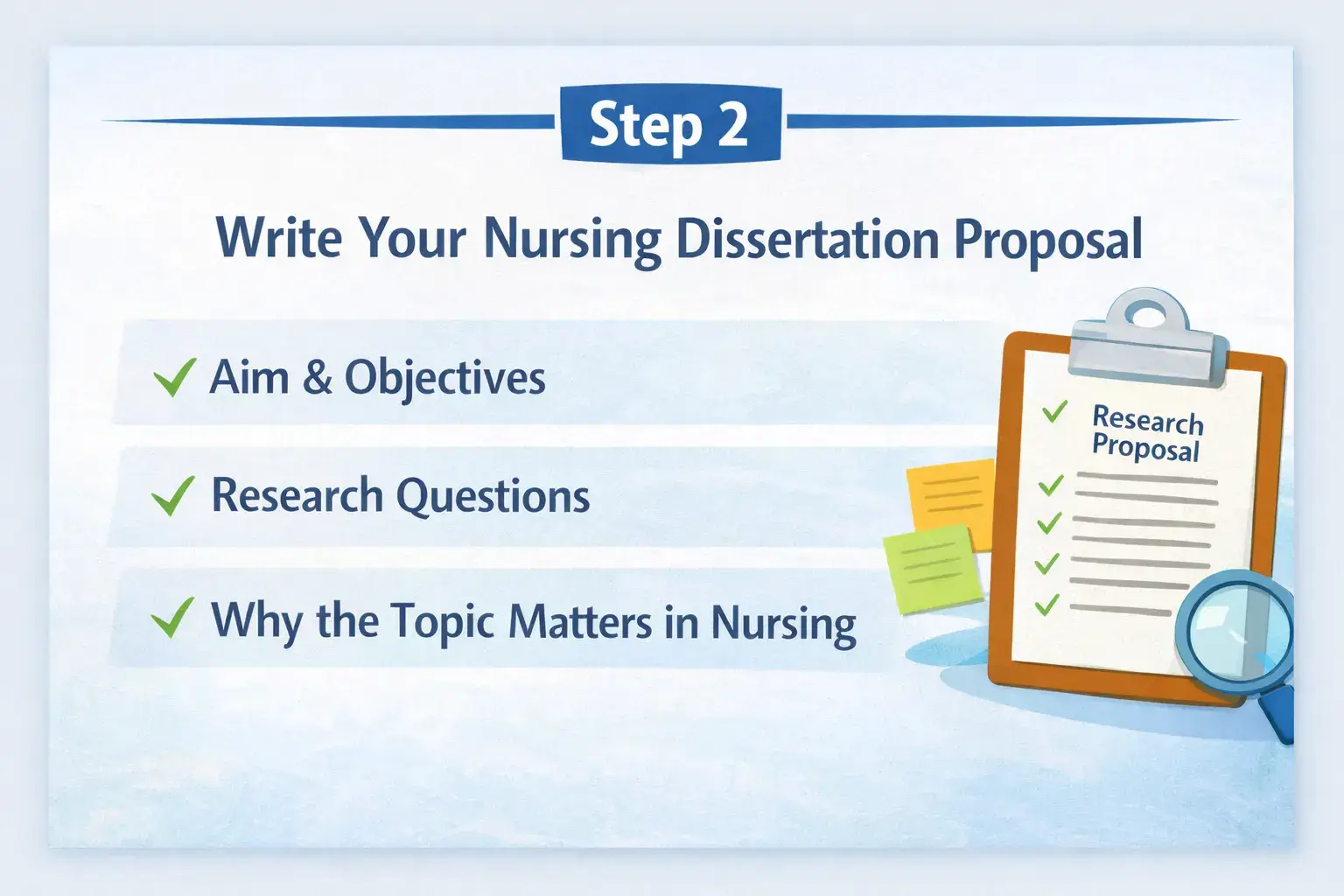
The next step is to write a dissertation proposal which explains what you plan to study and who it matters. When writing it, there are some essential things you to focus on like:
- Aim – What the study intends to achieve
- Objectives – Clear, measurable goals
- Research questions – What you want to find out
- Justification – Why the topic is important in nursing
Additionally, your proposal shows your supervisor that your topic is:
- Relevant
- Ethical
- Researchable
- Academically sound
Additionally, writing a clear proposal can save you time and prevent major changes later.
| Need Help Perfecting Your Proposal?
Struggling to structure your nursing dissertation proposal? Get expert guidance and tips to make it clear, concise, and ready for supervisor approval. |
Step 3 – Conduct a Literature Review
The literature review is the essential part of the dissertation. Think of it as a way to set the tone for the entire research work. However, it is also the most-time consuming chapter.
When conducting a literature review, make sure to examine the existing research on your topic. Furthermore, also identify the gaps in the knowledge and demonstrate your critical thinking.
Make sure to use the correct nursing sources like:
- Academic databases
- Peer-reviewed nursing journals
- Government health publications
- Evidence-based healthcare reports
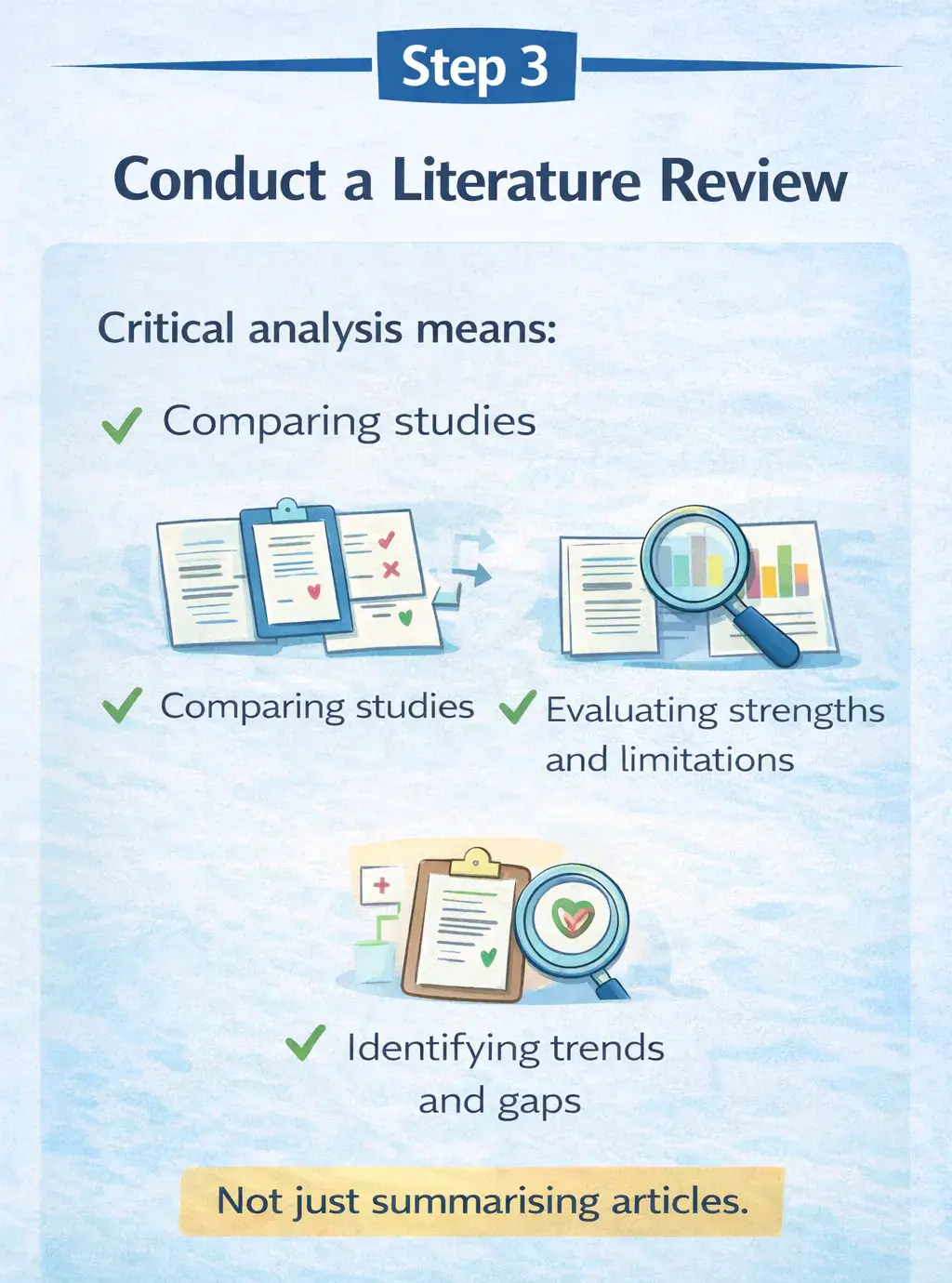
Additionally, when critically analysing, comparing the studies, evaluating the strengths and limitations and identifying the trends instead of summarising the articles.
Step 4 – Select the Right Methodology
Methodology is also an essential part of the dissertation as it explains how you conducted your research, what methods you chose, and why. Here are different methods you can choose:
Qualitative vs Quantitative Research
| Type | Description | Examples |
|---|---|---|
| Qualitative | Explores experiences and opinions | Interviews, focus groups |
| Quantitative | Uses numerical data | Surveys, questionnaires |
Nursing research often includes:
- Questionnaires
- Interviews
- Secondary data analysis
Furthermore, there are some ethical considerations you should be aware of when conducting the research.
Ethical Considerations in Nursing Research
Ethics are crucial in nursing dissertations. You must:
- Protect patient confidentiality
- Gain informed consent
- Avoid harm or bias
- Follow university ethical guidelines
Always remember that failing to address ethics can lead to automatic failure. Also, do justify the reasons why you have chosen that particular research.
Step 5 – Present Results Clearly
Now it is time for you to present the results clearly. Tell the readers what you found and not what it means. Here are some key points that you should follow while writing the dissertation:
- Make sure to use tables and figures where appropriate
- Furthermore, keep data accurate and neutral
- Avoid interpretation or opinions as they can lead to bias.
Here is a short example of how you can write the result section.
| Example Table: Survey Results |
|---|
| Factor |
| Communication improves care |
| Workload affects quality |
Once you have created the table, make sure to go into detail and explain everything.
Step 6 – Write the Discussion Chapter
Here comes the easiest chapter of the dissertation, where you can score highly. The only key is knowing how to write it properly.
Here is what you need to do:
- Make sure to compare results with existing literature
- Additionally, explain similarities or differences
- Don’t forget to discuss implications for nursing practice
- You should also acknowledge study limitations
Writing strong discussions show the deep understanding. Furthermore, they go beyond the description.
Step 7 – Write the Conclusion
This is the last step of the dissertation writing. It helps bring your work together and make a lasting impression.
To write a good conclusion, you should start by
- Summarising key findings
- Additionally, answer research questions clearly
- Also, make sure to highlight contributions to nursing practice
- You can also suggest areas for future research
Always remember that you should not add any new information, as it can cause confusion among the readers.
Nursing Dissertation Structure Explained
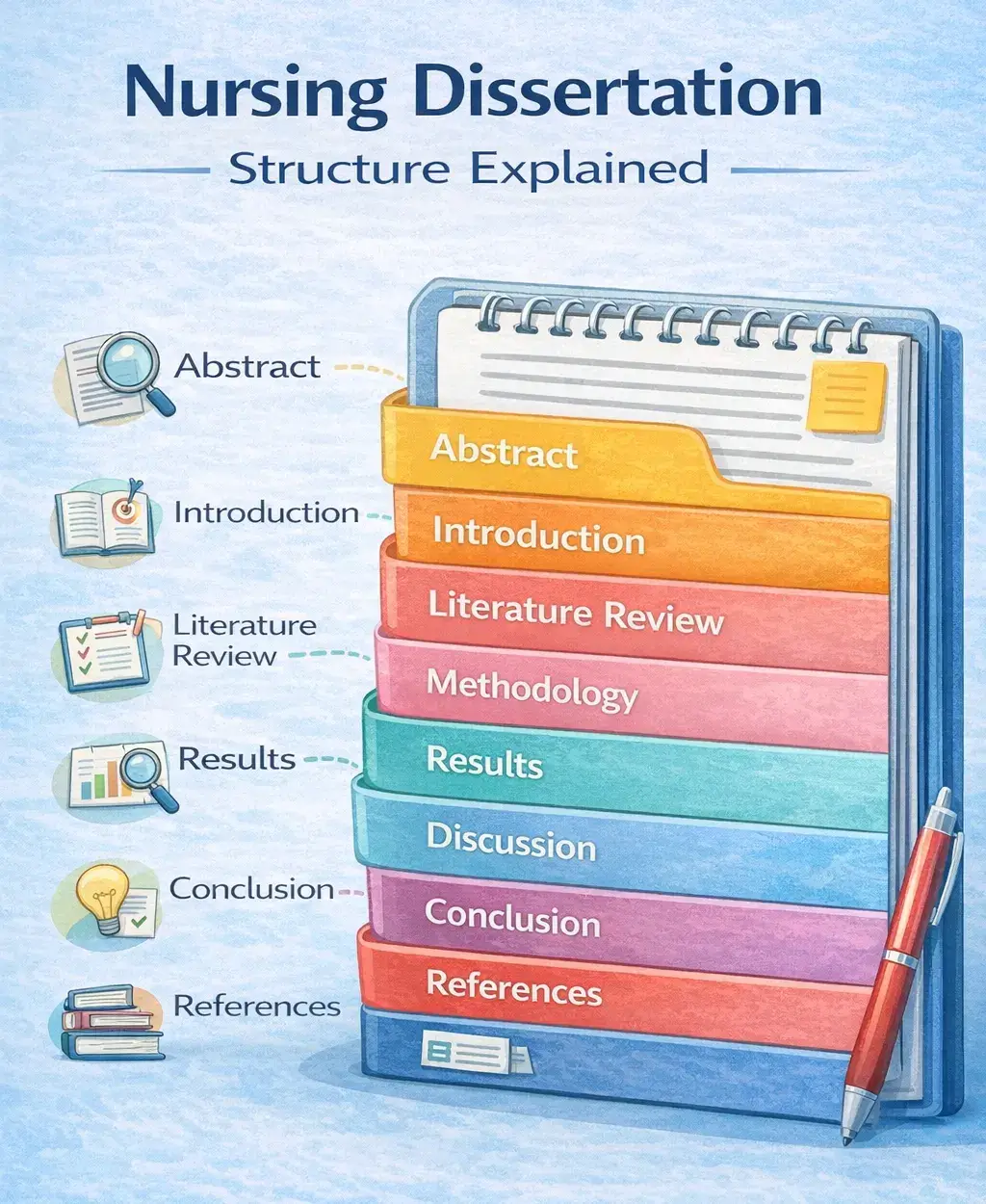
When it comes to writing the dissertation, you have to follow the proper structure. It can help reduce errors and maintain the flow throughout. Furthermore, each of the chapters serves its own purpose. Come on! Let’s have a look at them.
| Chapter | Purpose |
|---|---|
| Abstract | Overview of the study |
| Introduction | Background and aims |
| Literature Review | Review of existing research |
| Methodology | Research design and methods |
| Results | Findings only |
| Discussion | Interpretation and comparison |
| Conclusion | Summary and recommendations |
| References | All cited sources |
Tips to Write Your Nursing Dissertation Successfully
If you want to make the dissertation writing successful, here are some tips and tricks that you need to follow. They include:
- Start early and create a timeline
- Furthermore, follow your university guidelines strictly
- Make sure to use evidence-based nursing sources
- Also, maintain a formal academic tone
- Edit and proofread carefully
Always remember that even a small improvement significantly raises your grade.
Common Mistakes When Writing a Nursing Dissertation
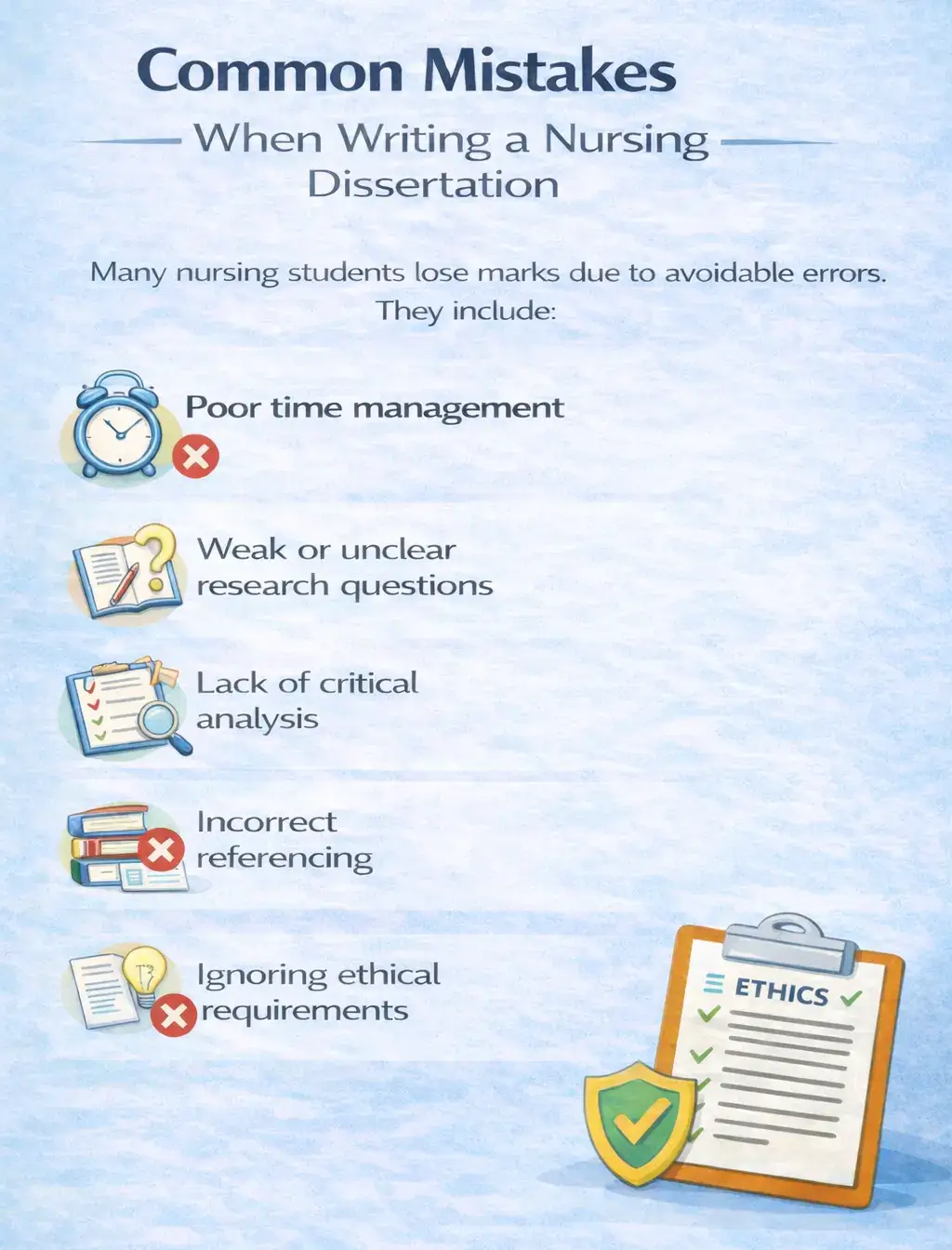
Many nursing students lose marks due to avoidable errors. They include:
- Poor time management
- Weak or unclear research questions
- Lack of critical analysis
- Incorrect referencing
- Ignoring ethical requirements
Being aware of these mistakes helps you avoid them early.
When Should You Get Help Writing Your Nursing Dissertation?
According to the studies, working nurses and placement-based students are twice as likely to struggle with dissertation. That is where the Nursing Dissertation Assistance services come in. Whether you are struggling to balance shifts and study, feel stuck with methodology or need clarity or feedback, they have you covered. Just make sure to use them in the correct manner instead of the shortcut.
Conclusion
This brings us to the end of the guide! In a nutshell, writing a nursing dissertation can feel overwhelming. However, with the right structure, planning, and mindset, you can manage it properly. I hope this guide helped you learn how to write a nursing dissertation step by step, from choosing the topic to writing a strong conclusion.
Remember that every nurse feels uncertain at one point. You are not alone and with the right support, whether through your peers or professionals, is a part of your learning journey.
With consistency and confidence, you can complete your nursing dissertation successfully and take an important step toward your nursing career.
FAQs
Q No1. How long should a nursing dissertation be?
Ans: Most nursing dissertations range between 8,000 and 12,000 words, depending on university guidelines.
Q No2. How long does it take to write a nursing dissertation?
Ans: On average, students spend 3–6 months, including research, writing, and editing.
Q No3. What referencing style is used in nursing dissertations?
Ans: Most nursing dissertations use APA referencing, though some universities may allow Harvard.
Q No 4. Can I get professional help with my nursing dissertation?
Ans: Yes, ethical academic support is available for guidance, editing, and structure.