
 By
By Opting for a career in nursing in the UK equates to a structured field with well-defined growth prospects. The bands of nursing under the NHS Agenda for Change pay system determine pay, responsibilities, leadership expectations, and career progression. As a school leaver, an international student, or a healthcare assistant looking to become a registered nurse, knowing about these bands will help you work out a realistic plan for your career and future.
Newly qualified registered nurses typically start at Band 5, and experienced registered nurses can progress to Bands 6, 7, 8, and 9, developing specialist skills, leadership experience and further qualifications. Nursing is one of the most rewarding careers in the UK, with attractive salaries, and nurses can also enjoy annual leave, pension benefits, paid training, flexible working opportunities, and career development pathways.
What are the Bands of Nursing?
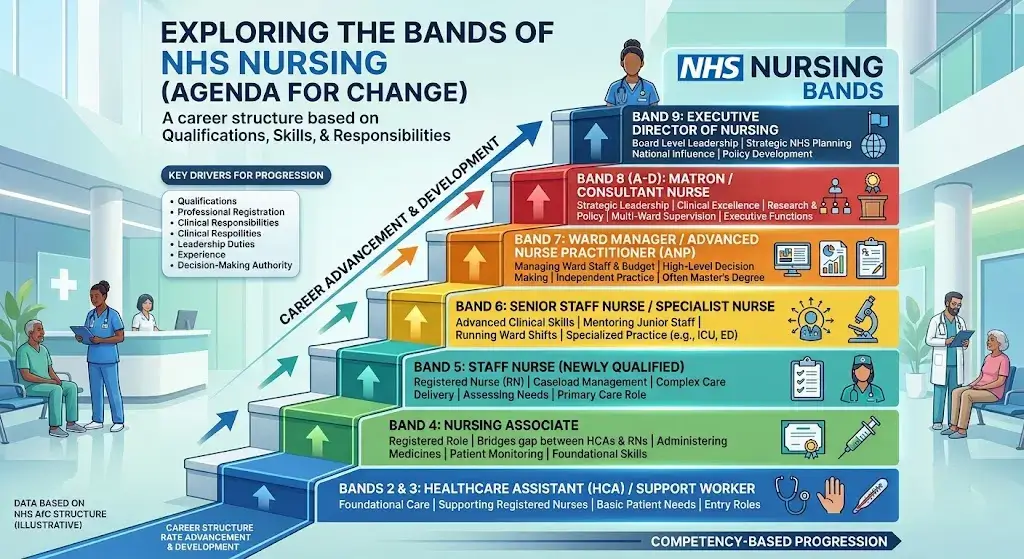
Under the NHS Agenda for Change (AfC) pay system, the nurse bands are salary and career grades. Rather than all of the nurses being paid the same amount, the NHS has classified them into bands, depending on their:
- Qualifications
- Professional registration
- Clinical responsibilities
- Leadership duties
- Experience
- Decision-making authority
Compensation, competency, and career advancement for each band are unique. Nurses can advance to higher bands as they develop specialist clinical skills, complete postgraduate training, gain more experience, or take up leadership roles.
Whereas in other fields pay reflects years of service, in the NHS it reflects experience, competence, and additional responsibilities. This helps ensure that progression is tied to professional development rather than mere time.
Why Is It Important to Have NHS Nurse Bands?
The Nursing NHS bands are essential because:
- They calculate income on an annual basis.
- They establish the responsibilities for the day.
- They affect promotions.
- They identify leadership expectations.
- They assist nurses in planning for their long-term careers.
- They assist with transparent recruitment at NHS trusts.
The NHS banding system is a great thing to know if you’re wondering how much a Band 5 nurse earns.
NHS Nursing Bands – A Detailed Explanation
The NHS nursing structure spans from Band 2 support workers to Band 9 executive nursing leaders. The levels represent a progressive increase in responsibility, autonomy, and strategic influence.
| NHS Band | Typical Role | Experience Level |
|---|---|---|
| Band 2 | Healthcare Assistant | Entry-level support |
| Band 3 | Senior Healthcare Assistant | Experienced support worker |
| Band 4 | Nursing Associate | Bridge between the assistant and the registered nurse |
| Band 5 | Registered Nurse / Newly Qualified Nurse | First professional nursing role |
| Band 6 | Senior Staff Nurse / Specialist Nurse | Experienced clinical practitioner |
| Band 7 | Advanced Nurse / Ward Manager | Clinical leadership |
| Band 8 | Matron / Consultant Nurse / Senior Manager | Senior leadership |
| Band 9 | Executive Chief Nurse | Strategic executive leadership |
Typically, promotions also come with greater responsibilities, larger teams to oversee, more clinical decisions to make, and higher pay.
Understanding Each NHS Nursing Band
1. Band 2 Healthcare Assistant
Band 2 (Healthcare Assistant) works directly with patients under the guidance of registered nurses.
Typical Responsibilities
- Assisting patients with personal care services.
- Recording observations.
- Assisting with meals.
- Maintaining patient comfort.
- Supporting mobility.
- Preparing clinical areas.
Many people start their healthcare careers at Band 2 Healthcare Assistant level and then go on to qualify as nurses.
2. Band 3 Health Care Assistant
Band 3 Health Care Assistant is more responsible than a Band 2 employee and may undertake delegated clinical duties.
Responsibilities May Include
- ECG recording
- Phlebotomy
- Supporting specialist clinics
- The supervision of young support staff
- Managing equipment
- Maintaining patient records
People looking to work as Nursing Associates and taking a nursing course are likely to be interested in Band 3 Health Care Assistant positions.
Band 4 Nursing Associate
The Band 4 Nursing Associate job role was added to the register to fill the gap between a healthcare assistant and a registered nurse.
Nursing Associates work alongside registered nurses in hospitals, community services, and primary care settings, providing hands-on patient care.
Common Duties Include
- Medication support
- Wound care
- Patient assessment
- Care planning
- Monitoring long-term conditions
- Patient Health Education
Many Band 4 practitioners go on to further study to become registered nurses through an apprenticeship or a university programme.
Band 5 Registered Nurse
Band 5 is the first band for most nurses upon registration with the Nursing and Midwifery Council (NMC) after completing their nursing education.
Band 5 Nurses Are Found in a Wide Range of Areas, Such As:
- Emergency departments
- Intensive care
- Medical wards
- Surgical wards
- Paediatrics
- Mental health
- Community nursing
- District nursing
- Oncology
- Cardiology
- Maternity services
A Band 5 nurse will provide evidence-based, safe care and work within a multidisciplinary healthcare team.
What is a Band 6 Nurse?
Band 6 nurse: A nurse with specialist clinical knowledge and leadership skills. Now, nurses have the chance to work with more complex patients, supervise less experienced colleagues, and participate in the development and enhancement of services.
Band 6 can be the initial formal leadership role in a nursing career.
What are the responsibilities of a Band 6 Nurse?
Such as Band 6 nurses work in:
- Emergency departments
- Intensive care units
- Community nursing teams
- Specialist clinics
- Surgical services
- Mental health services
- Oncology departments
- Infection prevention teams
Typical Responsibilities
- Care for complex patients
- Leading clinical shifts
- Supervising Band 5 nurses and students
- Mentoring junior staff
- Coordinating multidisciplinary care
- Supporting clinical audits
- Implementing evidence-based practice
- Making a positive financial impact on service improvement initiatives
There are many Band 6 nurse jobs available for nurses who have a few years of experience as a Band 5 registered nurse. This job is an ideal role for someone seeking to build leadership capabilities whilst maintaining their specialist care for patients.
What is a Band 7 Nurse?
The Band 7 nurse is a senior Clinical Leader who leads teams, advances healthcare, and works to meet the strategic goals of the organisation. Professional nurses within this category possess advanced clinical knowledge and demonstrate proficiency in operational management and leadership.
There are also several specialist or advanced practice nurses in Band 7.
Band 7 Nurses’ Duties
Band 7 nurses work in several specialist and leadership roles, such as:
- Hospital wards
- Community healthcare
- Specialist services
- Critical care
- Mental health
Typical Responsibilities
- The maintenance of wards and departments
- Leading multidisciplinary teams
- Supervising Band 5 and Band 6 nurses
- Developing clinical policies
- Staffing and patient flow control
- Carrying out quality improvement projects
- To assist in staff education/training
- Compliance with clinical standards
Most Band 7 nurse positions include postgraduate qualifications, leadership skills, and several years of experience working in a Band 6 position.
How to Become a Band 7 Nurse in the UK
Few people are promoted to Band 7 upon becoming registered nurses. Most professionals take several years to gain experience across various specialties before applying for leadership positions.
Typical progression includes:
- Become a registered nurse.
- Gain experience as a Band 5 nurse.
- Move on to the Band 6 specialist/senior nurse role.
- Fully complete postgraduate education as necessary.
- Gain leadership and mentoring experience.
- Involved in quality improvement projects.
- Apply for jobs in Band 7.
Successful management of clinical teams, coordinated complex patient care,e and excellent communication and decision-making skills are often sought-after attributes by employers.
What is a Band 8 Nurse?
Band 8 nurse is a senior leader who manages a large clinical service, creates healthcare strategies, and enhances organisational performance. Band 8 roles are split into 4 bands (8a, 8b, 8c, and 8d), depending on the specific role.
These nurses influence how the health service is delivered across departments and NHS Trusts.
What Does a Band 8 Nurse Do?
Band 8 nurses can be employed as:
- Modern Matrons
- Head of Nursing
- Consultant Nurses
- Lead Nurses
- Associate Directors of Nursing
- Advanced Clinical Practitioners
Typical Responsibilities
- Leading clinical services
- Managing healthcare budgets
- Developing workforce strategies
- Taking charge of patient safety programs
- Supporting organisational governance
- Effectively leading senior nurses
- Driving service redesign
- Monitoring healthcare performance
Many Band 8 nurse positions demand considerable leadership experience, advanced qualifications, and experience in managing large healthcare services.
How to Become a Band 8 Nurse?
Continuous professional learning is needed over several years to move to Band 8 leadership. Common requirements include:
- Extensive Band 7 experience
- Postgraduate qualifications, like a Master’s
- Leadership training
- Quality improvement experience
- Budget management experience
- Staff management responsibilities
- Evidence of successful service development
Enrolling in leadership, healthcare management, advanced clinical practice, or nursing education courses can be an advantage for nurses pursuing a Band 8 position.
What is a Band 9 Nurse?
Band 9 is the highest level for nursing professionals in the NHS Agenda for Change pay structure. These executive leaders are involved in developing the organisation’s direction, providing leadership in nursing services, and in shaping regional and/or national healthcare policy.
Band 9 positions demand broad clinical experience, outstanding leadership abilities, and proven success in implementing large-scale service improvements.
What Does a Band 9 Nurse Do?
Typically, Band 9 nurses have executive leadership roles, including:
- Chief Nurse
- Executive Director of Nursing
- National Nursing Director
- Executive Clinical Leader
Typical Responsibilities
- Developing organisational strategy
- Providing excellent nursing care in NHS Trusts
- Managing multimillion-pound budgets
- Advising executive boards
- Improving patient safety and quality of care
- Leading workforce planning
- Driving healthcare transformation
- To represent nursing nationally and in organisations.
Band 9 professionals make a significant contribution to the future of healthcare, helping to ensure high-quality patient care, good working practices and ongoing improvement of services in the NHS.
How to Become a Band 9 Nurse?
There is no one way, but successful candidates usually have:
- Significant experience in senior leadership roles
- The experience of a large number of years serving in Band 8
- A Master’s Degree or Doctorate in Applied Technology is required
- Executive leadership qualifications
- The ability to provide effective financial management experience
- Organisational transformation expertise
- A national or regional leadership experience
- A history of enhancing health care services
Progress to Band 9 typically takes a long period of time and involves increasingly senior leadership roles.
Ace Your Nursing Bands By Seeking Guidance from the Professional Nursing Assignment Writers UK
Whether you are struggling with nursing band 5, 6,7,8, or 9, consider seeking guidance from our team. We’ve experts who have completed their nursing qualifications and can help you prepare for the future.

Student Nurses and NHS Bands
It is common to think that when students become nurses, they automatically get a band from the NHS.
In most instances, student nurses don’t have an NHS band as they are in the process of university education and supervised placement, not as registered professionals.
A student nurse’s final year consists of around half of their program being spent on clinical placements in hospitals, community,y and primary care settings with a registered practitioner.
Their employer pays some of them to study on a Nursing Degree Apprenticeship while employed, but their roles are not the same as those of registered Band 5 nurses.
Career Progression in the Nurse Bands
One of the most explicit career progression pathways in the UK healthcare system is offered by the NHS. For example,
| Career Stage | NHS Band | Typical Experience |
|---|---|---|
| Healthcare Assistant | Band 2 | Entry level |
| Senior Healthcare Assistant | Band 3 | Experienced support worker |
| Nursing Associate | Band 4 | Enhanced clinical responsibilities |
| Registered Nurse | Band 5 | Newly qualified nurse |
| Specialist/Senior Nurse | Band 6 | Experienced practitioner |
| Ward Manager/Advanced Practitioner | Band 7 | Clinical leader |
| Senior Manager/Matron | Band 8 | Strategic leadership |
| Chief Nurse | Band 9 | Executive leadership |
Career Tips for Aspiring Nurses
As you move through the nurse bands, continual learning is required throughout your career. NHS employers are looking for people who are keen to develop their knowledge and practice.
To boost your job prospects, you can:
- Complete Continuing Professional Development (CPD) courses
- Getting experience in various clinical fields
- Taking leadership volunteer opportunities
- Engaging in quality improvement work
- Demonstrating communication and teamwork abilities
- Pursuing postgraduate qualifications
- Tutoring young staff and student nurses
- Being up to date with evidence-based practice
Throughout all bands, good communication is one of the most important nursing skills. Preparing to build these skills early helps increase safer patient care and better multidisciplinary teamwork.
Similarly, reflective practice is an important aspect of professional development. Learning structured reflection models can improve clinical judgement and fulfil revalidation needs.
Selecting the right school is also vital for students making their school choice. When selecting the best private college, one way to make the choice easier is to compare tuition costs, course offerings, and outcomes.
Conclusion
Knowledge of the nursing bands provides insight into the progression of nursing careers in the NHS. In all roles from Band 2 Healthcare Assistant to Band 9 nurse executives, the nurse bands indicate different levels of clinical competence, leadership, and career development opportunities. If you are becoming a nurse, looking to advance to Band 5 nurse roles, or considering senior leadership positions, it is important to understand the NHS nursing bands to make informed career choices and chart a successful path in your healthcare career.
Frequently Asked Questions (FAQs)
1. What are bands of nursing in the NHS?
All nursing bands are in the NHS Agenda for Change (AfC) pay system. The nurse bands differ between Band 2 and Band 9 and will define salary, job responsibilities, qualifications, experience, and career progression.
2. How much does the NHS pay Band 5 nurses?
Nurse Band 5 salaries are paid in line with the nationally negotiated NHS Agenda for Change pay scale. A newly qualified nurse is paid at the Band 5 level and will be paid at higher bands as the nurse gains experience. Overtime, weekend enhancements, night shifts, and High Cost Area Supplements are also potential sources of additional earnings.
3. What kind of jobs can a Band 5 nurse do?
Many Band 5 nurse jobs are within the NHS, in emergency departments, intensive care, surgical and medical wards, community nursing, mental health, paediatrics, oncology, cardiology, maternity, or outpatient services. These Band 5 nursing positions offer solid experience to move up to higher-level positions.
4. What are Band 5 newly qualified nurse jobs?
Band 5 newly qualified nurse jobs are entry-level roles within the NHS for graduates who have a recognised Nursing qualification from an approved degree programme from their university and are registered with the Nursing and Midwifery Council (NMC). Some NHS Trusts provide preceptorship schemes for new nurses.
5. What is the salary of a Band 5 nurse?
The salary for a Band 5 nurse depends on experience, location, and work schedule. Nurses can also receive extra pay for working weekends, nights, bank holidays, and overtime.
6. What is the function of a Band 5 midwife?
The Band 5 midwife is a newly qualified registered midwife who provides antenatal care, assists women in labour and at birth, arranges postnatal care, and evaluates newborn babies.
7. What is the salary of a Band 5 nurse?
The salary for a Band 5 nurse depends on experience, location, and work schedule. Nurses can also receive extra pay for working weekends, nights, bank holidays, and overtime.
8. What is the function of a Band 5 midwife?
The Band 5 midwife is a newly qualified registered midwife who provides antenatal care, assists women in labour and at birth, arranges postnatal care, and evaluates newborn babies.
9. What do Band 6 nurses do?
A Band 6 nurse is an experienced registered nurse who supervises lower-level staff, makes care more complex, coordinates clinical shifts, helps with service improvement projects, and may work in a specialist area. Hospitals and Community Healthcare Services have a wide variety of Band 6 nurse positions.
10. What does a Band 7 nurse do?
A Band 7 nurse will be a senior clinical leader managing wards or departments, leading multidisciplinary teams, mentoring staff, improving clinical services and ensuring that high standards of patient care are provided. Nurse specialties that are popular for hiring in Band 7 include Ward Manager, Advanced Nurse Practitioner, and Clinical Nurse Specialist.
11. What is a nurse’s role in Band 8?
A Band 8 nurse is the strategic leader in the NHS. Duties cover department management, budget control, work planning, patient safety management, organising governance,e and more. Common Band 8 nurse roles include Head of Nursing, Modern Matron, Consultant Nurs,e and Associate Director of Nursing.
12. What does a Band 9 nurse do?
A Band 9 nurse is employed in the NHS at the executive level. They are responsible for leading nurses within their services, developing strategy for their organisation, managing large budgets for healthcare services, and contributing to quality improvement within NHS organisations. Common positions for nurses at the Band 9 level include Chief Nurse and Executive Director of Nursing.
13. How to get to a Band 5 nursing role in the UK?
To enter the UK workforce as a Band 5 nurse, candidates must first undertake an NMC-approved nursing degree or Nursing Degree Apprenticeship, be registered with the Nursing and Midwifery Council, and apply for the NHS Band 5 vacancies.
14. What to expect in an interview for an NHS Band 5?
To prepare for an NHS Band 5 interview, update your NHS values, practice answering questions about clinical scenarios with the STAR method, refresh your understanding of patient safety and safeguarding, and research the NHS Trust before your interview.
15. What must I do to achieve Band 7 as a nurse in the UK?
Band 7 nurses in the UK usually have at least several years of experience as a Band 5 or Band 6 nurse, in leadership roles, with specialist clinical knowledge, and, in many cases, postgraduate-level qualifications before applying for Band 7 positions.
16. How can I become a Band 8 nurse?
To achieve Band 8 nurse status, there is a need for a broad range of clinical experience, leadership and management duties, further learning, service development work, and successful application for senior roles within the NHS.
17. What does a Band 9 nurse do?
A Band 9 nurse is employed in the NHS at the executive level. They are responsible for leading nurses within their services, developing strategy for their organisation, managing large budgets for healthcare services, and contributing to quality improvement within NHS organisations. Common positions for nurses at Band 9 include Chief Nurse and Executive Director of Nursing.
18. How to get to a Band 5 nursing role in the UK?
To enter the UK workforce as a Band 5 nurse, candidates must first undertake an NMC-approved nursing degree or Nursing Degree Apprenticeship, be registered with the Nursing and Midwifery Council, and apply for the NHS Band 5 vacancies.
19. What to expect in an interview for an NHS Band 5?
To prepare for an NHS Band 5 interview, update your NHS values, practice answering questions about clinical scenarios using the STAR method, refresh your understanding of patient safety and safeguarding, and research the NHS Trust before your interview.
20. What must I do to achieve Band 7 as a nurse in the UK?
Band 7 nurses in the UK usually have at least several years of experience as a Band 5 or Band 6 nurse, in leadership roles, with specialist clinical knowledge, and, in many cases, postgraduate-level qualifications before applying for Band 7 nurse jobs.
21. How can I become a Band 8 nurse?
To achieve Band 8 nurse status, there is a need for a broad range of clinical experience, leadership and management duties, further learning, service development work, and successful application for senior roles within the NHS.
22. What should I do to become a Band 9 nurse?
Band 9 nurses typically have extensive senior-level leadership experience, advanced qualifications, executive management skills, and a track record of leading large healthcare services.
23. What is the difference between Band 5 and Band 6 nurses?
Band 5 nurses are responsible for developing their clinical competence, whilst Band 6 nurses are responsible for more complex patient cases, supervising junior nurses, coordinating teams, and being involved with service development.
24. What does a Band 4 nurse do?
Band 4 Nurses (also called Nursing Associates) are a type of nurse that sits between a healthcare assistant and an RN. Band 4 Nursing Associate roles include the following functions: liaising with patients, contributing to care planning, providing delegated care, and assisting registered nurses in hospitals, GP practices, and community healthcare settings.
25. What is a Band 2 Healthcare Assistant responsible for?
A Band 2 Healthcare Assistant provides registered nurses with vital care support in the following areas: personal care, mobility, food and drink, observations, and the maintenance of a safe clinical environment.
26. What does a Band 3 Health Care Assistant do?
Band 3 Health Care Assistants are more skilled in clinical work than Healthcare Assistants (Band 2). Duties may include performing electrocardiograms (ECGs), drawing blood, collecting blood samples, operating equipment, and assisting with special clinics.
27. What does a Band 6 midwife do?
A Band 6 midwife is someone who has significant experience, manages complex cases of pregnancy, supervises less experienced midwives, participates in service development, and can lead maternity teams.
28. What are the duties of a nurse in the UK?
When you ask what qualifications you need to be a nurse in the UK, you should be aware of the following requirements: GCSEs, Level 3 qualifications (A Levels or Access Diploma), an NMC (Nursing and Midwifery Council) approved nursing degree or Nursing Degree Apprenticeship, supervised clinical placements, and registration with the Nursing and Midwifery Council.
29. What is the process for becoming a nurse in the UK?
If you’re thinking of becoming a nurse, the process is simple. Pass an accepted nursing course, get supervised clinical experience, register with the NMC, and apply for Band 5 nursing employment.
30. Can I take a nursing course without going to University?
Yes. So, if you are considering becoming a nurse but don’t want to attend university, then Nursing Degree Apprenticeships are for you. Apprentices receive a salary during training and qualify as registered nurses upon completion.
31. What are the most pertinent skills to be employed in the healthcare industry in the UK?
The most relevant qualifications for working in the UK healthcare sector are GCSEs, A Levels or equivalent Level 3 qualifications, an NMC-approved nursing degree or Nursing Degree Apprenticeship, and continued learning through Continuing Professional Development (CPD). These are also the important qualifications needed to be a nurse in the UK.