
 By
By 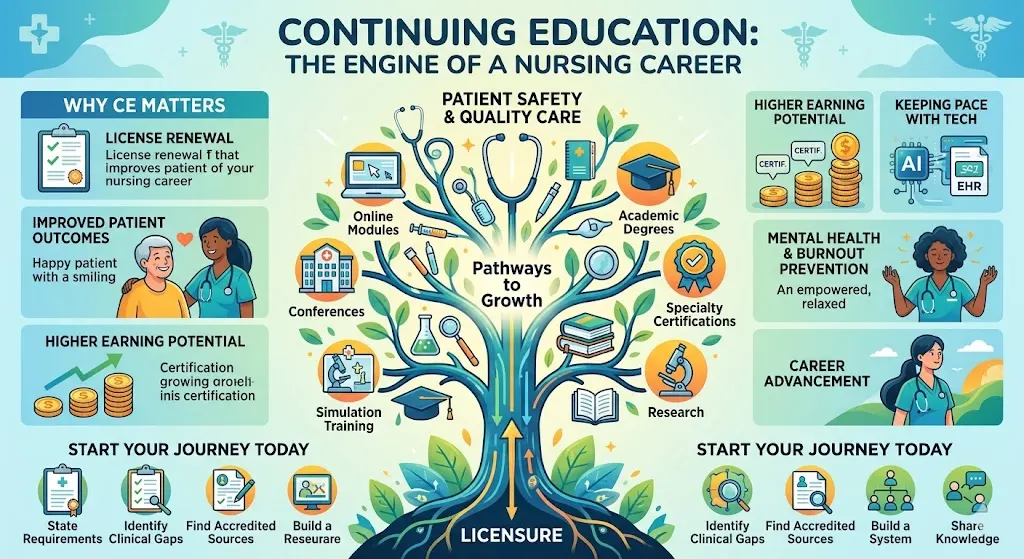
Picture this: a patient comes in with symptoms that five years ago might have been misdiagnosed. But today, a nurse who spent her lunch break completing a 2-hour online module on emerging sepsis indicators catches it early. Fortunately, this patient goes home in 2 days instead of spending three weeks in the ICU. The nurse? She did not perform surgery. She did not prescribe any medicine. All she did was keep learning, highlighting the importance of continuing education for nurses in saving lives.
I have been a registered nurse for over eleven years now. I have worked day and night. I have cried in the parking lot. I have sat in a hospital’s conference room taking a continuing education seminar on pain management, wondering if I could have slept instead.
I am telling you this very honestly: education always wins. Not because it was exciting every time (it was not). But because every single course I have taken has given me something which I did not have before. Also, I can trace patient outcomes directly back to the knowledge I acquired outside of my nursing degree.
This blog is for nurses who are tired, sceptical, or short on time. It is also for new nurses who are just starting to think about what a long career in this profession might look like. For now, keep in mind that the importance of continuing education for nurses goes beyond a checkbox on your license renewal form. It is the engine that keeps your career – and your patients – alive and well.
What is Continuing Education in Nursing?
If you are wondering why continuing education is for nurses, then here is what you need to know:
Nursing continuing education refers to the process of acquiring new knowledge and skills beyond the basic nursing education. It is a commitment to ongoing professional development, which ensures that nurses provide the highest quality of care, emphasising the importance of continuing education for nurses.
It is a broad umbrella. You will find everything from a 1-hour online module about infection control to a full Master of Science in Nursing program.
Besides that, a nurse also uses reflective tools such as the Driscoll Model of Reflection to turn their CE experiences into structured learning, clinical insight, and emotional resilience.
Furthermore, this offers an opportunity for registered nurses to build upon their education and experience and develop their abilities and knowledge throughout their careers.
In practical form, Continuous Education (CE) can look like:
| CE Format | Examples | Typical Contact Hours | Best for |
|---|---|---|---|
| Online modules | Wound care update, pharmacology, EHR training | 1-10 hours | Busy working nurses |
| Conferences and seminars | ANA Annual Conference, speciality summits | 6-30 hours | Professional networking |
| Hospital-based training | In-services, simulation labs, skills fairs | Varies | Hands-on clinical skills |
| Academic coursework | BSN, MSN, DNP, post-master’s certificate | Credit hours | Major career transitions |
| Specialty certification | CCRN, CPN, CNOR, CWOCN | Exam + ongoing CE | Clinical specialisation |
| Peer-reviewed study | Journal clubs, research participation | Varies | Evidence-based practice |
Table 1: Common formats for nursing continuing education and their typical use cases.
Continuing Education (often called CE in short) consists of formally structured training that helps nurses develop new skills and stay up-to-date with important advancements happening in the field and understand the importance of continuing education for nurses.
The State of Nursing Right Now: Why Learning Cannot Wait
Before we talk about why CE matters, first, let us analyse how nurses are operating currently in the field. Understanding the bigger picture makes the urgency of ongoing learning undeniable.
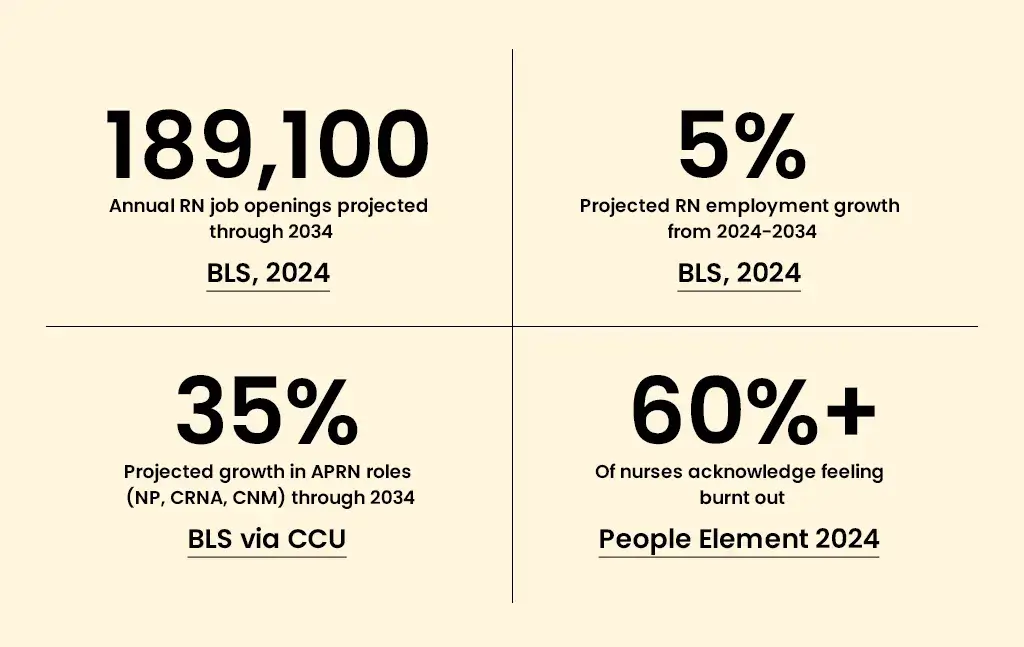
The WHO report states that 4.5-6 million new registered nurses will be needed by 2030 to address the current nurse shortage. Meanwhile, Nursing in Practice in 2025 has clearly stated that more than 40% of nurses are considering leaving the profession completely, due to the broken pay system and limited opportunities for training and development.
Notice that connection. It is not just burnout. It is a lack of growth pathways that is driving nurses out the door. This amplifies the importance of continuing education for nurses.
The healthcare technology has been developing faster than any generation of nurses has experienced. There are new treatment methods and changing patient needs.
- AI diagnostics
- Telehealth expansion
- Genomic medicine
- Changing clinical guidelines
and you name it…
In this situation, a nurse who stopped learning the day she passed her NCLEX is a nurse who is already behind (in some aspects). Therefore, staying updated is not just optional. It has become essential to grasp the importance of continuing education for nurses.
| “The Association for Nursing Professional Development defines ongoing professional learning as “the continual acquisition of professional knowledge, skills, and abilities throughout one’s career.”
American Nurse Journal, citing Harper & Maloney, 2022 |
The Six Reasons Why Continuing Education Matters
1. Your License Depends on It (Literally)
Let us begin with the practical reality. In addition to initial licensure, most states require continuing education for nurses every two to three years. Even though some states do not have continuing education requirements, you still may have to pursue them – employers and certain nursing credentialing bodies may require periodic continued competency training.
The variation between states is important. Here is a brief:
| State | CE Requirement (RN) | Renewal cycle | Special requirements |
|---|---|---|---|
| California | 30 contact hours | Every 2 years | Includes implicit bias training |
| New Jersey | 30 contact hours | Every 2 years | – |
| New York | 3 contact hours infection control | Every 4 years | Varies by specialty |
| Massachusetts | 15 contact hours | Every 2 years | 2 hours plain and symptom mgmt |
| Michigan | 25 contact hours (RN) | Every 2 years | – |
| Washington State | 8 hours CE + 96 hours practice | Annual | 2 hours health equity CE |
| Louisiana | No CE requirement | – | The employer may require |
Table 2: Sample CE requirements by state. Always verify with your State Board of Nursing, as requirements change. Sources: IntelyCare, AAMN, WA Board of Nursing.
Most nurses need 20-30 hours per renewal cycle. In addition, ANCC certification renewal requires 75 CE hours every 5 years.
Missing your CE hours is not just an administrative inconvenience. It can put your license at risk and affect your patients’ safety. This is the key reason for understanding the importance of continuing education for nurses.
| Personal Tip
I learned the hard way early in my career to spend CE hours out across the entire renewal period rather than cramming them in the last month. Not only is it less stressful, but the information actually sticks. I blocked two Sundays a month as “CE time” and treat them like a scheduled shift. Eleven years in, this habit has become as automatic as charting. |
2. Patient Safety – This is the Non-Negotiable One
Every study I have read or mentor I have had; it brings me back to this: nurses who keep learning provide better patient care. It is not subjective.
| A review of 14 research studies published between 2018 and 2024 found that continuing nursing education significantly contributes to the enhancement of nurses’ knowledge and skills. And nurses also develop high levels of self-confidence and proficiency in decision-making through CNE. |
Furthermore, using evidence-based practice promotes a more collaborative approach to care. The variation of care is reduced when all providers are basing their care on the latest evidence.
Variation in care means some patients get the gold standard of care while others do not. This is one of healthcare’s most persistent problems. The good part is that CE is part of what closes this gap.
Moreover, evidence-based practice helps to 1) increase patient safety and improve patient outcomes, 2) reduce healthcare costs, and 3) reduce differences in patient care.
Think about this practically: how many treatments or clinical guidelines have changed since you graduated? If you have been in the nursing profession for more than five years, the answer is: a lot.
There have been many examples of once-common treatments that we now understand to be ineffective or harmful. Nurses are often the primary point of contact for their patients. Therefore, what nurses know or do not know has direct consequences for their patients.
3. Your Career Won’t Wait for You Either
Nurses can move to other settings or be promoted with good performance, experience, and continuing nursing education. Management-level nursing positions often require a graduate degree in nursing or health services administration.
And the financial reward for investing in your education is real:
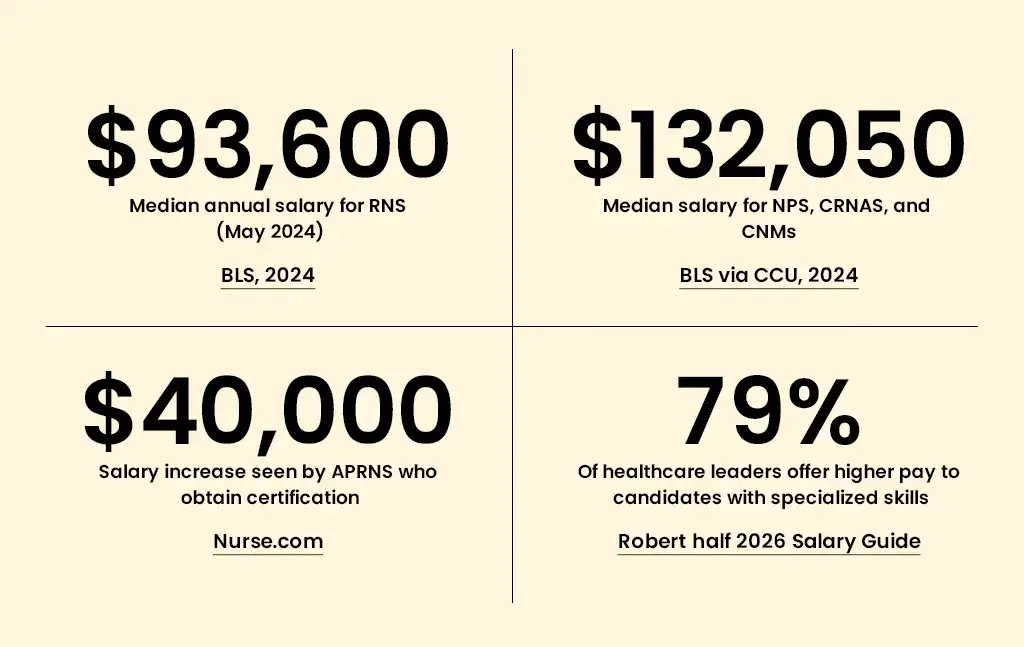
Certification resulted in a $13,482 salary bump for LPNs/LVNs. APRNs saw the largest gain with certification that leads to a $40,000 increase. (Source: Nurse.com)
Moreover, over 30% of all nurses plan to pursue a degree. And among RNs, nearly half (almost 48%) plan to earn an MSN.
Continuing nursing education supports what is known as the nursing career lattice. This is a modern approach to career development. It not only recognises upgradation but also lateral movements into new specialities and practice areas.
For example, some nurses choose to pursue a BSN or MSN through the cheap universities in the UK. They effectively combine work-based CE with degree-level study that still fits within their budget.
In other words, CE is not only about climbing a ladder. Sometimes it is about finding a completely new door you did not know existed. This is why it is crucial to understand the importance of continuing education for nurses.
4. Technology Is Moving Faster Than Any Of Us Anticipated
Electronic health records (EHRs) were still a unique innovation in many hospitals when I started after graduation. But today, EHR proficiency is table stakes. And tomorrow it will be AI-assisted clinical decision support, genomics-informed care plans, and remote patient monitoring at a scale we are only beginning to understand.
The global electronic health record market size is calculated at USD 37.92 billion in 2024. In addition, it is expected to be worth of $43.66 billion by 2034. (Source: BioSpace).
So wearable technologies are changing how health data is monitored – devices that track vital signs allow nurses to quickly respond to changes in patients’ condition.
Hence, nurses who do not keep up with these technologies not only fall behind professionally – they become a liability to patient safety. Therefore, you must understand the importance of continuing education for nurses in tech adaptation.
The nurse who does not understand how to interpret a continuous glucose monitor alert. Or who does not understand that a new infusion pump interface creates risk. Continuing education is where those gaps get filled before they become problems.
| From the Floor
When our unit adopted a new sepsis protocol linked to our EHR early warning system, I signed up for the in-service three times. The first time, I learned what the system did. The second time, I learned how to respond faster. The third time, I started teaching other nurses. That third session – the one where I was teaching – is when I truly owned the knowledge. Consider repeating modules when the stakes are high. |
5. Speciality Certifications: The Single Best Investment You Can Make
If you have been a nurse for a couple of years and have not thought seriously about speciality certification. I want you to pause and consider the importance of continuing education in nursing.
The evidence is clear, and the financial case is compelling.
| Certification | Full name | Certifying body | Specialty area |
|---|---|---|---|
| CCRN | Critical Care Registered Nurse | AACN | Critical Care/ICU |
| CPN | Certified Pediatric Nurse | PNCB | Pediatrics |
| CNOR | Certified Perioperative Nurse | BCEN | Operating Room |
| OCN | Oncology Certified Nurse | ONCC | Oncology/ Cancer Care |
| CWOCN | Certified Wound Ostomy Continence Nurse | WOCNCB | Wound/ Ostomy Care |
| PMHNP-BC | Psychiatric-Mental Health NP | ANCC | Mental Health (APRN) |
| FNP-BC | Family Nurse Practitioner | ANCC | Primary Care (APRN) |
Table 3: Popular nursing certifications by speciality. Sources:Wanderly, ANCC, and respective certifying bodies
Studies have shown a positive link between certifications and higher earning potential for RNs. Certifications provide in-depth training in specific areas. This makes nurses true experts in their chosen fields.
| According to the Robert Half 2026 Salary Guide, 79% of nonclinical healthcare leaders say they typically offer higher salaries to candidates with specialised skills than to those without them in the same role. |
6. Continuing Education Protects Your Mental Health
This is the one people do not talk about enough. And I feel strongly about it.
Over 60% of nurses acknowledge the feeling of burnout. And 40% are considering leaving this profession completely. The factors behind this include increased workloads, a shortage of staff, and limited opportunities for training.
Here is what I have noticed in my own career and in conversations with hundreds of colleagues over the years: the nurses who feel most burned out are often the ones who feel most stuck. Did not get it? Let me explain.
They are doing the same tasks in the same way, without any growth or variation. Hence, continuing education – a new certification course, a conference, even a lunch-and-learn – breaks that cycle. It reconnects you with why you opted for this profession and helps you understand the role of a nurse in health education.
So when you finish a tough CE course, there is a real sense of achievement. And when you use that new knowledge in a patient case? That is the moment that makes you remember why you chose this career. This is a hidden gem in the importance of continuing education for nurses.
What the Research Actually Says About CE Effectiveness
Let us be honest about something: not all continuing education is created equal.
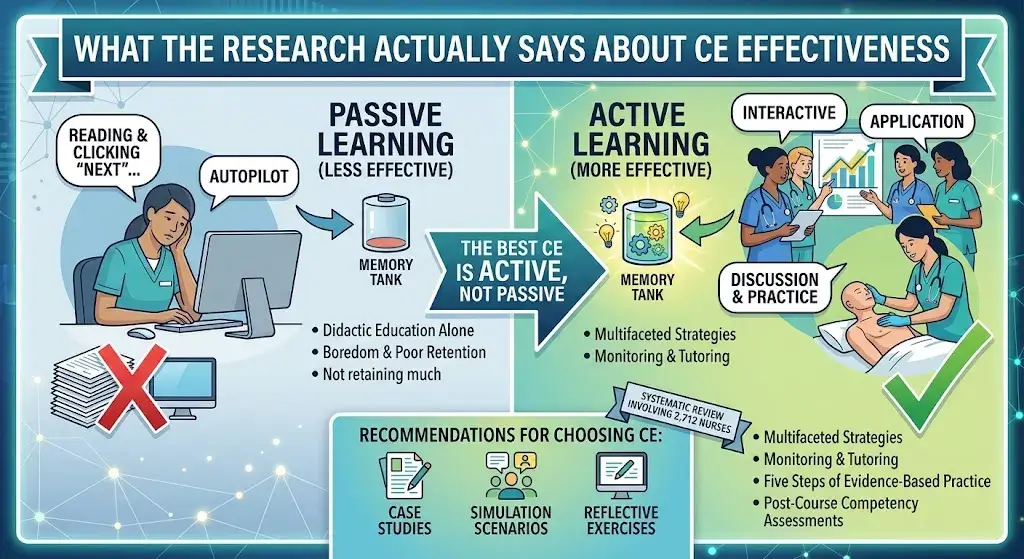
A nurse sitting through a lecture they do not care about or clicking through slides on autopilot is probably not learning much. The research supports this nuance.
Interactive education (used in combination with other practice-supporting strategies) has more positive effects on improving evidence-based practice than does didactic education alone.
In simple words: the best CE is active, not passive. It involves application, discussion, simulation, or hands-on practice – not just reading and clicking “next.”
Three types of effective educational interventions were determined in a systematic review involving 2,712 nurses. These are:
- Multifaceted educational strategies incorporating monitoring and tutoring.
- Single educational strategies (often delivered online).
- Multifaceted educational strategies using the five steps of evidence-based practice.
What does this mean for you? When choosing CE courses, look for those that include 1) case studies, 2) simulation scenarios or 3) reflective exercises.
Remember: A course that asks you to apply knowledge to a patient case is worth more than one that simply presents information. So always look for programs with post-course competency assessments, and not just satisfaction surveys.
Pathways: What Does CE Actually Look Like at Different Career Stages?
Continuing education is not a one-size-fits-all prescription. What makes sense at year two of your nursing career looks very different from year fifteen.
Here is a rough framework:
| Career stage | Years in practice | Recommended CE focus | Potential next step |
|---|---|---|---|
| New graduate | 0-2 years | Clinical skills consolidation, EHR fluency, safety protocols, ACLS/BLS certification | First speciality certification eligibility |
| Developing clinician | 2-5 years | Speciality CE in chosen area (ICU, peds, oncology), first speciality certification | Preceptor training, charge nurse roles |
| Experienced nurse | 5-10 years | Advanced certifications, leadership coursework, and possibly RN-to-BSN or MSN pursuit | NP/CRNA/CNS programs, nurse education, management |
| Senior clinician/ leader | 10+ years | Healthcare administration, policy, DNP, research, mentorship training | CNO, nurse educator, consultant, advanced research roles |
Table 4: CE pathways by career stage in nursing. Frameworks based on ANDP professional development models and BLS occupational data.
If someone asks why continuing education is important for nurses. The answer is simple.
Nurses need to prioritise CE for their professional growth and development. In addition, they also get up-to-date education about the ongoing happenings. These components help you meet the license requirements.
A Note on Burnout, Growth, and Staying in the Profession
Here is something I genuinely believe that comes from my eleven years of experience and research on the importance of continuing education for nurses: the nurses who stay are the ones who never stop being curious.
Not every nurse needs to pursue a doctorate or a leadership role. I did not immediately begin practice after my graduation. But every nurse needs to feel like they are growing and learning something. This is it.
The relationship between CE and burnout reduction is not just my anecdote. Continuing education may develop high levels of self-confidence and proficiency in decision-making. Also, new technology and recent educational tools may strengthen nurses’ motivation to participate in continuing education programs.
Also, confidence reduces anxiety. Mastery in a field reduces the feeling of drowning. And motivation, that is the thing that keeps you coming to work.
I think about the nurses I have watched retire after 30 or 35 years. Those who looked most fulfilled – the ones who were not just counting down the days – were the ones who had kept reinventing themselves along the way.
A wound care nurse who became a wound care educator. An ICU nurse who earned her NP and started working in a palliative care role. A floor nurse who became a quality improvement specialist because she took a CE course on patient safety metrics and got obsessed.
None of these paths was obvious at the start. CE opened every single one of them.
How to Get Started (or Get Restarted)
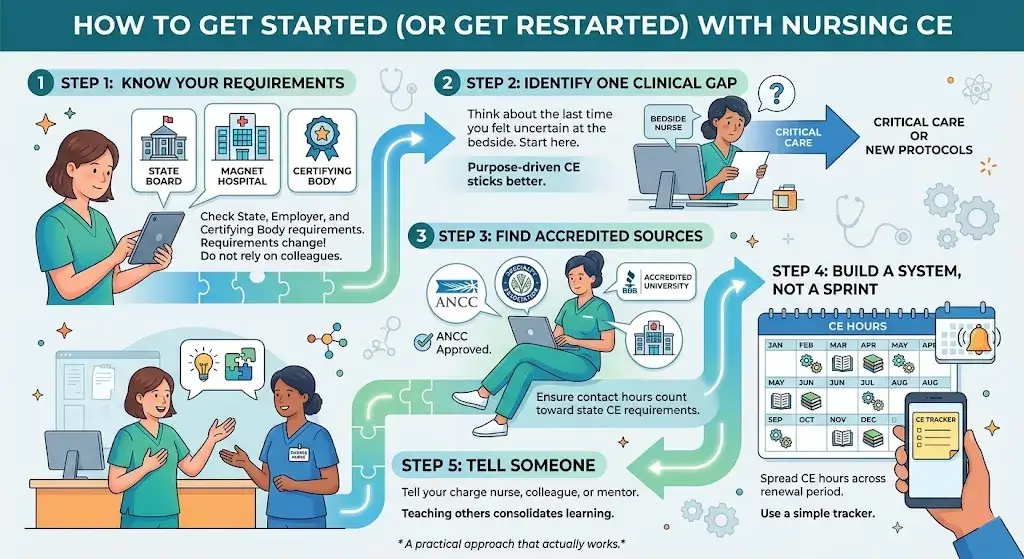
Here is a practical approach that actually works if you have been putting CE off (and most of us have at some point):
Step 1: Know Your Requirements
Check the current CE requirements for your state board of nursing. Do not rely on what your colleague told you last year. Because requirements change, you must understand the importance of continuing education for nurses in recent times.
Magnet hospitals or speciality certifications like medical-surgical and critical care have specific requirements for continuing education. Check all three levels: state, employer, and certifying body.
Step 2: Identify One Clinical Gap
Think about the last time you felt unsure at the bedside. What topic made you hesitate? Start here. Tenacious CE works better than randomly selecting a module.
Step 3: Find Accredited Sources
An ANCC-approved continuing education course ensures that contact hours count toward state CE requirements. Reliable sources include:
- Speciality nursing associations.
- Accredited universities.
- Hospital-based education departments.
Our Experts Can help you with Finding Credible & 100% Authentic Sources, quickly!
Personalize help available in the nursing field for any type of task at the lowest pricing with exclusive features and amazing services that are quick but without errors.

Step 4: Build a System, Not a Sprint
Distribute your CE hours evenly through the renewal period. Use a simple tracker. It could be a note on your phone that works fine. Set a calendar reminder once a month for CE time.
Step 5: Tell Someone
Accountability works every time. Here is what you can do: tell your charge nurse, a colleague, or your mentor what you are studying. Teaching others (even informally) makes your own learning faster than any other method.
Final Thoughts
Nursing is not a degree you earn once and apply forever. It is a living practice – one that helps you grow as healthcare grows, learn as medicine learns, and adapt as patients and their needs change. Lifelong learning in nursing is even more important in today’s time, when tech is evolving faster than ever.
And remember: You do not have to do it all at once. You do not have to earn a doctorate to prove yourself. But you do have to keep moving. Because the moment a nurse stops learning is the moment the gap between what she knows and what her patients need starts to widen. And in this profession, that gap has real consequences.
Start with one course. One conference. One journal article you read all the way through. Then another. That is all it takes to begin and to keep going.
The patient you have not met yet is counting on the nurse you are still becoming.
FAQs
Is continuing education (CE) mandatory for all nurses?
Yes, continuing education (CE) or Continuing Professional Development (CPD) is mandatory for most nurses to maintain their licensure. However, the requirements vary by location. In the UK, nurses must complete 35 hours of CPD every 3 years of revalidation.
Why is continuing learning important in nursing?
Continuing education in nursing is important to ensure patient safety, improve care through evidence-based practice and maintain regulatory registration. This also helps nurses to stay updated with the recent medical advancements and technology while fostering professional confidence.
What are the 5 principles of CPD?
The five principles of Continuing Professional Development in health and social care are:
- Individual responsibility and employer support
- Benefit service users
- Improve quality
- Balance and relevant
- Recorded and effective
How many hours is equal to 1 CEU?
One continuing Education Unit (CEU) is typically equivalent to 10 contact hours of participation in an organised continuing education experience under responsible censorship, capable direction, and qualified instruction. A contact hour is defined as 60 ins of instruction.
- 1 CEU = 10 hours
- 0.1 CEU = 1 hour
Is 40 too old to train as a nurse?
No, 40 is not too old to train as a nurse. There is no age limit. And mature students are often seen entering the profession. They bring valuable life experience, emotional intelligence, and strong motivation. Many nursing students begin in their 40s or 50s and successfully balance studies with life commitments.
Which nurse has the highest burnout rate?
Emergency Room (ER) and Intensive Care Unit (ICU) frequently experience the highest burnout rates due to high-acuity and fast-paced working spaces. Moreover, nurses working in paediatrics, oncology, dialysis, and progressive care (PCU) also show a high burnout rate.
Does my BSN or MSN count as continuing nursing education?
Yes, a BSN and MSN typically count as continuing nursing education (CNE) or professional development requirements. These advanced degrees improve your knowledge and skills and are the core components of CPD for revalidation.
How should I keep track of my completed CE hours?
It is important to keep track of completed continuing education (CE) hours for license renewal and professional development. The best strategy to do so is to digitise records immediately, so you do not lose the paperwork. Also, use a centralised system to track progress toward renewal goals.