
 By
By The reflective practice plays a crucial role in professional growth. Moreover, it is essential for healthcare professionals where decision-making can directly impact patient outcomes. The nurses encounter complex clinical situations daily. That’s where structured reflection helps them. It allows the nurses to learn from experience, improve their practice, and enhance patient safety. That’s where the Gibbs Reflective Cycle comes in.
It is one of the most widely used reflection models in healthcare. Furthermore, this structured framework enables nurses and healthcare experts to analyse their experiences systematically, understand their emotions, analyse their actions, and develop strategies for improvement.
But What is the Gibbs Reflective Cycle?
In this comprehensive guide, we will explore what the Gibbs Reflective Cycle is, its six stages, its application in nursing and healthcare, advantages and disadvantages, along with real-world examples. We will also discover how to write the essay using the Gibbs Reflective Cycle.
Come on! Let’s get into the blog.
What is Gibbs’ Reflective Cycle?
The Gibbs Reflective Cycle was developed by Graham Gibbs in 1988 as part of his book Learning by Doing. Think of it as a reflective practice that provides a structured six-stage model designed to guide individuals through reflective thinking after an experience.
The purpose of the model is to:
- Encourage systematic reflection
- Furthermore, it helps promote continuous professional development
- It even improves the future performance
- Moreover, it enhances critical thinking
The cycle consists of six stages:
- Description
- Feelings
- Evaluation
- Analysis
- Conclusion
- Action Plan
The Gibbs Reflective Cycle in Nursing is known for its clear structure and easy-to-follow format. From education to nursing and healthcare settings, this reflective cycle is widely used.
Gibbs Model of Reflection: The 6 Stages Explained
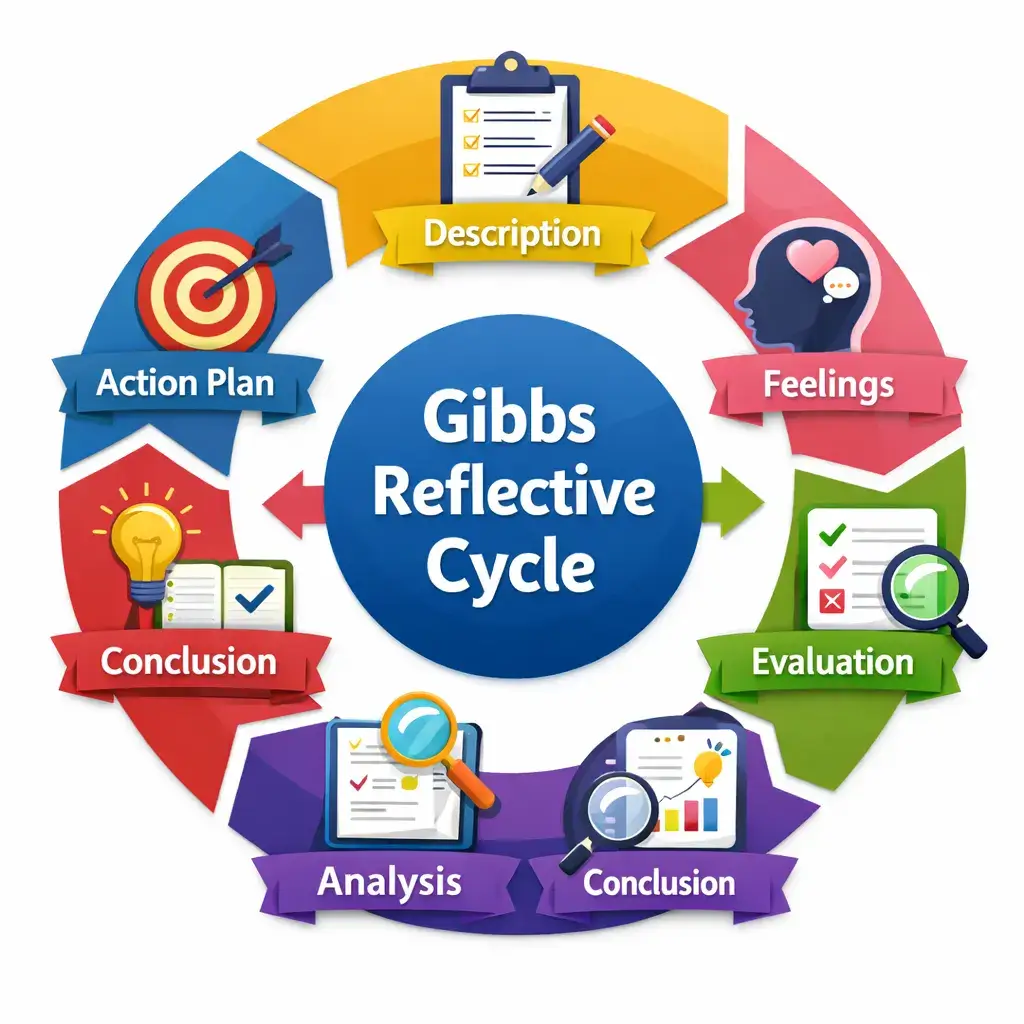
To help you learn more about the Gibbs Model of Reflection, let us explain the 6 stages to you. They include:
1. Description
This stage answers the question: What happened?
Furthermore, you have to provide an objective summary of the event without any judgment. In nursing, it usually involves describing a clinical situation, patient interaction, and team communication issues.
While writing the description, make sure to follow the key points like:
- Stick to facts
- Avoid opinions
- Maintain patient confidentiality
2. Feelings
In this stage, you have to explore your thoughts and emotions that occurred during the event,
In healthcare, emotional awareness is very important. Many nurses may experience anxiety, confidence, frustration, or uncertainty during clinical situations. Thus, recognising these emotions can help you identify the personal biases and areas for improvement.
3. Evaluation
This stage considers:
- What went well?
- What did not go well?
In Gibbs Reflective Cycle in Nursing, evaluation can help nurses identify strengths and weaknesses in clinical practice.
4. Analysis
This is the critical thinking stage.
You examine:
- Why things happened the way they did
- What theory or evidence explains the situation
- How are clinical guidelines applied
Hence, you need to link the practice to evidence-based nursing to strengthen professional development.
5. Conclusion
In this stage, you have to ask yourself:
- What else could I have done?
- What have I learned?
In this step, you need to consolidate your learning and identify the alternative strategies.
6. Action Plan
This is the final stage, which focuses on improvement. You need to ask yourself:
- What will I do differently next time?
- What skills do I need to develop?
This is the action-oriented approach, which makes the Gibbs model highly practical in healthcare settings.
Reflective Writing Giving You a Tough Time?
Students often struggle to work on their reflective writing because they have no clue how to apply their learning. In that case, you should consider seeking guidance from the Reflective Essay Writing Services.

What is Gibbs’ Reflective Cycle In Nursing?
Reflective practice is a fundamental part of nursing. Furthermore, the Gibbs Reflective Cycle in Nursing supports:
- Improved patient safety
- Better clinical decision-making
- Enhanced communication
- Professional accountability
- Continuous Professional Development (CPD)
Furthermore, nurses need to make sure that they meet regulatory standards and show reflective learning as part of relevance. Sometimes, it is also a professional practice requirement.
Example Scenario in Nursing
To help you understand the Gibbs Reflective Cycle, here is an example to help you understand.
Let’s imagine you are a nurse administrator whose job is to administer medication and later realizes the patient experienced mild side effects.
Hence, you considered using the Gibbs model to reflect on:
Here is what you did:
- What happened (description)
- Their anxiety (feelings)
- What is the correct dosage and what delayed documentation (evaluation)?
- Importance of timely record-keeping (analysis)
- Why is there a need for better time management (conclusion)?
- Planning to double-check documentation immediately (action plan)
This is the proper structure that can help you reflect on your mistakes and even improve future patient care.
Gibbs Reflective Cycle in Healthcare
The Gibbs Reflective Model is not limited to nursing. Instead, it is also widely used across healthcare professionals, including:
- Doctors
- Physiotherapists
- Paramedics
- Occupational therapists
- Allied health professionals
Additionally, in the broader healthcare settings, this reflection can contribute to your:
- Improved patient safety
- Quality improvement initiatives
- Clinical supervision
- Team learning
- Interprofessional collaboration
The Gibbs Reflective Cycle in Nursing also supports multidisciplinary learning environments. Additionally, it enhances teamwork and communication.
Advantages of Gibbs Reflective Cycle
Whether you are a nurse or working in a healthcare setting, Gibbs Reflective Cycle has many advantages. It includes:
- Clear and Structured Framework: It has a step-by-step structure, which makes it accessible to students and professionals. Furthermore, it is clear and easy to follow.
- Encourage Deep Reflection: The Gibbs Reflective Cycle goes beyond simple storytelling. Instead, it promotes critical analysis.
- Focus on Emotional Awareness: Using this cycle helps you understand your emotions better. This in return improves empathy, communication and emotional intelligence in nursing.
- Action-Oriented Approach: Having the final action plan can help ensure continuous improvement rather than passive reflection.
- Widely Accepted in Academia: The Gibbs model is commonly required in Nursing Assignments. Thus, this makes it practical for academic use. Well, if you ever face a problem in this, you can seek guidance from professional reflective essay writers.
Disadvantages of Gibbs Reflective Cycle
While the Gibbs Reflective Cycle has its own perks, there are also some disadvantages that you need to be aware of. They include:
- Time-Consuming: Well, it requires six stages. Hence, the detailed reflection can be hard in busy healthcare environments.
- May Feel Repetitive: Following the same structure that is applied to every situation can feel repetitive.
- Overemphasis on Feelings: This reflective cycle focuses on emotions. Well, sometimes professionals prefer more analytical frameworks.
- Risk of Being Too Descriptive: Students may sometimes focus too much on narration rather than on critical analysis.
- Not Ideal for Complex Cases: In the highly critical or ethical dilemmas, more advanced reflective models may be required.
Example of Gibbs Reflective Cycle in Nursing Practice
Scenario: Communication Breakdown
1. Description:
During a shift handover, I failed to clearly communicate a patient’s allergy status.
2. Feelings:
Since I was doing the double night shift, I was tired and felt rushed. Moreover, I was slightly overwhelmed by workload pressures.
3. Evaluation:
While the rest of the handover was accurate and smooth, I missed the allergy information which posed a safety risk.
4. Analysis:
Effective communication is the core of better patient safety. Evidence-based practice emphasises structured handover tools such as SBAR.
5. Conclusion:
I came to the conclusion that I should have followed a structured checklist to make sure no vital information was missed.
6. Action Plan:
I created a plan, which was that I would implement a standardised handover format and allocate focused time for communication during shift changes.
This detailed example shows how the Gibbs Reflective Cycle in Nursing can strengthen your accountability. Moreover, it plays a great role in professional growth.
Gibbs Reflective Cycle Vs Other Reflection Models
If we compare the Gibbs Reflective Cycle with other reflection models;
- Gibbs provides a clear emotional exploration
- Additionally, some models are more theory-focused
- Others are shorter and less detailed
Gibbs Reflective Cycle is a structured six-stage approach that makes it suitable for nursing students and early-career professionals.
Gibbs Reflective Cycle Vs Driscoll Model of Reflection
The Driscoll Model of Reflection is another great reflective model used in nursing. Moreover, it was discovered by John Driscoll in the 1990s and 2000s.
This follows a simple approach of three key questions. Therefore, it is often compared with the Gibbs Reflective Cycle.
Come on! Let’s have a look at them:
| Feature | Gibbs Reflective Cycle | Driscoll Model of Reflection |
|---|---|---|
| Structure | Six structured stages | Three core questions |
| Depth of Reflection | Detailed and comprehensive | Concise and focused |
| Emotional Exploration | Strong emphasis on feelings | Limited emotional focus |
| Ease of Use | Ideal for students and structured essays | Simple and quick to apply |
| Academic Use | Common in nursing assignments | Used in practice settings |
| Action Planning | Clear action plan stage | Included in “Now What?” |
| Time Required | More time-consuming | Less time-intensive |
Gibbs Reflective Cycle Reference (APA Example)
Here is how you can reference the Gibbs Reflective Cycle using the APA format. It includes:
APA Reference:
Gibbs, G. (1988). Learning by Doing: A Guide to Teaching and Learning Methods. Oxford Polytechnic.
In-text citation example:
(Gibbs, 1988)
Harvard reference format:
Gibbs, G., 1988. Learning by Doing: A Guide to Teaching and Learning Methods. Oxford Polytechnic.
How to Write a Gibbs Reflective Essay (Step-by-Step)?
Here is how you can write a Gibbs Reflective Essay step-by-step.
- Start with a brief introduction. Make sure to tell the readers why you are writing this essay. Also, use a real-world scenario for better understanding.
- Clearly structure the six stages as headings like Description, Feelings, Evaluation, Analysis, Conclusion, and Action Plan.
- Maintain patient confidentiality. Furthermore, you should ask your patients if they are comfortable sharing their information.
- Use professional academic language. Also, keep your language simple and avoid jargon.
- Additionally, make sure to support analysis with scholarly references
- Lastly, end with a strong action plan.
- If you are facing any troubles in writing the Gibbs Reflective Essay, consider seeking help from the professionals.
Make sure to avoid purely descriptive writing. Also, make sure that you have included the critical analysis. To learn more about how to write a reflective essay using different models, consider reading our blog: How to Write A Compelling Reflective Essay in Nursing?
Tips for Nursing Students
Before we end the guide, here are some tips for nursing students while following the Gibbs Reflective Cycle. They include:
- Make sure to reflect on real clinical experiences
- Furthermore, be honest yet professional
- You should also link practice to nursing theories
- Follow the university marking criteria
- Lastly, you should proofread carefully
Always remember that using the Gibbs Reflective Cycle in Nursing correctly can enhance your chances of getting good grades. Moreover, it is essential for clinical competence
Conclusion
This brings us to the end of the guide! The Gibbs Reflective Cycle in Nursing remains one of the most practical and widely used reflection models in healthcare.
Furthermore, it has a structured six-stage approach which helps promote critical thinking, emotional awareness, and continuous professional development.
Therefore, by applying this model effectively, nurses can improve patient safety, enhance clinical competence and strengthen professional accountability.
Frequently Asked Questions
Q No.1: What is the Gibbs Reflective Cycle?
It is a six-stage reflection model developed in 1988 by Graham Gibbs to guide structured learning from experience.
Q No.2: Who developed the Gibbs Reflective Cycle?
Graham Gibbs developed the model in 1988.
Q No.3: What are the six stages?
The six stages of the Gibbs Reflective cycle includes Description, Feelings, Evaluation, Analysis, Conclusion, Action Plan.
Q No.4: Why is Gibbs Reflective Cycle important in nursing?
The reason this reflective cycle is essential is that it improves patient care, professional development, and clinical decision-making.
Q No.5: How is Gibbs Reflective Cycle used in healthcare?
The reflective cycle is used in healthcare because it supports reflective practice, quality improvement, and professional development.
Q No.6: What is the difference between Gibbs and other models?
Gibbs includes emotional reflection and structured action planning.
Q No.7: How do you reference the Gibbs Reflective Cycle?
To reference the Gibbs Reflective Cycle, make sure to use APA or Harvard referencing formats as shown above.
Q No.8: Is it suitable for academic assignments?
Yes, it is widely accepted in nursing education.