 By
By Reflection is a key skill in nursing and healthcare. Not only is it essential for personal development, but it also helps professional nurses learn from their experiences, improve patient care, and grow in confidence. One of the most popular frameworks that students and nurses use in healthcare is Driscoll Model of Reflection, created by John Driscoll.
You must be wondering what it is?
Well, in this blog, we will explain everything you need to know about the model. Furthermore, you will also learn what it is, why it is used in nursing, its benefits, examples, advantages, disadvantages, and how to use it in assignments.
So, what are you waiting for?
Let’s get into the blog.
What Is Driscoll Model of Reflection?
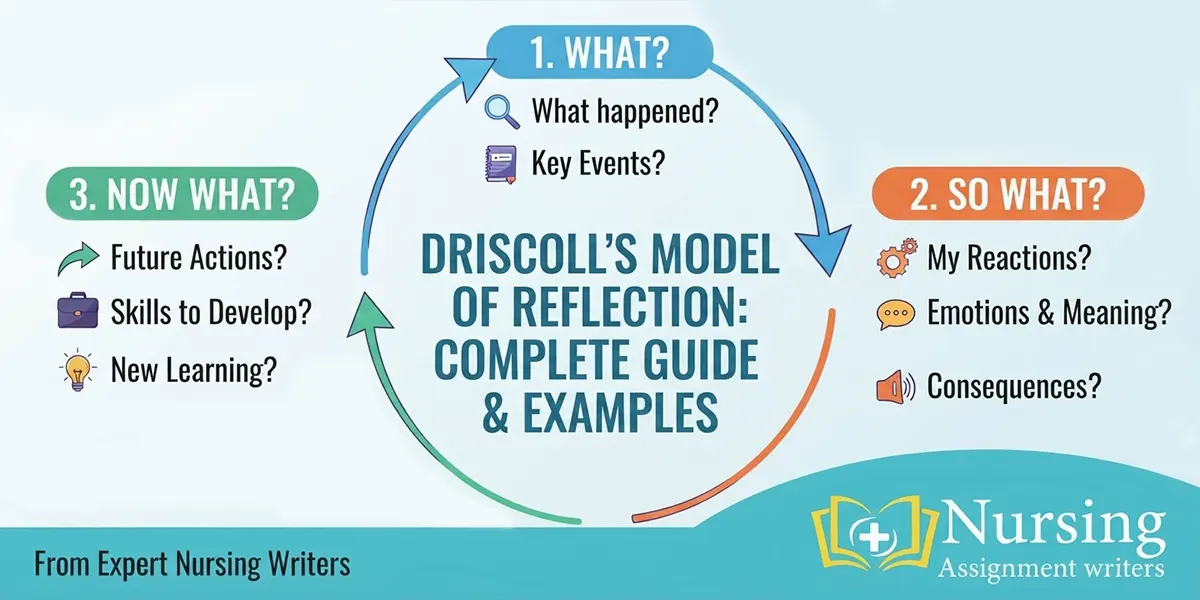
Driscoll Model of reflection is a simple framework used by nurses and students to think about experiences, learning from them. Furthermore, it was developed by John Driscoll in 1994 and was revised in 2004 or 2007 to become the simplest framework of reflective writing. This reflection model is based on three basic questions, including:
- What?
- So what?
- Now what?
These are the three questions that help nurses and students break down their past experiences, understand them, and decide what to do differently next time.
Additionally, this model is widely used in nursing education because it is:
- Easy to understand
- Quick to apply
- Effective for learning from real situations
The best part is that it is helpful for reflective essays, clinical placements, and professional development.
The Three Stages of Driscoll Reflective Model
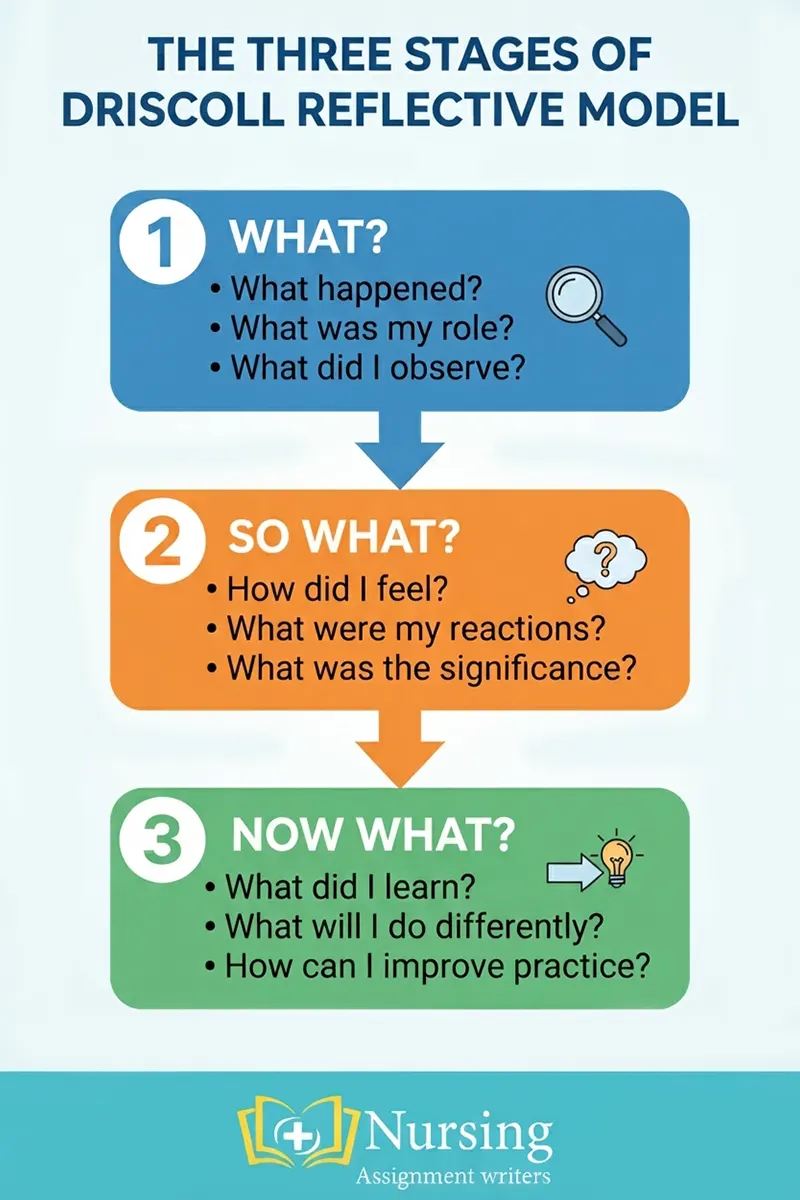
As we previously talked about, the Driscoll reflective model has three stages. They include:
- What or Description
- So What or Analysis
- Now What or Action Plan
Come on! Let’s dive deep into the details about them.
What? (Description)
This is the first stage in the reflection model, which is used to describe the situation without judging yourself. Furthermore, you have to ask yourself questions like:
- What happened?
- Who was involved?
- What did I do?
- What did others do?
The main point of this section is to provide a factual account of the events that occurred to you to help you reflect on them properly.
For example:
During my shift, a patient pressed the call bell several times. I went to check and found they were in pain after surgery. I informed the senior nurse and helped reposition the patient.
Think of this stage as the foundation for reflection because you can’t analyze or improve something unless you first understand what actually happened.
So What? (Analysis)
In this step, you reflect on the meaning of the experience. Furthermore, you get to understand why this particular situation matters and what you can learn from it. You have to ask yourself questions like:
- Why was this essential?
- How did I feel?
- What did I learn?
- What went well or badly?
This stage helps you develop critical thinking skills. Moreover, you become more self-aware of your feelings.
For example:
I realized the patient’s pain could have been managed earlier if I had checked on them more frequently. I was concerned that they had to press the bell repeatedly. I learned the importance of regular patient monitoring.
This stage can help you understand the situation and turn the experience into a learning opportunity.
Now What? (Action Plan)
This is the most important stage of the Driscoll Model of reflection because it focuses on improvement. You are constantly thinking of the future and what actions you can take. Therefore, ask yourself:
- What will I do differently next time?
- How can I improve?
- What skills do I need to develop?
This stage helps you turn the reflection into real learning and leads to change.
For example:
Next time, I will check postoperative patients more frequently and ask about their pain levels before they need to call for help.
Moreover, the “Now what” stage helps transform your reflection into professional growth and better patient care.
Driscoll Model of Reflection 2007 Version
The Driscoll Model of Reflection (2007) is a refined version of John Driscoll’s framework. Furthermore, it is specifically updated to provide academic depth for healthcare professionals and students. While maintaining the core “What?, So What?, Now What?” pattern, the 2007 update offers clearer prompts to encourage critical analysis over simple description.
Widely used in nursing portfolios and assignments, this model bridges the gap between clinical experience and professional growth. Additionally, it empowers practitioners to transform routine encounters into meaningful learning outcomes. Thus, it ultimately strengthens professional judgment and communication skills.
Why Use Driscoll Model of Reflection in Nursing?
Nursing is a practical profession. Every day, nurses face new challenges, emotional situations, and learning opportunities. Furthermore, the reflection helps them grow professionally and personally.
Why do these three stages matter in nursing?
Together, these stages can help nurses:
- Learn from everyday experiences and think about the future.
- Furthermore, it improves clinical skills.
- Develop communication skills by learning to convey your thoughts clearly.
- Build confidence.
- Provide safer and more compassionate care.
Additionally, Driscoll’s three-step structure is simple, practical, and easy to remember. Hence, it is widely used in nursing education and clinical practice, as nurses can use it quickly even after busy shifts.
Driscoll Model of Reflection in Nursing Practice
This reflection model is not only for the students and their coursework. Instead, it is also considered part of real clinical work. Nurses, doctors, and those starting out with their careers use this to reflect on:
- How did their patient interactions go?
- Medication administration
- Emergency situations
- Communication with colleagues
- Tackling their ethical dilemmas
- Leadership experiences
By reflecting on this, the nurses can enhance their decision-making, think critically, and provide the best patient care, contributing to healthcare.
Need Help with Reflective Nursing Assignments?
If you are struggling with reflective writing, essays or understanding models like Driscoll’s, expert academic support can make things easier. Hire the professional nursing assignment writing services in the UK and start improving your grades.

Driscoll Model of Reflection Example (Nursing)
Here is a simple example of the Driscoll Model of reflection in nursing to help you understand how it works:
Scenario: Communicating with a Patient
Think of it as a scenario where we have to communicate with the patient, conveying information about their sickness and providing the best patient care. Here you will use the three stages.
What?
During my shift, I spoke to a patient named Mark who was quite anxious about his knee surgery. Even after I explained the procedure, he looked quite worried. He had no clue what was going on.
So What?
When reflecting, I realized I used the medical terms that Mark did not fully understand. Thus, I felt I could have communicated better using simple and comforting words. That is when I learned that emotional support is just as important as information, especially when he is going for the surgery.
Now What?
From my past experience and reflection, I learned that next time, I will use simple language and ask patients if they understand. Furthermore, I will also check their emotional state, offer reassurance, and listen to their problems to avoid miscommunication.
Through this example, you can learn why reflection is important and how it can lead to better communication, enhancing the overall patient care.
Benefits of Driscoll Model of Reflection
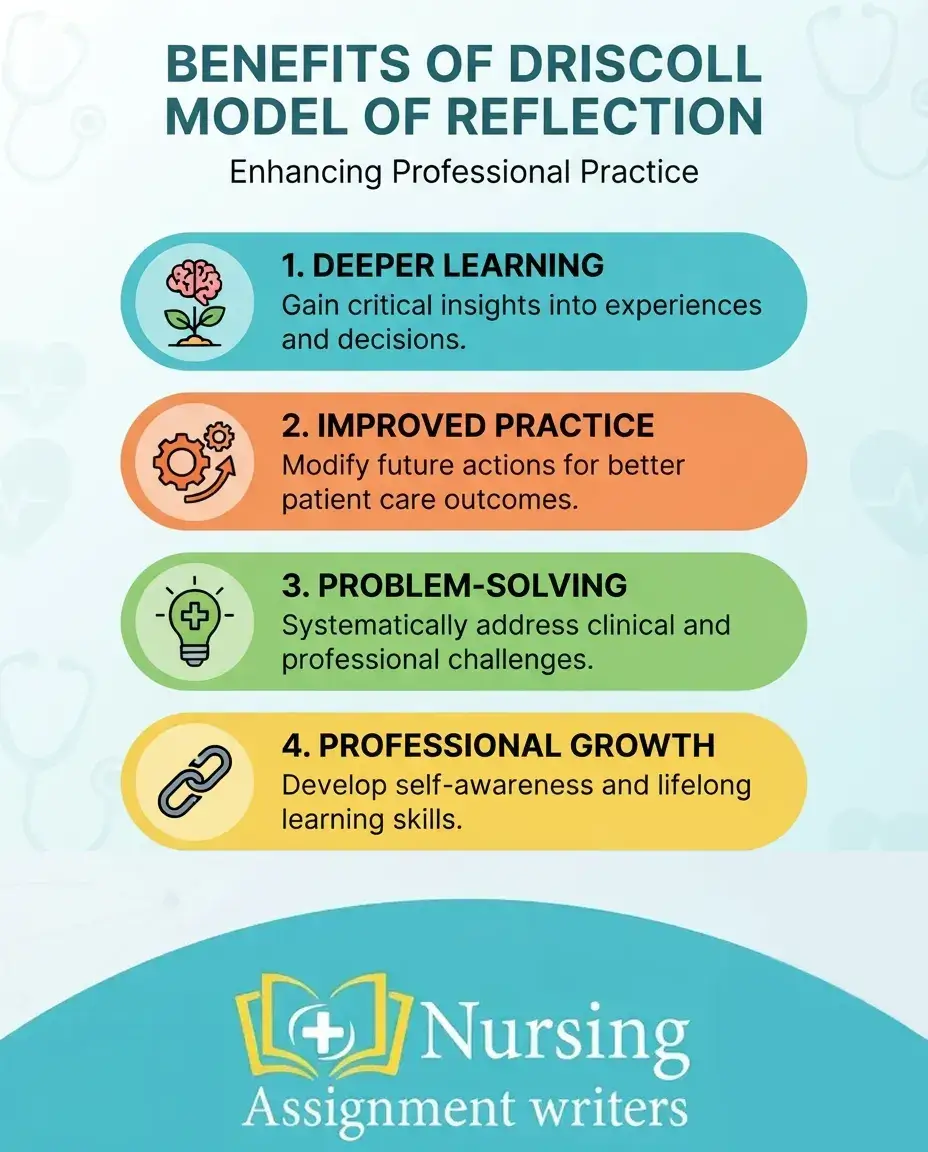
Driscoll model of reflection has many benefits for both nursing students and professionals. They include:
- Simple & Easy to Use: The three-step structure is very simple and structured. Thus, even the beginners can follow this to reflect on their past experiences.
- Improves Learning: Not only in the professional career, but this reflection model is also essential for personal development. It helps students connect theory with practice, providing them with real-world insights.
- Builds Confidence: Reflecting on past experiences and thinking of their future ensures that nurses are more prepared. It even boosts their confidence, allowing them to provide better patient care.
- Enhances Patient Care: Another great advantage of using the Driscoll Model of reflection is that it helps nurses learn from past situations, which ultimately leads to better outcomes.
- Encourages Critical Thinking: By engaging in the reflection, nurses and students learn to analyze their actions. Furthermore, it allows them to think and make effective decisions.
- Supports Emotional Awareness: The best thing about this reflection model is that it helps manage stress and emotional experiences.
- Helps in Academic Assignments: Driscoll Model of reflection is not only for professionals, but it can also even help nursing students with their assignments, providing a clear structure for essays and reports. Here is the thing: If you are a student and have trouble with this Driscoll Model, consider seeking help from Nursing Assignment Writers in the UK.
Disadvantages of the Driscoll Reflective Model
Although the Driscoll Model of Reflection is popular, it has some limitations. Learning about them can enhance your experience:
- Too Simple for Complex Situations: Some experiences require deeper analysis than three questions. Sometimes, you won’t even need them.
- May Miss Emotional Depth: There are other models that can help you explore your emotions in more detail.
- Risk of Superficial Reflection: If used quickly, learning may be limited.
- Not always suitable for the Research: When conducting academic research, you might need more structured frameworks.
While there is no doubt that this model of reflection has its own drawbacks, it still remains widely used because of its simplicity.
Why Is Driscoll Model Good for Nurses?
Nursing involves real-life situations that require quick learning. That is where the Driscoll model of reflection comes in. It helps nurses:
- Reflect on the patient care and identify what worked for them, what needs improvement, and what they can do to improve.
- Learn from mistakes safely.
- Improve communication
- Develop professional judgment
- Adapt to the changing healthcare environments.
What makes this reflection model stand out is that it supports lifelong learning, which is crucial in healthcare.
Driscoll Model of Reflection Example Essay
When it comes to using the Driscoll model of reflection in their assignments, students often struggle with the reflective writing. Here is the a simple essay format that can help them.
Introduction
When working on the a reflection essay, start by explaining what it is and why it matters in nursing. Furthermore, talk about its advantages and drawbacks.
What?
The next step is to describe the event that happened to you recently in a clear manner. Talk about what happened and what went wrong.
So What?
Next, make sure to analyze your experience and feelings. Furthermore, talk about your emotions and what you felt.
Now What?
Once you have reflected on past experiences, explain the future actions and learning.
Conclusion
Lastly, conclude your essay by summarizing the lessons learned.
This is the general reflection essay structure that can help you create organized and meaningful assignments.
Driscoll Model Vs Other Reflective Models
There are different reflective models used in nursing. So, now the question is what makes the Driscoll Model of Reflection better.
Compared with the Gibbs Reflective Cycle
| Driscoll Model | Gibbs Reflective Cycle |
|---|---|
| This model is simpler | Gibbs has more steps |
Compared with the Borton Model
| Driscoll Model | Borton Model |
|---|---|
| Driscoll is based on Borton’s questions | It has adapted for healthcare |
Compared with John’s Model
| Driscoll Model | Johns Model |
|---|---|
| Driscoll is quicker and easier | John’s is deeper and more detailed |
How to Use Driscoll Model of Reflection (Step-by-Step)?
Here are some steps that you need to take while using the Driscoll model of reflection. They include:
- Choose an experience: Pick a real situation from clinical practice or learning. Furthermore, you can even go for past experiences.
- Describe: Explain the event clearly and describe what happened.
- Analyze: Think critically and analyze what it means. Furthermore, reflect on your emotions and lessons.
- Plan: Identify the changes that you need to make for future practice and avoid making the same mistakes.
- Apply Learning: Use your insights and apply them to real situations, especially when working on assignments. This approach can turn your experiences into professional growth.
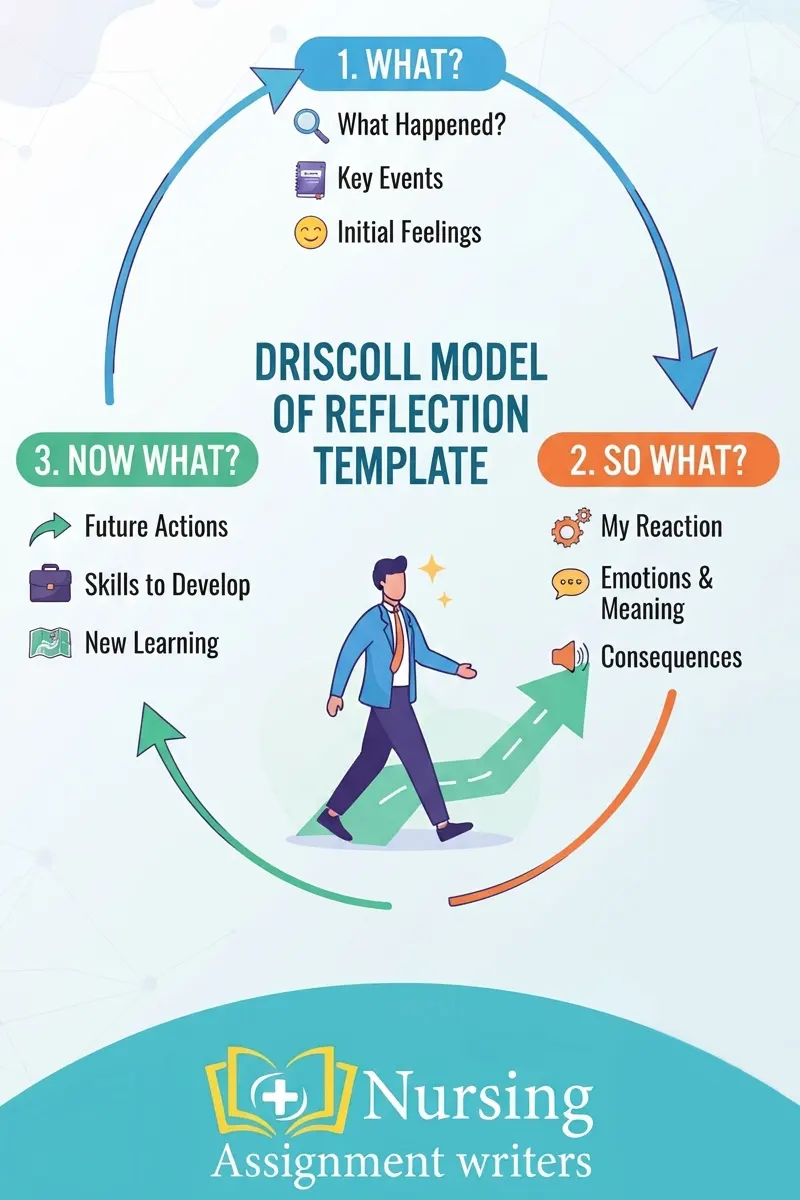
Driscoll Model of Reflection Template
Common Mistakes in Reflective Writing
When it comes to applying the Driscoll model of reflection when working on the assignments, students often make these errors. They include:
- They only describe the events without giving any relevant scenario. Instead, you need to dive deep into the details.
- Furthermore, they don’t analyze their learning.
- Even some students ignore what they are feeling.
- They have no action plan or they are being too general.
Always remember that the reflection must go beyond the storytelling.
Tips for Writing a Strong Reflection
If you want to write a strong reflection assignment or essay, here are some tips that you need to follow:
- Make sure to be honest
- Furthermore, use simple language
- Focus on the learning
- Additionally, connect your theory to practice.
- Make sure to include the future plans
- Always stay structured.
These are some tips that can help you improve your academic work. Furthermore, it also contributes to your professional development.
Role of Reflection in Nursing Education
Reflection helps students:
- Develop clinical skills
- Improve communication
- Understand patient needs
- Build empathy
- Learn from feedback
Furthermore, it prepares the students for healthcare settings.
Real-Life Nursing Reflection Example
Here is a real-life nursing reflection example that can help you understand the Driscoll Model better.
Situation
Here is the situation where a 28-year-old patient named Greg refused to take his medications.
Reflection
Here is what my feelings were.
- I felt frustrated initially.
- Once I reflected deeply on my method, I realized I did not fully explain the purpose of the medication.
- That taught me that the communication could have been better.
Learning
Using the Driscoll model of reflection taught me that patients need understanding and not just the instructions. Also, I realized I used the medical terms, which made it harder for him to comprehend.
Action
Next time, I will make sure to explain everything clearly using simple language, listen to their concerns, and involve the patient in the decisions.
This reflection can lead to better patient-centered care.
Importance of Reflective Practice for Career Growth
Reflective practices play a vital role in career growth as they can help nurses support their long-term success in healthcare. Furthermore, it is also a powerful tool for them because it can:
- Improve decision-making
- Help nurses become leaders
- Develop confidence
- Help them learn from experiences
- Build professional identity
Driscoll Model in Healthcare Beyond Nursing
The Driscoll Model of reflection goes beyond nursing. In healthcare, it can also be used in:
- Social work
- Midwifery
- Physiotherapy
- Teaching
- Counseling
Always remember that any profession that involves human interaction can benefit from these reflections.
Future of Reflective Practice in Nursing
Let’s be real! The healthcare field is changing fast. The reflection will continue to play a key role in:
- Patient safety
- Clinical training
- Emotional resilience
- Professional development
Additionally, there are different digital learning platforms and e-portfolios that now include the reflective tools based on models like Driscoll’s.
Key Takeaways
In a nutshell:
- Driscoll Model of Reflection is one of the simplest and most effective frameworks used in nursing education and practice.
- Furthermore, introduced by John Driscoll in 1994 and revised in 2007, it has become a great reflective writing tool.
- It is a three-step approach – What, So What, and Now What. Additionally, it helps nurses learn from experiences, improve patient care, and grow professionally.
- Whether used for assignments or real clinical situations, this model encourages critical thinking, emotional awareness, continuous improvement, and better decision-making.
Despite some drawbacks, its simplicity makes it ideal for students and practicing nurses. Furthermore, reflection is not just an academic exercise. It is a powerful tool for becoming a better healthcare professional.