
 By
By The first step in any nursing research project is to write a strong research problem statement in nursing. A research problem describes the problem that a researcher wants to study and why it is important to the healthcare industry. If there is no clear research problem, then it will be hard to formulate research questions, select research methods and gain meaningful results.
Nursing research problems may address patient care, health care systems, nurse education, or clinical practices. A clear research problem can be useful in identifying gaps in knowledge and evidence-based practice. For any nursing student or professional researcher, knowing how to write a research problem can enhance the quality of their study.
This blog will discuss what a nursing research problem is, how to write one, examples, common pitfalls and tips for writing a research problem statement.
What is a Research Problem Statement in Nursing?
A problem statement in nursing research is a clear statement that defines a problem that needs to be investigated. Describes the nature of the problem, its impact on others and its significance to nursing practice.
For instance, a hospital can identify that more patients are falling at night. A nurse researcher might choose to study why this is the case and what might be done to change the situation.
Typical problems in nursing research are:
- Patient safety
- Healthcare quality
- Nurse burnout
- Infection control
- Communication issues
- Medication errors
- Mental health support
- Staff shortages
A good problem statement provides direction to the entire research study.
Why is a Research Problem Statement in Nursing is Important?
The research problem is the basis of all nursing research. It can help researchers to remain focused and organised during the research process. Whether you have a quantitative research topic, qualitative or both, this is essential in all.
A solid problem statement should be able to:
- Determine the need for knowledge gaps in health care
- Improve patient care
- Support evidence-based practice
- Help create effective nursing policies
- Improve healthcare outcomes
- Guide future research
Many clinical problems in nursing for research come directly from real healthcare situations. This makes nursing research highly practical and valuable.
Struggling with your Nursing Research Question?
No Worries, Nursing Assignment Writers UK is right here to help you through your nursing research.

Characteristics of a Good Nursing Research Problem
Not all topics make good research problems. A nursing research problem should possess some characteristics.
Clear and Specific
The problem should clearly communicate the issue that is being explored.
Example:
Communication failure between nurses during shift changes will lead to more medication errors.
Researchable
The issue has to be something that can be studied by collecting and analysing data.
Relevant to Nursing Practice
The problem should be directly related to patient care, nursing education, healthcare management or clinical practice.
Significant
The research should relate to an issue that has an impact on healthcare quality or patient outcomes.
Feasible
The problem must be realistic, considering available time, resources, and access to data.
Steps to Write a Research Problem in Nursing
It can be challenging to write a nursing research problem initially, but it can be made easier with a step-by-step approach.
Identify an Area of Interest
Brainstorm and choose a topic you are interested in for your nursing. This may be from clinical experiences, classroom discussions, or healthcare observations.
Examples include:
- Patient safety
- Mental health nursing
- Elderly care
- Emergency nursing
- Nursing education
- Infection prevention
Having a worthwhile subject to research makes research more interesting.
Analyse and Observe Current Healthcare Issues
Notice issues taking place in healthcare systems, clinics, or hospitals.
The following are examples of common research problems in nursing:
- A high nurse burnout rate.
- Patient readmission issues
- Medication administration errors
- Poor patient communication
- A lack of resources available for mental health.
The best research opportunities are found in real-world issues in healthcare.
Conduct Background Research
Review the existing literature before deciding on the problem statement. This enables you to see what research has already been conducted and what gaps exist in the research.
Look for:
- Research articles
- Nursing journals
- Healthcare reports
- Clinical studies
Background research avoids repetitive writing and narrows down the topic.
Tips to Write A Nursing Research Question
Once the research problem is identified, the next step in the process is to learn how to write nursing research questions. Research questions direct the research and aid in the goal-setting process.
The following are characteristics of a good nursing research question.
- Clear
- Focused
- Specific
- Researchable
- Relevant
Good research questions are related to the problem statement.
Clearly State the Problem
Your problem statement should include explanations for:
- What the issue is
- Why it matters
- Who is affected
- What is the missing link in knowledge today?
Example:
Although hospital safety measures have improved over the years, medication errors in the emergency department (ED) remain on the rise, particularly during the night hours.
This is a good example to demonstrate the problem and its significance.
Explain the Importance of the Problem
The reader should be aware of the rationale behind the problem.
You can mention:
- Patient risks
- Healthcare costs
- Nurse performance
- Public health concerns
- Quality of care
A good explanation enhances the value of the study.
Make the Statement Brief
Don’t include irrelevant information. Typical problem statements will be 1 or 2 paragraphs in length.
Do not include more information than necessary to address the main concern and any context.
Structure of a Nursing Research Problem Statement
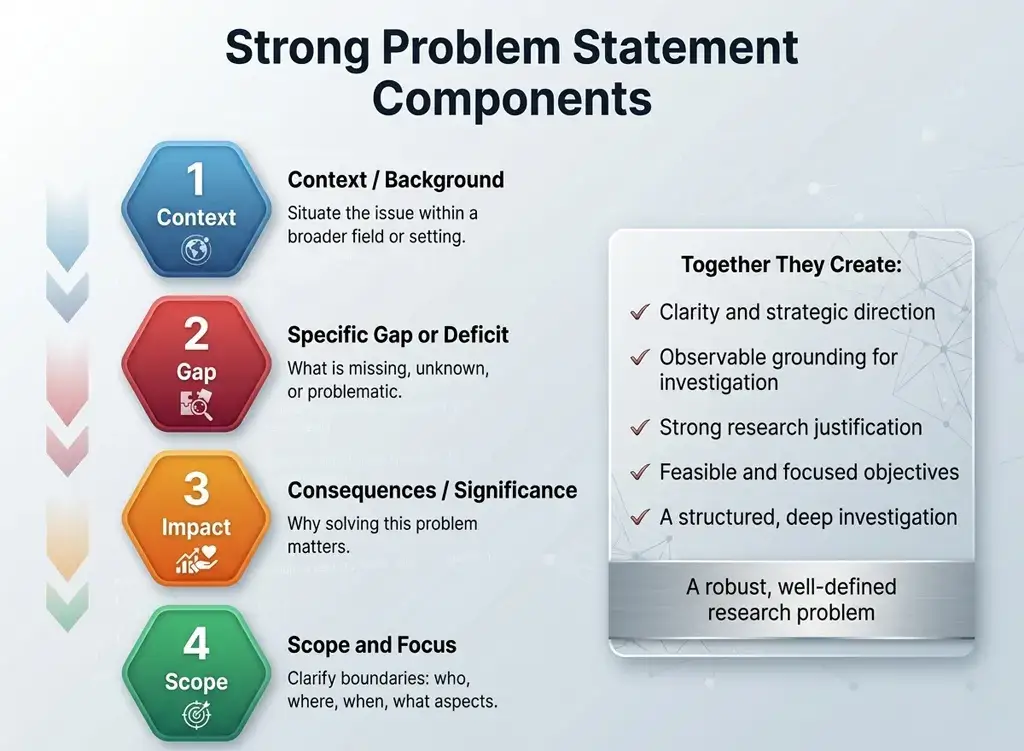
Typically, a problem statement in nursing research consists of the following elements.
Introduction to the Issue
State a brief description of the health issue.
Evidence of the Problem
Provide facts, statistics or observations to demonstrate that the problem is present.
Research Gap
Describe gaps in existing research or practice.
Purpose of the Study
State the purpose of the research.
Example of a Nursing Research Problem Statement
A sample Nursing Research Problem Statement is provided below:
Patient falls are still a significant cause of injury in hospitalised elderly patients. Even after implementing fall prevention strategies, many hospitals continue to experience high fall rates during night shifts. There has been little research on the impact of nurse staffing on fall prevention effectiveness in elderly care areas. The aim of this study is to investigate the effect of nurse staffing on falls in geriatric wards.
This example makes it easy to see the problem, gap and purpose of the study.
Common Mistakes When Writing a Research Problem
A lot of nursing students commit unnecessary errors in the construction of their research questions for nursing dissertation.
Choosing a Topic That Is Too Broad
You can’t do a good job of research on a broad topic.
Weak Topic:
Role of nurses.
Better Topic:
Role of nurses in health education
Lack of Research Evidence
A good research question needs to be backed up by evidence or observation.
Unclear Language
Try to refrain from using ambiguous language that will draw the reader’s attention away from the text.
Focusing on Personal Opinions
Research problems should be based on facts and evidence, not assumptions.
Ignoring Feasibility
Resources and/or access to resources may be needed for some research topics that are unavailable.
Final Thoughts
A well-formulated research problem statement in nursing is a key component of writing successful nursing research. Problem statements are important for researchers to identify health care problems, to direct research questions and to enhance outcomes of patient care.
When you are studying nurse burnout, patient safety, or any other topic related to healthcare communication, the important thing is to select a topic that is both meaningful and researchable. The knowledge of a well-defined nursing research problem statement can be used by nursing students and practitioners to develop meaningful studies that can be used to inform evidence-based healthcare practice.
Given the constantly changing nature of healthcare, the challenge of recognising and addressing significant nursing research issues will continue to be vital to the quality of patient care and the strengthening of the nursing profession.
FAQs
1. What is a nursing research problem?
A research problem in nursing is a health problem or a concern that can be studied by research.
2. Why is it necessary to have a research problem statement?
It serves as a guide to research and highlights the importance of the issue in nursing practice.
3. What is the length of a problem statement for nursing research?
The typical problem statement is 1 or 2 paragraphs, depending on the topic.
4. How do you know if a problem is a good one for nursing research?
A good problem is well defined, narrowed, researchable, relevant and meaningful.
5. What are the typical clinical issues that need to be addressed in research in Nursing?
Some of these recurring subjects are patient safety, nurse burnout, medication errors, infection control and communication problems.
6. What are some examples of nursing research topics?
Select a topic that is observed in healthcare, of personal interest, or a missing area of research.
7. Are nursing students allowed to carry out research?
Yes. As part of a nursing program, students may be required to do a research project.
8. Explain the difference between a research topic and a research problem?
Research topics are broad subject areas, and research problems are specific issues within a topic.
9. How do research questions relate to the problem statement?
Research questions are derived from the problem statement and inform the study.
10. What are some research areas in nursing?
These can include mental health nursing, emergency care, paediatric nursing, elderly care and nursing education.