 By
By Have you recently planned to pursue your master’s in the UK? Then, you might be all set to write your personal statement. If you are wondering why it matters a lot for you to write a polished statement, let me tell you that it is one of the deciding factors that can change the entire situation of your higher education and career goals.
You might already be aware that among thousands of applicants competing for limited seats, UK universities expect you to explain to them why you are the most suitable fit for their programme.
That’s why you have to ensure that you not just write a personal statement for a master’s degree, but you effectively demonstrate your academic achievements, educational background, relevant work experience in the same subject area, and genuine motivation in a unique, personalised way.
In this post, you will learn what you can include in your master’s personal statement, the standard word count, and the formatting tips that can help you create a statement that increases your chances of getting admission.
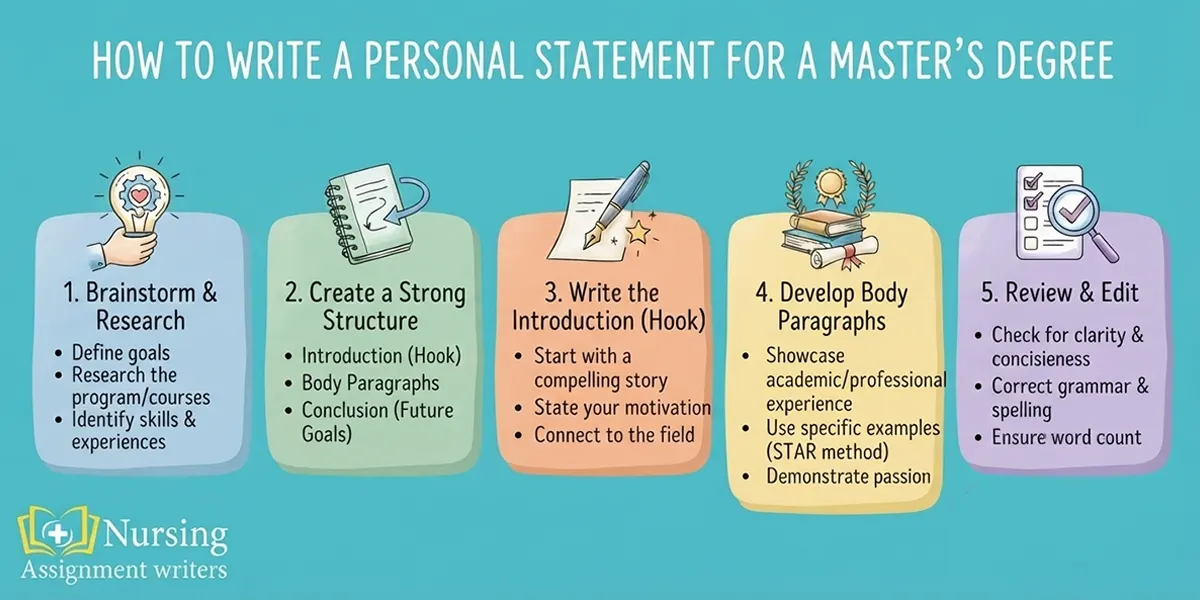
Key Sections to Include In Your Personal Statement for a Master’s Degree
When you are finding out how to write your personal statement for a master’s degree, you should make sure to tailor your statement to fit the course requirements and other specific guidelines. What I mean is, what you include in your statement significantly depends on the course you are applying for.
Here is what you will generally be required to write about:
- Introduction: Begin writing your introduction in 1 paragraph. State the exact course name you want to pursue your master’s in, your current academic status, and your primary reason for applying. Since this is the hook that will keep your admission tutor interested, make sure that you write it properly.
- Academic Background: Then, you will have to write 2 body paragraphs to explain your academic background, the projects or dissertations, and the specific modules from your undergraduate degree programme that developed your interest. (Note for Research Degrees: If you are applying for a research-focused Master’s like an MRes or MPhil, you must replace part of your module discussion with a clear outline of your proposed research interests, methodology, and potential alignment with faculty supervisors.)
- Work Experience: Moving forward to your work experience, you have to highlight the appropriate jobs, internships, or any other volunteer work you have done that helped you gain relevant skills in 1 paragraph.
- University Choice: Next, you have to dedicate a paragraph to explain why you chose the specific university to advance your academic experience. Don’t forget to mention the specific modules, research groups, or other factors that drew you to prefer their institution for your master’s programme over others.
- Conclusion: Like any other piece of writing, you have to write a conclusion of 1 paragraph and make sure you properly summarise your core strengths and also conclude how your chosen degree fits with your career goals.
It is also better that you seek assistance from personal statement writing services if you are confused about what you should include in your statement.
Are you unable to figure out how to write your Personal Statement for a Master’s Degree?
At Nursing Assignment Writers UK, our dedicated team of personal statement writers is here to help you with your personal statement.

How Long Should Your Personal Statement for a Master’s Degree Be?
When you know the structural basics and how to write a personal statement for a master’s programme, the next question that may come to your mind after these is, ‘How many words do I have to write my master’s personal statement’ .
Don’t worry, I can clear your confusion. There is a generic limit for your personal statement for a master’s degree of around 500 to 600 words, and it is a single side of an A4 paper. However, keep in mind that it can vary depending on the specific university.
Formatting Tips to Ace Your Personal Statement for a Master’s Degree
You must keep in mind that, unlike a college personal statement, most UK universities require you to format your master’s personal statement in a one-sided A4 document, which usually turns out to be roughly 3,000 to 4,000 characters including spaces (or around 500 to 600 words, keeping in mind that online portals strictly count every character and space).
Here is a simple explanation for you:
- For the length of your statement, you should aim for around 500 to 600 words, but make sure to follow the specific requirements provided by the university you are applying for.
- If you are wondering about the font, you should use a professional font like Arial, Calibri, or Times New Roman, in the most commonly used font size 12, unless your selected university requires you to follow other specific requirements.
- As for the spacing, go for the standard margins and single line spacing, unless the university specifies different spacing requirements.
- Lastly, for the formatting type, you may be required to paste your statement directly into the university’s official online application portal. Alternatively, you may be asked to upload an A4 document.
DO NOT FORGET: You must remember that these are general requirements and may vary depending on the specific UK university you are applying for. Therefore, make sure that you thoroughly check the submission requirements so you know how to do a personal statement without confusion or room for mistakes.
Frequently Asked Questions
How many paragraphs should be enough for my master’s application personal statement?
When you are writing a personal statement for a master’s programme, it is best that you aim for 5 to 6 cohesive paragraphs. It usually includes one introductory paragraph, 3 to 4 body paragraphs, and 1 closing or conclusion paragraph.
What format do UK universities follow for a personal statement for a master’s degree?
Generally, personal statements for Master’s programmes in the UK follow the direct academic format, which is typically around 500 to 600 words or about one side of an A4 document.
What’s the best way to explain how my chosen subject links to my previous education and future goals in my master’s personal statement?
The most suitable way you can use to link your course to your educational background and your future goals is by using a clear bridge. You can do that by clearly demonstrating how your past studies have helped you build your skills and how the specific master’s degree can help you advance your career.
How many words should I write for my personal statement for a master’s degree?
You must keep in mind that there is no single word count limit for a master’s personal statement, but most UK universities require you to write around 500 words or roughly 3,000 to 4,000 characters including spaces. To find a more specific word count limit, you should refer to the specific university you are applying to.
Is It Safe to Use AI to Write Your Personal Statement for a Master’s Degree?
While relying on AI to write or generate the entire statement from scratch is unsafe and leads to generic text, using AI responsibly as a brainstorming partner, structural guide, or grammar checker is completely acceptable as long as your authentic voice and personal experiences drive the writing.
- Lack of Authenticity: Admissions committees look for your unique voice, genuine motivations, and personal reflections, qualities AI cannot authentically replicate.
- Risk of Plagiarism & Generic Output: AI often produces clichéd phrasing and formulaic structures that sound identical to thousands of other applicants.
- Detection & Disqualification: Many universities use AI-detection software or easily spot generic AI writing, which can lead to immediate disqualification.
Putting it Altogether
To sum up, I want you to understand that writing your personal statement for a master’s degree in a way that increases your chances of securing admission to your chosen university requires careful attention rather than listing your academic achievements.
Instead, you are required to present a clear, evidence-based story of how your academic journey and career goals link to the course you are applying for. When you follow the right approach and write within the correct structure, you can create a compelling master’s personal statement that perfectly reflects your strengths and potential.
Good luck with writing your personal statement and acing your master’s journey!