 By
By Have you graduated from college and are now preparing for your university admission process? Then, you may already know that your university personal statement is one of the most vital components of your UCAS application process.
If you are unaware, let me tell you that UCAS is a central organization that manages student applications for higher education in the UK. Since the UCAS personal statement format has changed, applicants are now expected to present their information in a more structured, simple format.
Therefore, you must know everything about this new approach so you can create a relevant personal statement that increases your chances of getting admitted to your preferred university.
Here, I have explained how you can write a personal statement for your university admission process in line with UCAS guidelines and the format for UK university applications, complete with examples.
How to Write Your Personal Statement For University?
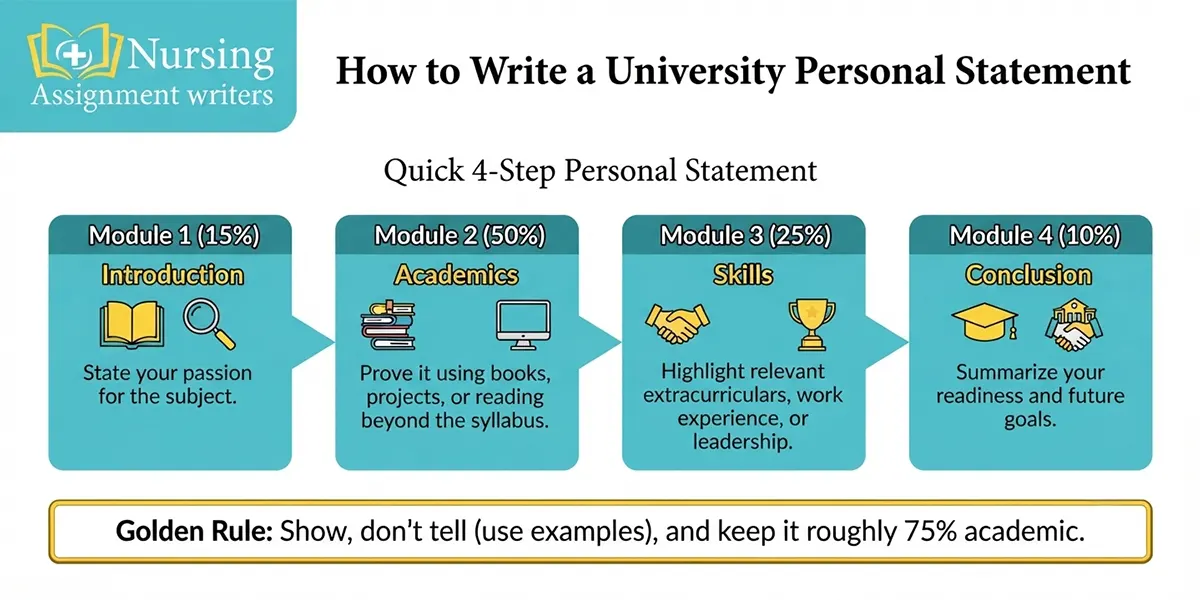
As for the current UCAS personal statement format for university, you are required to answer three specific questions, including your purpose of studying a specific course, how your qualifications prepare you for it, and how well you have prepared other than your qualifications, rather than a longer, continuous essay.
1. Start Your Statement by Explaining Why You Want to Study the Course
For the first question of your university personal statement, you are required to explain why you have chosen the specific course you are applying for. Also, you must know that the admission committee wants to understand your motivation and enthusiasm for the subject area.
Here, you have to explain,
- The moments or experiences that sparked your interest in your selected field.
- How your passion for the subject developed over time.
- Your purpose of choosing the specific university to study in your selected area.
- What you expect to achieve through it.
Pro tip: Make sure to follow the personal statement format for university accurately and keep your answer specific by focusing on the experiences that inspired your decision rather than adding general statements.
2. Show How Your Educational Background Has Prepared You
Here, you are required to demonstrate how your previous qualifications and studies have equipped you with the knowledge and skills that best fit your chosen course.
Therefore, you should mention,
- Your relevant school and college subjects.
- Any research projects or coursework in an area similar to your selected field.
- Any appropriate academic achievements.
Pro tip: Whether you are writing a postgraduate personal statement or an undergraduate university statement, make sure that you explain what you learned from each experience and how it helped you improve your understanding of the subject you are applying for.
3. Describe What You’ve Done To Prepare Other Than Your Education
Proceeding to the third question, you can consider it your opportunity to mention any other activities outside of formal education that contribute to making you a suitable candidate for your selected course.
For instance,
- You can mention any previous work experience, volunteer work, or internships you have done in your chosen field.
- Moreover, you can include any types of extracurricular societies and community involvement events.
Pro tip: You should keep your focus on explaining what exactly you have gained from these experiences and how they have helped you develop abilities that will support your success throughout your studying journey.
Need Assistance in Writing Your University Personal Statement?
Let our personal statement writers handle that for you.

Some Tips for You to Write a Perfect University Personal Statement
Before submitting your UCAS application, review each response carefully to ensure it is polished and accurate, and follow these insightful tips:
- You must proofread your entire statement before you submit it.
- Make sure that you have answered each of the three UCAS questions clearly, all within the given character limit.
- Moreover, you should avoid including the same information across responses.
- Thoroughly check your statement for any spelling, punctuation, and grammar mistakes.
- You should also ensure all your content provides valuable information about your motivation, suitability, and preparation for your selected course.
- Make sure your content reflects on your experiences.
Examples For University Personal Statement
Like other students who take formatting and writing style ideas from the personal statement examples in the UK, you can also explore samples to understand what effective responses look like.
For instance, when figuring out how to do a personal statement as a nursing course applicant, you should explain how your experience working as a nurse has changed you and strengthened your interest in nursing.
Moreover, you can seek assistance from personal statement writers so you can focus on personal development instead of just listing your achievements.
How Many Words Should You Write Your University Personal Statement?
You might be wondering, “How many words is a personal statement for university?” You must remember that:
- The character cap is a maximum of 4,000 characters, including spaces.
- The line cap is a maximum of 47 lines of text.
- As for the formatting, you will probably be required to split it into specific question sections, and write at least 350 characters per section.
Frequently Asked Questions
How do I start a university personal statement?
You should start by explaining your interest in your selected course, focusing on your motivation and connecting your personal experiences directly to the subject. This will help ensure your statement remains relevant.
Can I use the same personal statement for different universities?
Yes, you can use the same statement for multiple universities, but you should focus on your chosen course rather than individual institutions. However, you may occasionally be required to write a tailored statement based on university-specific information.
What should I avoid in a personal statement?
You should avoid copying examples, exaggerating your achievements, and repeating the same points. Instead, you should keep each of your responses honest, specific, and strictly relevant to your chosen field.
How many times should I proofread my personal statement?
To increase your chances of making your personal statement error-free, you should check for spelling, punctuation, clarity, and character limits, ensuring that each of your responses answers the UCAS questions accurately.
Wrapping it Up
All in all, your personal statement lets you highlight your academic ambitions, experiences, and reasons for choosing the course you are applying for.
Moreover, writing your university personal statement requires honest reflections and a clear understanding of UCAS requirements so that you can write a well-planned statement.
You can make this process even easier when you follow the standard format and align each of your responses with the latest UCAS guidelines. It will ultimately help you open doors to the opportunity of securing admission to your preferred university and making a positive impression.