
 By
By Are you all set to apply for your undergraduate degree? If yes, then you should know that writing your personal statement is one of the key components of your university’s admission process.
You should understand that, unlike other requirements, it is actually an opportunity for you to demonstrate why you are the most suitable fit for your chosen course, showcase your interest in your chosen field, and highlight the experiences that have inspired your academic interests.
If you are prepared for your university admission process but don’t know much about this, I have explained everything so you can find answers to what a personal statement actually is, what you should include in your statement, and the standard structure requirements.
By covering everything from basics to in-depth detail, I hope you increase your chances of writing a successful one.
Let’s get started with our insightful conversation.
What Is Personal Statement?
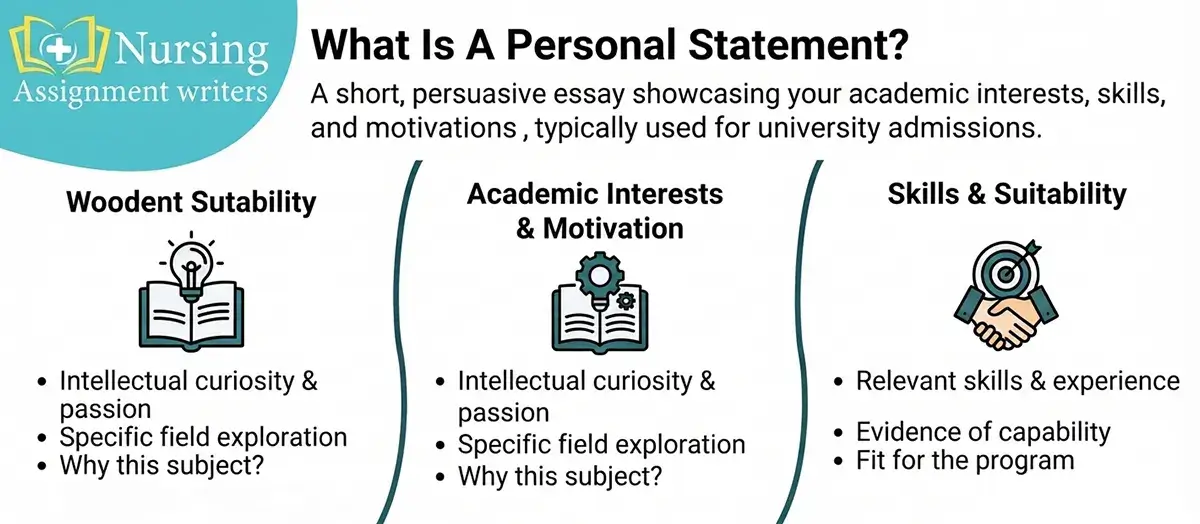
Before you begin writing a personal statement, you should clearly know what it is, so you can write yours in the format, structure, and purpose that your preferred college requires.
It is a reflective essay that you need to write as part of your university’s application process, which helps you bridge the gap between your educational journey and your experience. In this, you are required to write about your educational background and the motivation and purpose behind choosing a specific university for the program.
You don’t have to worry or get puzzled about understanding the structure of a personal statement. I have explained the structure in one of the next sections to make your writing process easier.
The Most Popular Types of Personal Statements
There are many types of personal statements, such as undergraduate, postgraduate, scholarship, and job or internship statements. Here is an overview for your better understanding:
- For Undergraduate Programs: It is one of the most common types that you will be writing when you apply to bachelor’s degree programs. Here, you have to write while explaining why you want to study your selected course and why you are a suitable candidate.
- For Postgraduate Programs: You must remember that a postgraduate personal statement is slightly different, as you are expected to demonstrate a deeper understanding of your selected field. Therefore, you should focus on your achievements, research interests, relevant experience, and even your career goals.
- For Scholarships: When you are writing to apply for a scholarship, the better approach is to explain why you deserve the scholarship opportunity. Make sure to highlight the personal challenges you have overcome, demonstrate your leadership qualities, and explain how the scholarship will be your stepping stone to achieve your goals.
- For A Job or An Internship: If you think you have to write personal statements for educational purposes only, let me tell you that some employers also ask candidates to write one as part of their application process. Therefore, your focus should be on your professional skills, work experience, and why you are the best fit for the role.
You should also check the requirements of the specific university you’re applying for, so you write your university personal statement accurately.
What You Should Actually Include in Your Personal Statement?
If you don’t know what your statement should include, you will have to follow a proper approach when writing a personal statement in the UK. By that, I mean a standardized structure that has recently changed to three separate questions. That’s why many students get confused and wonder, ‘What to put in a personal statement?’
Let me tell you that you must write in a way that answers these three questions:
- The first question requires you to explain why you want to study your selected subject. You must clearly state your interest and motivation that led you to choose the specific subject and university. Rather than adding cliché statements, I suggest that you include a question or your experience that sparked your interest.
- The second question requires you to answer how your qualifications and studies helped you prepare for your chosen course. For this section, you should also discuss your background and relevant skills. Suppose you want to apply to a prestigious university for their nursing program; you should demonstrate your educational experience as a medical student.
- The third question requires you to demonstrate what else you have done to prepare and why it is useful. Here, apart from your education, you have to highlight the super-curricular activities that helped you extend your learning beyond your school syllabus, your work experience, and even your hobbies. Also, don’t forget to explain how your selected course supports your future academic and career goals and why your chosen university can be the best option to support your development.
Here’s a pro tip: You must not forget that you have to keep your answers for each section around a minimum of 350 characters, so you don’t exceed the maximum word limit.
Still confused about how to structure your statement to enter a nursing programme?
Let our nursing personal statement writers help you write a solid statement that increases your chances of getting selected.

How Long Should Your Personal Statement Be?
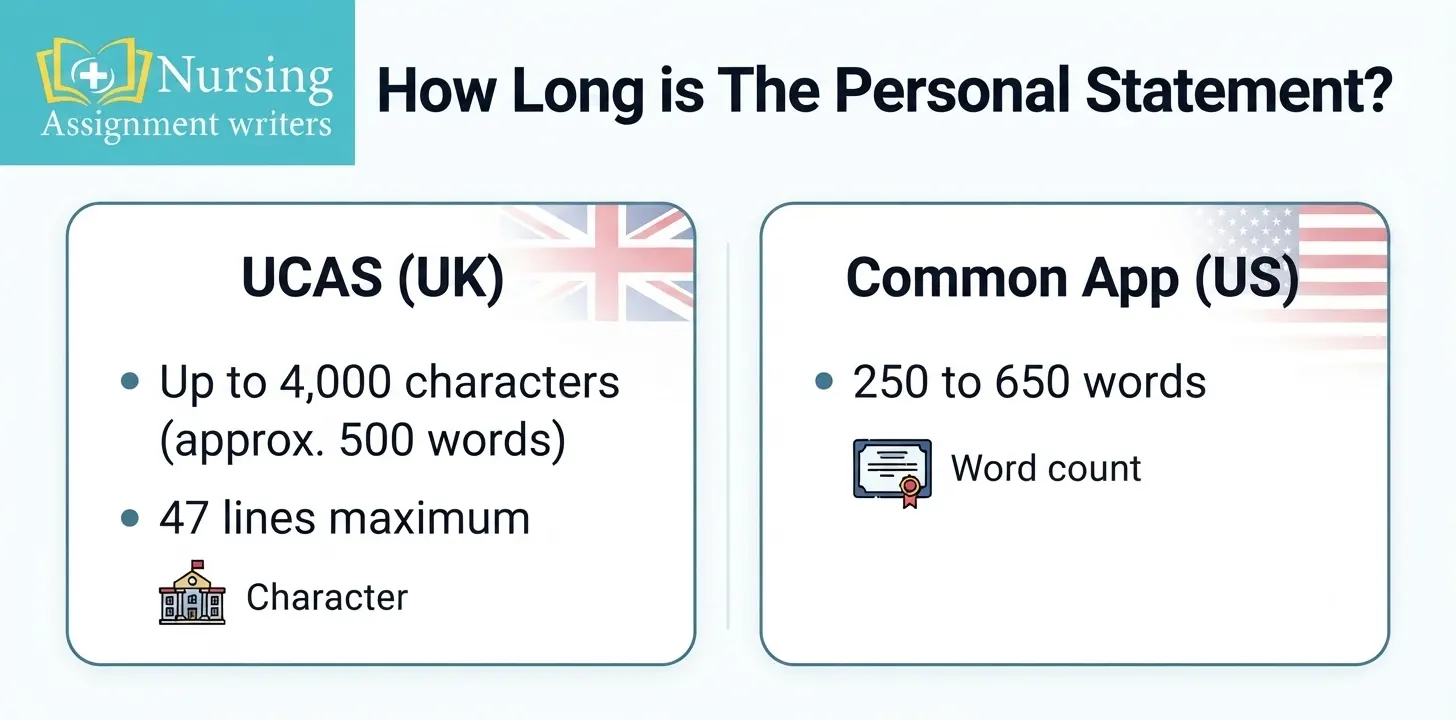
Many UK universities follow the same limit for UCAS undergraduate applications: a maximum of 4,000 characters (including spaces), which is around 500 to 650 words.
If you are still confused and wondering, ‘how many words is a personal statement?’ Then let me make it simpler for you to understand:
- For a UCAS application, you are required to write within 4,000 characters or 650 words, and your statement will be based on three questions.
- If you are applying for a UK medical school, you usually have to follow the same limit of 4,000 characters (including spaces) or 47 lines.
- Alternatively, if you apply through Common App (a non-profit online application platform), you have to write a maximum of 650 words.
If you are writing this for the first time and are unsure about the structure or word limit, it may be a great option for you to seek personal statement writing services. This way, you can write without exceeding your word limit or making mistakes.
Frequently Asked Questions
What mistakes should I avoid while writing my personal statement?
You should avoid writing a generic essay that feels like you are restating your grades or educational achievements. Instead, ensure you focus on your relevant skills, your experiences, and the motivation or inspiration that led you to choose the specific course.
How many paragraphs should I include in my statement?
When you’re writing a standard statement, you should aim for 4 to 5 paragraphs, including one for the introduction, 2 to 3 body paragraphs, and 1 for the conclusion. Altogether, these can easily help you achieve the standard 500-650 word count.
Why is a personal statement important for university admission?
It makes it easier for the admissions committee to assess your relevant experiences and your academic goals, and it’s also a deciding factor that differentiates you from other candidates.
How do I follow the 80/20 rule in my personal statement?
To follow the 80/20 rule, you have to ensure that roughly 80% of your essay is based on your academic interests and relevant skills. As for the remaining 20%, you have to focus on your extracurricular activities, hobbies, and the personal qualities that make you a suitable candidate.
What makes a good personal statement?
To write a good statement, you must connect your past experiences to your future educational goal by highlighting your values and passion for your chosen subject and also demonstrating how you’re going to contribute to your chosen program and institution.
Wrapping it Up
That brings us to the end of this guide.
To sum up, learning everything from basic definitions to structure and other guidelines of a personal statement is equally important as other components of your university admission process.
Therefore, you should ensure you not only know the basics, but also the commonly accepted types of these statements, the different guidelines and word limits for each, and the key points you need to include in your statement.
I hope my explanations help you get a clear understanding, so you can write a solid statement that improves your chances of securing admission to your preferred institution and the subject area you applied for.