 By
By Learning is not a simple process that happens through experience. It starts when you reflect on your experience, understand what it teaches you, and then apply the lessons to a new situation. This is where Kolb’s Learning Cycle lies. Developed by educational theorist David Kolb, this model explains the continuous learning process. This model argues that learning doesn’t come from passive instruction. It is a continuous loop that starts from concrete experience to active experimentation. This guide comprehensively covers Kolb’s model, from the learning cycle and learning stages to its benefits, limitations, and real-world applications.
What is Kolb’s Learning Cycle?
Kolb’s Learning Cycle, also known as Kolb’s Experiential Learning Cycle, is a four-stage continuous model that describes learning as a loop process rather than a single event. This iterative framework proposes that learning is not based on passive instructions. It is built through the transformation of concrete experience into active experimentation.
An American educational theorist and social psychologist, David Kolb, proposed this model in his book, Experiential Learning, in 1984.
Describing how people learn and build knowledge through experiences, this model is one of the most widely used learning techniques in workplaces. Instead of solely relying on theory, it helps learners connect formal training with real situations.
The Theory Behind Kolb’s Learning Cycle
The theoretical roots of Kolb’s learning originate from the work of some previous learning theorists. John Dewey, Kurt Lewin, and Jean Piaget’s thinking primarily contribute to this framework. John Dewey inspired Kolb’s stage of reflection by describing learning as a practical, problem-solving journey. Kurt Lewin focused on action research, inspiring the circular testing of Kolb’s cycle. Jean Piaget described learning as a structural process of adaptation, thus inspiring the abstract thinking of Kolb’s model.
Synthesising these influences into a single model, Kolb’s experiential learning theory is based on the idea that learning involves turning experiences into knowledge. According to Kolb, effective learning starts when a person experiences. The process continues when he reflects on it, gains some insights, and finally applies them to a new situation. The cycle continues – this is where actual learning happens.
At its core, the theory describes learning through two dimensions.
- How we grasp experience
- How we transform experience
These dimensions intersect to form the four learning stages of this cycle.
The Four Stages of Kolb’s Experiential Learning Cycle
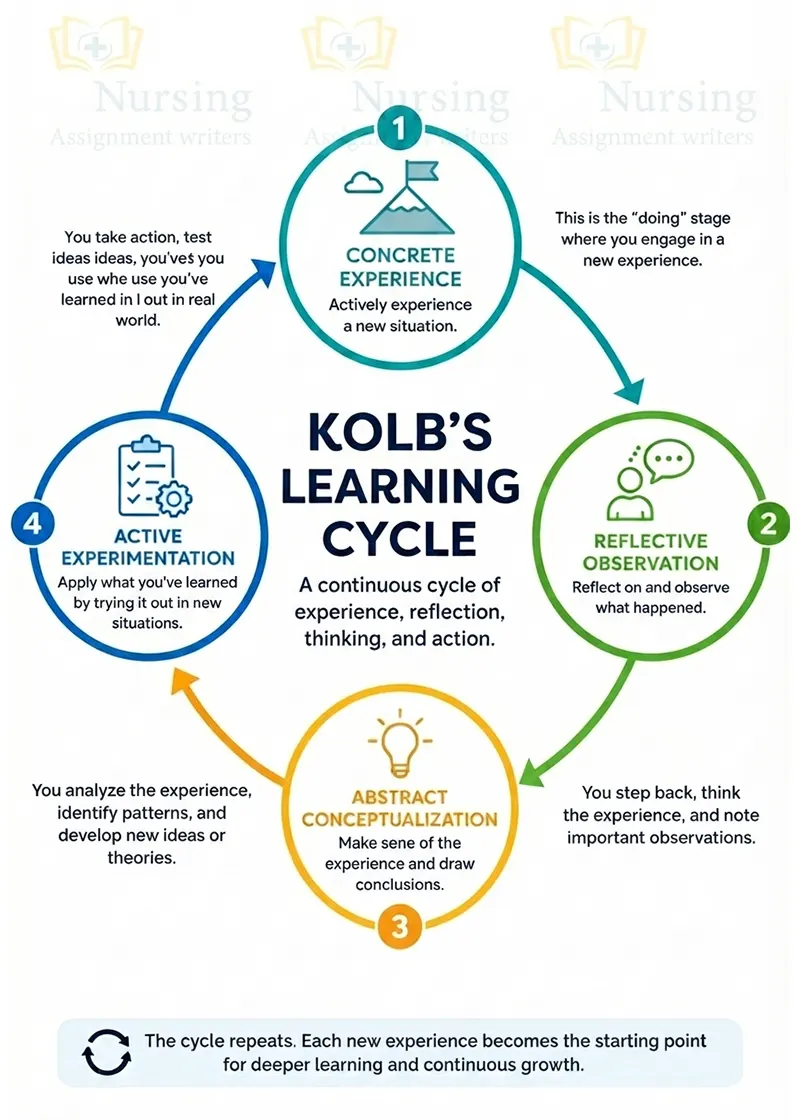
Kolb’s reflective cycle is built on four interconnected stages. These include Concrete Experience, Reflective Observation, Abstract Conceptualisation, and Active Experimentation. Each stage lays the foundation for the next, maintaining the flow in the cycle. The cycle repetition helps learners gain mastery over time.
Stage 1 – Concrete Experience
This is where the cycle begins. It involves engaging in an experience with a new angle or doing something new. It could be a meeting or taking on a responsibility at the workplace. Facilitating a project kick-off meeting could be an experience that starts the learning process. Other training examples include:
- Handling an angry customer conversation.
- Running a first attempt at a project task.
- Leading a team activity for the first time.
- Practising a new skill using new tools.
- Completing a new task under the guidance of a trainer.
The quality of initial experience matters as it lays the foundation for the subsequent stages. The more practical and relevant the experience is, the more meaningful the reflection will be.
Stage 2 – Reflective Observation
This is the second stage of Kolb’s learning cycle. It is the critical analysis stage where the learner focuses on what happened. Instead of immediately moving to the next task, the learner wonders and watches the previous actions and examines them from different angles. The key questions include :
- What happened?
- What did I notice?
- What went well?
- What was lacking?
- How did others respond?
- What can I learn from it?
- How would I approach it differently next time?
For example, after giving a presentation, a nursing student focuses on his experience. He compares what he prepared and what he delivered. He might get to know that the content was well-prepared, but he couldn’t deliver it that way. Answering the above questions effectively gives him a clear pathway to how he can improve. Student Nurse Reflection on Learning and Development can also help students in focusing on the areas where they can improve.
Although this is the central step to transfer experience into lasting knowledge, this one is sometimes the most neglected stage. Skipping this stage means you’re directly turning experience into action without understanding what you actually learnt.
Stage 3 – Abstract Conceptualisation
Abstract conceptualisation serves as the intellectual engine of Kolb’s cycle. This is a cognitive process where the learner takes information from the reflective experience and turns it into new meaningful theories or ideas. Instead of just focusing on what happened to me, the focus shifts to :
- Why did this happen?
- What does this teach me?
- How does it connect with what I already have?
- What could I conclude from this?
The learner identifies problems and connects them with personal real-world examples, and forms new models and concepts. For example, the student nurse finds out a patient becomes more anxious after a procedure. After reflecting on the situation, the student abstracts that clear communication can help reduce patient anxiety. This is where reflection turns into understanding. Other training examples may include :
- Using a framework to identify the key factors behind an outcome.
- Reading a supporting theory after an activity.
- Turning real-world lessons into practical strategies.
Stage 4 – Active Experimentation
This is where the loop closes. Active Experimentation involves the application of conclusions from the conceptual understanding to new real-world situations. This is actually the deliberate testing of specific ideas. Examples may include :
- Trying a new communication technique with the customer.
- Applying a newly learned software to new tasks.
- Completing a practical exercise in an e-learning module.
- Implementing a new workplace process to check whether it improves efficiency or not.
This is where the cycle begins again. The outcomes from active experimentation become the new concrete experience, and the cycle continues. This layered process helps in complex skill development.
Here is a visual representation of the 4 stages of Kolb’s learning cycle.
The Learning Loop Test
Not every experience can turn into meaningful learning. A learning loop test is a key framework to check the growth and productivity of a process. In this continuous experimentation framework, the results from an assessment directly refine the next iteration of the process. Kolb’s learning cycle becomes valuable when the outcomes of deliberate testing become the foundation of the next concrete experience.
A student gives repetitive presentations without any improvement or effectiveness in the process. The presentation provides the experience, but if the student never reflects on the experience, meaningful learning may not occur. Thus, reflecting on the previous experience and taking action is where the learning happens.
Here are some signs that reflection is skipped.
- Repeating the same mistake without identifying why it happened.
- Relying on assumptions instead of examining.
- Immediately moving from one task to the next one.
- Struggling to explain why it happened.
These signs may help you know that the experience is not processed fully. Kolb’s model helps learners find these gaps by comparing theory with real experiences. The learning loop test helps the learner understand how he approaches the next experience. A change in experience means improved future performance.
The Four Learning Styles in Kolb’s Model
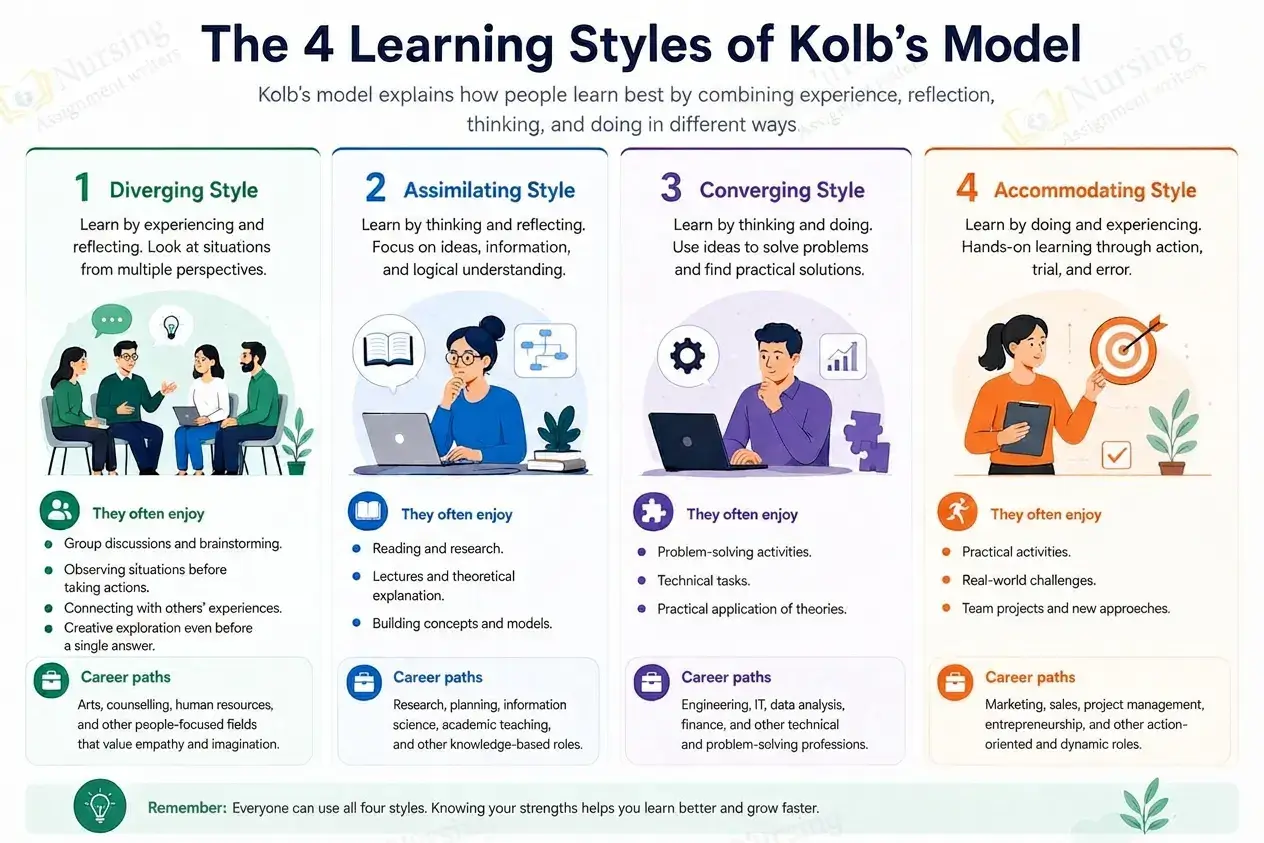
Beyond the four stages, David Kolb’s experiential learning also describes four learning styles. These include Diverging, Assimilating, Converging and Accommodating. Each style describes the habitual ways a learner approaches new information and moves through the learning cycle.
Diverging Style
Diverging learners focus on learning through experiences. They look at the situations from different perspectives, thus combining concrete experience with reflective observation. They generate ideas through imagination and feelings. Diverging learners often enjoy :
- Group discussions and brainstorming.
- Observing situations before taking actions.
- Connecting with others’ experiences.
- Creative exploration even before a single answer.
Divergers usually choose careers in fields that value empathy, imagination, and diverse perspectives, such as arts, counselling, and human resources.
Assimilating Style
Assimilating learners focus on understanding ideas, gathering information, and developing logical consequences. They combine abstract conceptualisation with reflective observation. They often enjoy :
- Reading and research.
- Lectures and theoretical explanation.
- Building concepts and models.
They usually seek careers in research, planning, information science, and academic teaching roles.
Converging Style
Converging learners use ideas to find problems and their practical solutions that work. They combine abstract conceptualisation with active experimentation. Their decision-making and problem-solving skills help them enjoy :
- Problem-solving activities.
- Technical tasks.
- Practical application of theories.
They prefer technical and engineering professions that utilise their skills.
Accommodating Style
Accommodating learners learn through hands-on experiences, actions, trials, and errors. They combine concrete experience with active experimentation. Their adaptability, initiative, risk-taking, and learning through direct experience strengths help them enjoy :
- Practical activities.
- Real-world challenges.
- Team projects and new approaches.
They often seek careers in marketing, sales, and project management. Here is the visual representation of Kolb’s learning styles.
How to Apply Kolb’s Cycle in The Workplace
Kolb’s model works well in places that focus on developing through experiences. It turns everyday workplace experiences into continuous learning and improvement. Instead of considering training as something that ends when an employee completes the course, this model encourages them to learn from real tasks. Reflect on them, abstract insights, and build new approaches for future practice. It strengthens learning through practices that connect training with real experiences.
Managers use this model during coaching conversations. They guide employees through each stage of the cycle, helping them identify what happened and how the learning can be applied next time.
This model is also used during onboarding programs. New employees utilise this cycle to build confidence. They complete new tasks. reflect on them, discuss with managers, and then apply the knowledge to new tasks.
At workplaces, the process begins when employees experience something new. This model encourages them to reflect on the experience, connect it with real workplace knowledge, test the new approach, and repeat for improvement.
Applying this model to the workplace helps organisations connect training with real experiences and encourage employees to learn from mistakes. Thus, it creates a culture of reflection and experimentation.
How to Use Kolb’s Learning Cycle for Personal Development
This cycle also promotes personal development. It helps people turn everyday experiences into practical lessons. It gives a clear pathway for future progress. This model encourages people to pause, understand, learn, and apply one experience’s insights to the next. Thus, it promotes continuous self-improvement. So, the goal is not to avoid mistakes. It’s to use those gaps for better learning.
Kolb’s Learning Cycle vs Gibbs’ Reflective Cycle
Both cycles encourage people to learn from their experiences. But how they approach the process is quite different. Kolb’s model focuses on how the experience turns into knowledge and then applies through action. So, it is used for experiential learning, training, and skills development.
Gibbs’ reflective cycle focuses on structured reflections. It includes 6 stages: Description, Feelings, Evaluation, Analysis, Conclusion, and Action Plan. It encourages learners to examine the experience in more detail, making it useful in clinical situations and teaching experiences. Nursing students usually approach Gibbs Reflection Nursing Assignment Help for their assignments.
So, the key difference is focus. Kolb’s model explains “how”, whereas Gibbs’ cycle gives a step-by-step structured guide for what to decide next. Read “What is Gibbs’ Reflective Cycle” for a comprehensive understanding of how it works.
Benefits of Kolb’s Model
Kolb’s model supports learners in developing knowledge and improving their performance over time. It is a practical way to turn everyday experiences into meaningful, non-merely-theoretical learning. A meta-analysis of this approach found a positive effect on student learning outcomes, with an overall effect size of d = 0.43 compared with other approaches.
- It helps learners engage in activities, thus making learning more practical.
- This model helps learners bridge the gap between theory and practice.
- It helps learners reflect on experiences, boosting their critical analytical skills.
- This cycle encourages self-reflection and effective problem-solving.
- Repeated practice and reflection using this model help learners build confidence and competence.
Limitations and Criticism of Kolb’s Learning Model
Although Kolb’s learning cycle is widely respected, it is not without criticism. Practitioners should be aware of this academic criticism.
One common criticism is that it underestimates the role of social and cultural context in learning. Learning doesn’t always follow four distinct stages that this model suggests.
Critics have noted that there is limited evidence that teaching someone according to a preferred style produces better outcomes. Thus, they question the evidence supporting Kolb’s learning styles.
Researchers have also questioned the design of the concrete experience that is genuinely relevant. In highly specialised workplaces, it can be difficult to create the right initial experience that provides a strong foundation for meaningful reflection and learning.
Despite the criticism and limitations, this cycle offers a practical framework for valuable workplace learning. It encourages reflection with a clear purpose, thus supporting the organisation in continuous development. However, nursing students also use Driscoll’s Model of Reflection for more focused and concise clinical learning.
Common Mistakes to Avoid while using Kolb’s Model
Kolb’s cycle works best when learners move beyond having an experience and actively take actions, develop understanding, and test new ideas. However, several common mistakes reduce the effectiveness of this model.
- Simply focusing on experience doesn’t guarantee learning.
- Skipping reflection and moving to the next task.
- Kolb’s learning styles are not permanent labels. Confusing them with fixed personality types reduces efficient learning.
- This cycle works best when learners evaluate what they have learnt. A failure to apply insights in practice should also be avoided.
Conclusion
Kolb’s Learning Cycle helps learners move beyond simply gaining information. It encourages them to recognise their strengths, identify weaknesses, and set meaningful goals for improvement. Learners should engage in the complete process of experience, reflection, understanding, and action to effectively turn their everyday experiences into continuous growth opportunities.
Frequently Asked Questions
What is Kolb’s learning cycle?
Kolb’s learning cycle is a four-stage approach that explains how people learn through experience, reflection, idea development, and the practice of those ideas in new situations.
Who developed Kolb’s learning cycle?
An American education theorist, David A. Kolb, developed this model in 1984.
What are the four stages of Kolb’s learning cycle?
The four stages are Concrete Experience, Reflective Observation, Abstract Conceptualisation, and Active Experimentation.
Is Kolb’s cycle the same as reflective practice?
No. Both of these are related but not the same. Reflective practice is a broader approach. While Kolb’s learning cycle is an experiential learning model that encourages learners to reflect on their experiences to improve learning.
Is Kolb’s learning model helpful for academic purposes?
Yes. It is widely used for academic purposes as it helps students bridge the gap between theory and practice while bringing them to growth opportunities.
Does Kolb’s learning cycle help in a clinical context?
Yes. Kolb’s learning cycle helps healthcare professionals learn from clinical experiences, reflect on practice, apply theory, and improve their future patient care.
What are Kolb’s four learning styles?
Kolb’s four learning styles include Diverging, Assimilating, Converging, and Accommodating.
Why is Kolb’s model also called experiential learning?
Kolb’s model is also called experiential learning because it helps people learn through experiencing, reflecting, understanding, and applying what they have learned.