
 By
By Like any other important test, applying for a postgraduate course at a prestigious university in the UK can often become overwhelming. Let me tell you that this stressful situation most commonly occurs when you are unsure of what exactly universities expect you to demonstrate, other than your grades and qualifications. Here, I have explained how you can write your personal statement for your chosen postgraduate programme using a step-by-step process, what exactly you have to include, and how long you should write it. Read till the end so you can learn how to compose a well-structured, properly written postgraduate personal statement.
7 Steps to Write a Winning Postgraduate Personal Statement
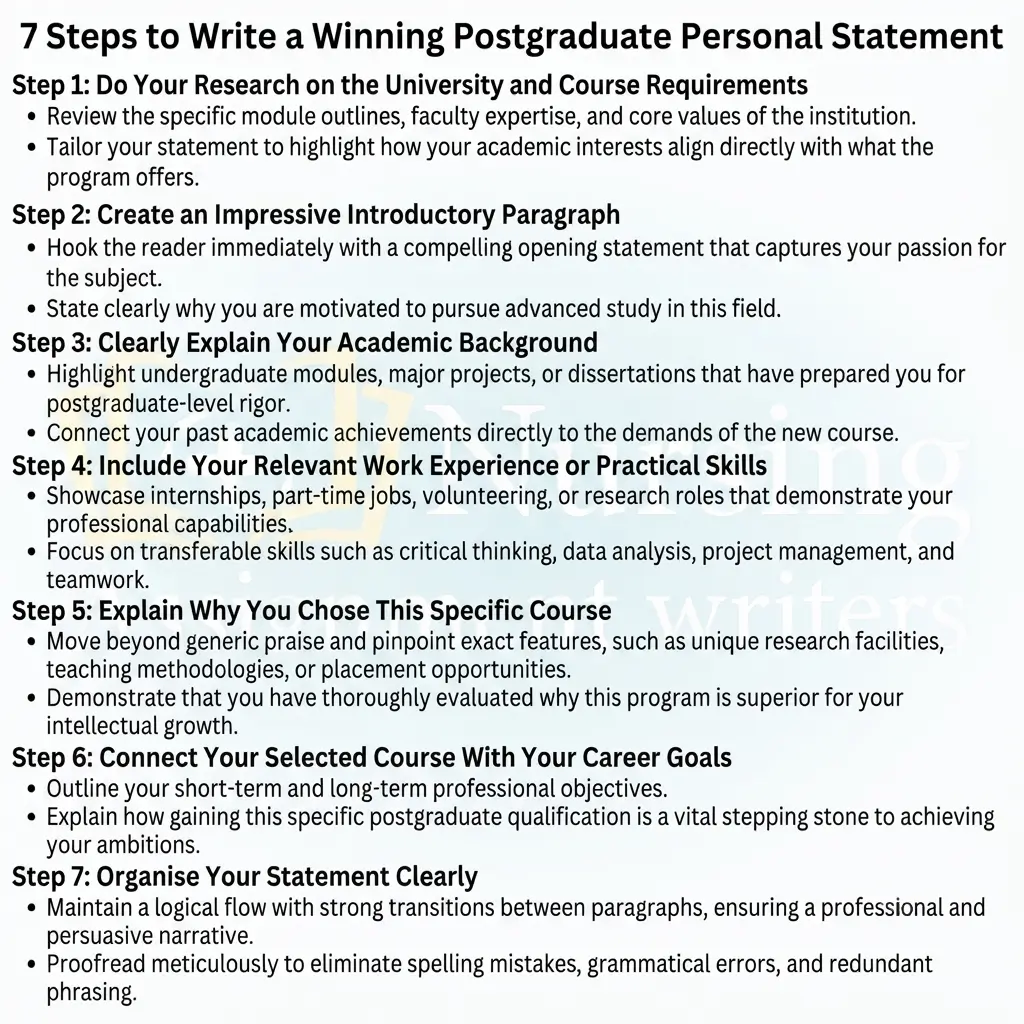
Step 1: Do Your Research on the University and Course Requirements
Before you begin writing, you should be clear about what the university is actually looking for. Since every postgraduate programme has different expectations from applicants, you should avoid creating a generic statement.
To ensure you stay on the right track from the start and connect your experiences with the university’s exact expectations, you should read the course information with careful attention and find out:
- Some of the main modules
- The research interests of the specific department you are applying for
- The career prospects for you after graduation
- Any specific questions or word limits provided
Step 2: Create an Impressive Introductory Paragraph
You should explain who you are, what exactly you want to study, and your actual purpose behind choosing the subject. To avoid common statements, you should include:
- The key factors that helped you develop an interest in your chosen subject
- The clear reason you are willing to continue studying the subject at a postgraduate level
Step 3: Clearly Explain Your Academic Background
You must not treat it similarly to writing your university personal statement. That’s because a postgraduate personal statement requires you to explain how your previous education contributes to your preparation for your selected course. Therefore, you should explain how your qualifications connect to your preferred postgraduate programme instead of just listing them.
Step 4: Include Your Relevant Work Experience or Practical Skills
Remember that your professional experience in the relevant field can make your application even stronger, but you should ensure that you do not simply copy-paste your CV’s content here. Instead, you have to explain how your experiences helped you develop useful skills, such as:
- Team collaboration
- Solving complex problems
- Applying your course knowledge in real-life scenarios
- Managing projects
What I mean is, rather than simply mentioning that you completed an internship, the best approach is to explain what you have learned from it and how it inspired you to pursue advanced education.
Step 5: Explain Why You Chose This Specific Course
While writing a postgraduate personal statement, you should understand that universities want you to explain why choosing their postgraduate programme is right for you. That means you have to include a convincing statement that effortlessly shows that you understand what makes the course valuable.
For instance, you will have to avoid including generic reasons, such as “this university is my favourite” or “this university is renowned.” Instead, you must focus on details to demonstrate that you have researched the institution properly.
Step 6: Connect Your Selected Course With Your Career Goals
When you are wondering how to structure a personal statement, you must understand that admissions tutors want to identify your clear reason for pursuing a postgraduate programme in their institution.
You have to explain your chosen career path, the benefits your selected degree will provide you with, and the skills and knowledge you hope to develop.
Step 7: Organise Your Statement Clearly
You should keep in mind that a good structure can make your personal statement for a postgraduate programme easier to understand and effectively state your purpose. By maintaining a logical flow from your academic background to your career goals, you can write a solid, impactful personal statement.
Are you stuck while writing your postgraduate personal statement?
Don’t worry, our personal statement writers are well aware of what exactly you have to include to write a solid personal statement.

How Many Words Is A Postgraduate Personal Statement?
You should know that these are different from undergraduate personal statements that follow UCAS guidelines. Therefore, there is generally not a single strict limit followed by all UK universities. Instead, each institution usually decides on its own requirements.
Generally, most UK universities require you to write your statement between 500 and 1,000 words, but make sure you review all the guidelines provided by the specific university.
Frequently Asked Questions
Do I have to write my postgraduate personal statement according to the UCAS three-question format?
No, you are usually required to follow the UCAS three-question format when you apply for undergraduate applications. As for postgraduate applications, you will have to follow the structure and format required by the specific university you are applying for.
What should I actually include in my postgraduate personal statement?
To make your personal statement for a postgraduate programme relevant and accurate, you should include your educational background, your career objectives, and your purpose of choosing the specific university to pursue your further education.
Should I mention my dissertation or research project in my statement?
Yes, you can absolutely include academic research, dissertations, and other major projects that you have worked on. It can be valuable to help you demonstrate your ability to conduct in-depth research, work independently, and study in your chosen subject at a higher education level.
What should I do to make my postgraduate personal statement unique?
You should make it personalised and ensure your examples and your statement’s overall content are highly relevant and connected to the course. When you use real examples based on your education and experiences, you can explain your inspiration behind your selected course more clearly.
Bringing Everything Together
In summary, writing a successful postgraduate personal statement can help you demonstrate your understanding, educational background, motivation, and potential, which makes you a suitable fit for your chosen programme in the exact way that most UK universities expect. Although there is no single format that you can follow to write your postgraduate applications, you have to ensure that you highlight your subject interest and preparation for higher studies within the programme or course you are applying for. I hope this step-by-step guide can help you write your personal statement in a way that it becomes one of the prominent components of your postgraduate application.
Good luck!