 By
By As a student, do you also agree that your grades open the door to university? I agree with that as well, but your personal statement is also your chance that you can take to get admission to your ideal university in your favourite subject area.
However, like other students, you might also be feeling confused about how you can actually follow each of the guidelines while writing and which of your experiences are worth including in your personal statement for a UCAS application.
Here, I have explained the updated UCAS structure for personal statements, the character limit requirements you need to follow, and some practical tips for you.
I hope this guide helps you compose a strong personal statement that highlights your ambitions and abilities and presents you as the most suitable candidate for your chosen course.
Let’s begin our conversation!
What’s the Actual 2026 Structure of a Personal Statement for UCAS?
According to the latest guidelines, you, as an applicant, will need to answer the following UCAS personal statement questions to obtain admission to the university rather than writing a long essay.
- What’s your purpose of choosing that particular subject?
- The particular factors and experiences in which your qualifications and studies prepared you.
- What else have you done beyond your education? Also, why are these experiences helpful?
What Exactly Do You Have to Include in Your Personal Statement?
I have included some questions you can ask yourself when writing your personal statement. These will help you decide which particular experiences and achievements of yours best demonstrate how suitable you are for the course and increase your chances of success.
- What do I like about a particular subject?
- What are my strengths?
- What is my passion for pursuing this course?
- What are my key ambitions to pursue a certain program? You need to explain the reasons if you have an interest in a certain field or want to learn.
- What pertinent experiences do I have? You can add relevant skills, achievements, extra activities, growth at school, societies, and volunteer work.
There’s no doubt that the best UCAS personal statement advice is that you aim to create the best impression on admissions tutors. What I mean is, for every response, you will need to provide evidence of your relevant experiences, academic interest, and even the skills that make you the ideal applicant. It can help you convince them to choose you over others.
Do Students Actually Have to Follow A Word Count?
After you find your complete answer to ‘How do you start a personal statement for UCAS?’ the next question that is a common query among many students is ‘what word limit do I have to follow?’
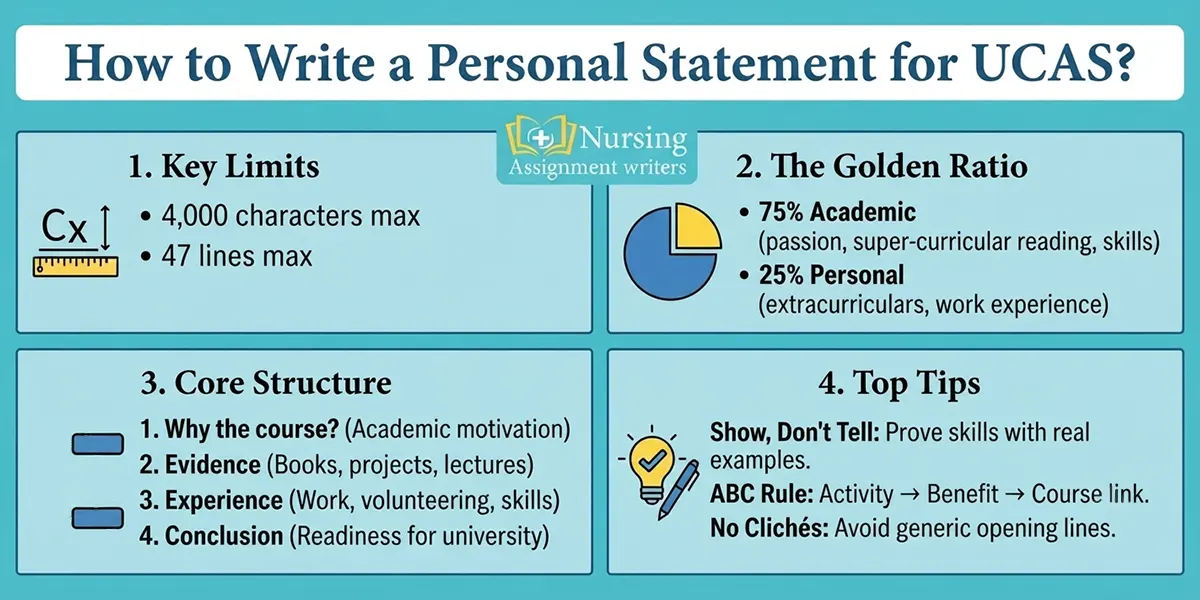
Don’t worry, as I have answered your query, ‘How long is a UCAS personal statement?’ for you. In the updated UCAS personal statement format (introduced for 2025/2026 entry onwards), applicants answer three specific guided questions rather than writing one continuous free-text essay, and the overall limit remains up to 4,000 characters (including spaces).
However, you must remember that you will be required to follow the specific university guidelines for character limit, structure, and other requirements when you are writing a personal statement for a master’s degree.
Still Confused and Need Help with Refining Your Personal Statement for UCAS? We’ve Got You!
Connect with our team so our academic experts can help you write an appropriate personal statement that highlights your achievements exactly how you want.

10 Essential UCAS Personal Statement Tips to Stand Out and Get Offers
In this section, I will guide you on how you can stand out from the other applicants. And write a good personal statement. So, if you are searching for UCAS personal statement guidance, you have landed on the right guide!
- Begin planning what exactly you will write. Spend time brainstorming your ideas, experiences, and motivations before diving straight into drafting your responses.
- Make sure you give clear answers to all three questions. Address the updated UCAS framework directly by focusing on your motivation for the course, how your studies prepared you, and your external experiences.
- Support all your claims with your real, personal experience-based examples. Avoid making generic statements; always back up your skills and achievements with concrete moments from your background.
- Reflect on what you have actually learned. Don’t just list what you did or the positions you held—explain the personal growth, critical thinking, or insights you gained from those experiences.
- Always personalise each of your responses in line with the specific course requirements. Tailor your content to demonstrate that you understand the academic demands and core competencies needed for your chosen subject area.
- Keep the content as authentic and clear as you can. Use straightforward, plain English and write in your own natural voice rather than adopting overly complex or pretentious language.
- Avoid clichés and overused openings. Steer clear of unoriginal hooks like “I have always been passionate about this subject since childhood,” and focus directly on your actual academic curiosity.
- Organize your points to avoid repetition across the three sections. Ensure that your answers flow logically into one another without repeating the exact same examples or accomplishments.
- Draft, redraft, and proofread carefully. Review your text multiple times to catch any spelling or grammar mistakes, and read it out loud to check the overall flow and tone.
- Use AI tools responsibly. Rely on technology only for brainstorming, structural ideas, or checking readability, ensuring the final text fully reflects your personal voice and genuine experiences.
Frequently Asked Questions
What’s the easiest way I can use to start my UCAS personal statement?
You can do that by smart planning, in which you should identify your reasons for choosing the specific course. Then, you will have to include your relevant achievements, experiences, and skills, while keeping your responses focused and honest.
Can I use AI to write my personal statement for UCAS?
Yes, you can use AI tools to brainstorm ideas, improve your grammar, and refine your overall tone and work. Also, make sure that you reflect your genuine experiences, personalised voice, and express your actual motivation and interests in that specific course.
What mistakes should I avoid in my statement?
To increase your chances of being selected based on your personal statement, other than your grades, you should not copy from any templates, and make sure that you double-check your entire personal statement’s content before you submit. It will enable you to submit a flawless statement.
Bringing It All Together
To put it in a nutshell, you should understand that writing a successful personal statement for UCAS does not require you to create fascinating stories about your experiences.
Instead, UK universities expect you to showcase your genuine interest in your selected subject, demonstrating your previous work and study experiences, and explaining how these factors helped you prepare for your university study journey.
When you understand the updated structure and provide honest answers to each of the questions, you can write a successful statement.
Good luck with writing your UCAS personal statement!